Summary from Goodreads:
Only once did David Foster Wallace give a public talk on his views on life, during a commencement address given in 2005 at Kenyon College. The speech is reprinted for the first time in book form in THIS IS WATER. How does one keep from going through their comfortable, prosperous adult life unconsciously? How do we get ourselves out of the foreground of our thoughts and achieve compassion? The speech captures Wallace's electric intellect as well as his grace in attention to others. After his death, it became a treasured piece of writing reprinted in The Wall Street Journal and the London Times, commented on endlessly in blogs, and emailed from friend to friend. Writing with his one-of-a-kind blend of causal humor, exacting intellect, and practical philosophy, David Foster Wallace probes the challenges of daily living and offers advice that renews us with every reading.
This is a very interesting speech and DFW brings up a number of things to think about. Unfortunately, it's terribly sad knowing now that DFW took his life a few years after giving this speech. It makes some anecdotes and thoughts in This is Water very eerie.
Summary from Goodreads:
In May 2012, bestselling author Neil Gaiman stood at a podium at Philadelphia’s University of the Arts to deliver the commencement address. For the next nineteen minutes he shared his thoughts about creativity, bravery, and strength: he encouraged the students before him to break rules and think outside the box. Most of all, he encouraged the fledgling painters, musicians, writers, and dreamers to make good art. This book, designed by renowned graphic artist Chip Kidd, contains the full text of Gaiman’s inspiring speech. Whether bestowed upon a young artist beginning his or her creative journey, or given as a token of gratitude to an admired mentor, or acquired as a gift to oneself, this volume is a fitting offering for anyone who strives to make good art.
In contrast, Gaiman's speech is on a serious subject, but it gives a wonderful uplift. Granted, this is for an arts college commencement - hence the emphasis on "good art" - but the message can be applied to almost any profession. Choose what you like, and be passionate about it so your outcome is good and worthy of your effort (a way better commencement address than any I had to sit through). The layout provided by Chip Kidd is a fabulous addition to Gaiman's words (for those of us who have heard Neil read, you can hear his voice in your head). Definitely a book to own in hard copy.
Showing posts with label reflection. Show all posts
21 May 2013
16 April 2013
For Boston
I had another poet lined up for today but after yesterday's horrific pictures at the Boston Marathon I decided to circle back to Christina Rossetti. "Remember" is a bittersweet little poem, posted here for those who lost their lives Monday.
When you can no more hold me by the hand,
Nor I half turn to go yet turning stay.
Remember me when no more day by day
It will be late to counsel then or pray.
Yet if you should forget me for a while
And afterwards remember, do not grieve:
For if the darkness and corruption leave
A vestige of the thoughts that once I had,
Better by far you should forget and smile
Than that you should remember and be sad.
Remember me when I am gone
away,
Gone far away into
the silent land; When you can no more hold me by the hand,
Nor I half turn to go yet turning stay.
Remember me when no more day by day
You tell me of our
future that you plann'd:
Only remember me; you
understand It will be late to counsel then or pray.
Yet if you should forget me for a while
And afterwards remember, do not grieve:
For if the darkness and corruption leave
A vestige of the thoughts that once I had,
Better by far you should forget and smile
Than that you should remember and be sad.
28 March 2011
Mockingbird
Imagine you are ten years old and your older brother has been killed in a school shooting. How would you understand? How would you learn to cope or deal with your grief?
Now imagine that you also have Asperger's syndrome. It is already hard enough for you to understand how to interact emotionally with your peers; they don't understand you and you don't understand them. How would you understand grief and loss?
In Mockingbird, this is Caitlin's predicament. She's is very intelligent, reads very well and draws far better than most adults, but she has Asperger's and her routine has been interrupted. The most patient and understanding part of her world - her older brother, Devon - is gone. Her school counselor tries to help her with both her regular therapy and with understanding grief. For Caitlin, she has to understand both her own and others' grief - a tall order for a ten-year-old who has trouble understanding empathy. In a chance meeting on the playground, she meets a younger student who lost his mother in the shooting and she decides that she will be his friend. When he mentions that his father needs "closure," Caitlin becomes obsessed with the word and its meaning.
Mockingbird is narrated by Caitlin so we see the world through her eyes and her thoughts. She likes absolutes, black-and-white drawings, so the unpredictable world of grief and loss - in many different shades - makes her anxious. Caitlin loves language, the interplay of words (she also capitalizes certain words and phrases like one would proper nouns - Look At A Person, Heart - because these words are important to her). She presses her father to finish Devon's Eagle Scout project, a wooden chest ("chest" as an object and "chest" as in the human thorax become linked in her mind), which is linked to her favorite movie, To Kill a Mockingbird, and Devon's nickname for her, Scout.
Mockingbird is a wonderful novel both for the story told within the pages and the character who does the narrating. Caitlin has a great voice and Kathryn Erskine drew on her own experience with her daughter to flesh out Caitlin's behaviors. In an afterword, Erskine noted that she wanted to write a book about recovery, kindness, and understanding. Erskine lives in Virginia and experienced the aftermath of the 2007 VTech campus shooting. She has steeped Mockingbird in kindness and understanding; it is Caitlin's unique version of kindness, but it comes from the heart.
Now imagine that you also have Asperger's syndrome. It is already hard enough for you to understand how to interact emotionally with your peers; they don't understand you and you don't understand them. How would you understand grief and loss?
In Mockingbird, this is Caitlin's predicament. She's is very intelligent, reads very well and draws far better than most adults, but she has Asperger's and her routine has been interrupted. The most patient and understanding part of her world - her older brother, Devon - is gone. Her school counselor tries to help her with both her regular therapy and with understanding grief. For Caitlin, she has to understand both her own and others' grief - a tall order for a ten-year-old who has trouble understanding empathy. In a chance meeting on the playground, she meets a younger student who lost his mother in the shooting and she decides that she will be his friend. When he mentions that his father needs "closure," Caitlin becomes obsessed with the word and its meaning.
Mockingbird is narrated by Caitlin so we see the world through her eyes and her thoughts. She likes absolutes, black-and-white drawings, so the unpredictable world of grief and loss - in many different shades - makes her anxious. Caitlin loves language, the interplay of words (she also capitalizes certain words and phrases like one would proper nouns - Look At A Person, Heart - because these words are important to her). She presses her father to finish Devon's Eagle Scout project, a wooden chest ("chest" as an object and "chest" as in the human thorax become linked in her mind), which is linked to her favorite movie, To Kill a Mockingbird, and Devon's nickname for her, Scout.
Mockingbird is a wonderful novel both for the story told within the pages and the character who does the narrating. Caitlin has a great voice and Kathryn Erskine drew on her own experience with her daughter to flesh out Caitlin's behaviors. In an afterword, Erskine noted that she wanted to write a book about recovery, kindness, and understanding. Erskine lives in Virginia and experienced the aftermath of the 2007 VTech campus shooting. She has steeped Mockingbird in kindness and understanding; it is Caitlin's unique version of kindness, but it comes from the heart.
11 January 2011
2011 - to set or not to set reading goals?
In thinking about reading (and blogging) for 2011, I wasn't sure I wanted to do any challenges this year.
I've come to realize they distract me. I think and worry and fret far more about what I need to read for a challenge than what I actually read. This gets worse when I have greater than one challenge going on at the same time. I finished one challenge (Women Unbound) but had trouble finishing the other (The Complete Booker) and I only made minimal progress on my projects.
So I think I'll just do one challenge (kind of one and a half). I'd like to work on The Complete Booker Challenge 2011 - it would help make a decent amount of headway on my Booker Project. I'll probably start with the "Pix-a-Mix of Six" (read six Booker winners) and it might upgrade to the "A Booker's Dozen" (read twelve winners or nominees from the short- or long-lists). I'll need to get a challenge post up for that one. I've also signed up for the Goodreads Challenge - which is simply a goal to read a certain number of books. Goodreads makes it really easy to track that with the stats page so I signed up with the goal of reading 100 books this year. I've not made a great start what with the mess of moving and all. One hundred books in a year is like my personal glass ceiling, somehow.
I slowly started accepting review copies from publishers this last year (well, just HarperPerennial/Harper Paperbacks, really). I didn't go overboard (thank goodness) but I haven't been very good at getting things read when I need to for publication dates. So I need to work on that. I also have to pay attention to what I ask for because sometimes you get what you ask for; I requested a review copy of the new Christopher Isherwood diaries never realizing for one minute that it was going to be quite thick (and, in the manner of diaries, not terribly "readable"). So I must keep a better head on my shoulders (I apologize to Harper for that one, it's going to take me a bit to get that one read).
I also need to work on a few more of my projects - especially the Nobel and Best American ones - because the projects are really my pets. They cover a nice cross-section of literature without a great deal of cross-over (there really isn't much, from what I've found).
So, in summary, my Reading Goals for 2011:
1) Only sign-up for "real" challenge: The Complete Booker 2011
2) Write a sign-up post for The Complete Booker 2011
3) Be smarter about review copies
4) Work on my projects
Bring it, 2011!
I've come to realize they distract me. I think and worry and fret far more about what I need to read for a challenge than what I actually read. This gets worse when I have greater than one challenge going on at the same time. I finished one challenge (Women Unbound) but had trouble finishing the other (The Complete Booker) and I only made minimal progress on my projects.
So I think I'll just do one challenge (kind of one and a half). I'd like to work on The Complete Booker Challenge 2011 - it would help make a decent amount of headway on my Booker Project. I'll probably start with the "Pix-a-Mix of Six" (read six Booker winners) and it might upgrade to the "A Booker's Dozen" (read twelve winners or nominees from the short- or long-lists). I'll need to get a challenge post up for that one. I've also signed up for the Goodreads Challenge - which is simply a goal to read a certain number of books. Goodreads makes it really easy to track that with the stats page so I signed up with the goal of reading 100 books this year. I've not made a great start what with the mess of moving and all. One hundred books in a year is like my personal glass ceiling, somehow.
I slowly started accepting review copies from publishers this last year (well, just HarperPerennial/Harper Paperbacks, really). I didn't go overboard (thank goodness) but I haven't been very good at getting things read when I need to for publication dates. So I need to work on that. I also have to pay attention to what I ask for because sometimes you get what you ask for; I requested a review copy of the new Christopher Isherwood diaries never realizing for one minute that it was going to be quite thick (and, in the manner of diaries, not terribly "readable"). So I must keep a better head on my shoulders (I apologize to Harper for that one, it's going to take me a bit to get that one read).
I also need to work on a few more of my projects - especially the Nobel and Best American ones - because the projects are really my pets. They cover a nice cross-section of literature without a great deal of cross-over (there really isn't much, from what I've found).
So, in summary, my Reading Goals for 2011:
1) Only sign-up for "real" challenge: The Complete Booker 2011
2) Write a sign-up post for The Complete Booker 2011
3) Be smarter about review copies
4) Work on my projects
Bring it, 2011!
01 January 2011
Happy New Year, happy new house!!
Hello 2011!
Hello new house!!
I spent my New Year's holiday moving from my old, poorly managed condo (seemed great when I bought it 7 years ago, but no...) to a zero-lot line (for those who don't have this legal designation it's like a duplex that you own). I closed on the purchase December 30, the movers came December 31, and, whew! It was crazy for a little while.
I'm working on getting a blog 2010 review post done, a blog 2011 goals post done, one more book review from 2010, and a post about the new house. That new camera got a workout, I tell 'ya.
Happy reading in the new year! Many thanks to my parents who helped out TREMENDOUSLY with the move (story about my mom and the kitchen later).
Hello new house!!
I spent my New Year's holiday moving from my old, poorly managed condo (seemed great when I bought it 7 years ago, but no...) to a zero-lot line (for those who don't have this legal designation it's like a duplex that you own). I closed on the purchase December 30, the movers came December 31, and, whew! It was crazy for a little while.
I'm working on getting a blog 2010 review post done, a blog 2011 goals post done, one more book review from 2010, and a post about the new house. That new camera got a workout, I tell 'ya.
Happy reading in the new year! Many thanks to my parents who helped out TREMENDOUSLY with the move (story about my mom and the kitchen later).
25 December 2010
Merry Christmas!
May you enjoy the warmth and blessings of the season.
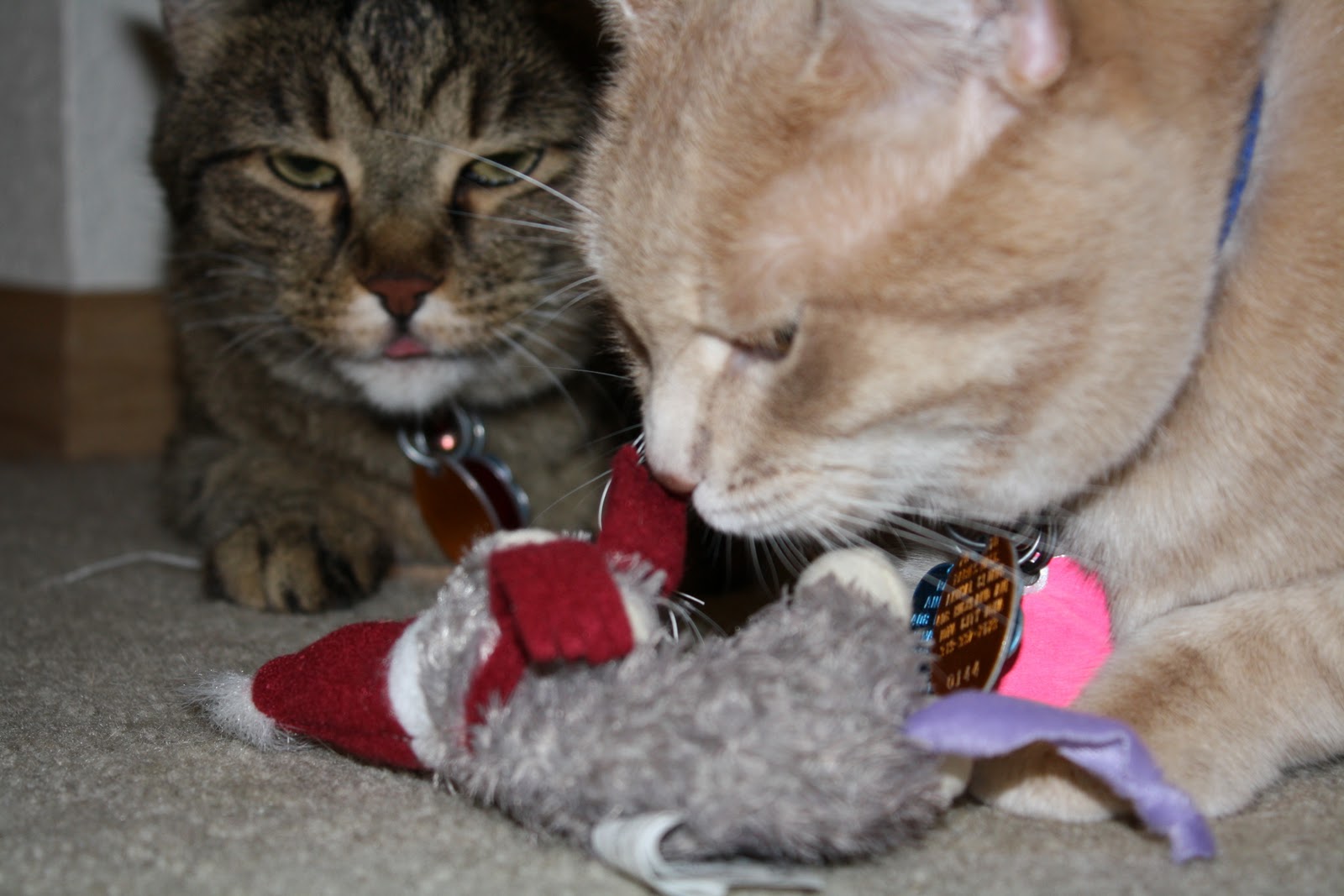
Or, if you're a cat, enjoy a new catnip Santa Mouse.
I still have a few reviews to finish and blogging/reading resolutions to think about...and a house to move! What a crazy end to the year!
Labels:
cats,
reflection
11 September 2010
04 September 2010
The Satanic Verses
I started reading Salman Rushdie's The Satanic Verses last September for BiblioBrat's Banned Books Challenge. I started reading during the last week of the challenge, which was busy, busy, busy on its own, so I only got about 150 pages read before October took over and The Satanic Verses wound up at the bottom of the reading pile. Now that September has returned, bringing with it Banned Books Week and the news that some crazy people want to burn Korans to punish Islamic fundamentalists (< sarcasm > because that's totally going to show them < / sarcasm >), it was appropriate for me to fish The Satanic Verses back out of the pile and finish it off.
Rushdie fully expects the reader to suspend belief right from the last line of the first paragraph:
Gibreel Farishta and Saladin Chamcha are the miraculous sole survivors of an act of terrorism and wash up on the beach of England. Each begins to display characteristics representative of an otherworldly being - one displays a halo, the other a pair of horns - setting off a story of acceptance and forgiveness interspersed with commentary on tolerance, faith/doubt, megalomania, and identity. Gibreel and Saladin form the frame narrative as we learn each man's history and as they try to piece their lives back together in the wonderfully titled section "Ellowen Deeowen". Gibreel (as the incarnation of the archangel Gibreel) develops visions of the prophet Mahound at the time of his revelations in Jalilia (an interpretation of the life of Muhammed in Mecca) as well as those of a modern Indian peasant girl, Ayesha, who moves an entire village to walk to Mecca - through the Arabian Sea - based on the belief in her revelations from the archangel.
There are many character and narrative threads in The Satanic Verses and they don't all start to come together until late in the novel. This is a novel to be savored and pondered with wonderfully evocative imagery. There are also many "doubles" in this novel - two Hinds, two Mishals, two or three Ayeshas (depending on how you count), Gibreel himself and Gibreel the archangel, and a Salman (who might mirror the author depending on how you look at it) - so you must also read The Satanic Verses closely.
This is a controversial novel, there is no getting around that. When the prophet Mahound issues a proclamation from the archangel that women are to be sequestered, a madam comes up with the idea to have her twelve girls take on the personalities of Mahound's twelve wives; the brothel receives a boost in business from the scheme but the brothel is eventually shut down and the prostitutes and collaborators are executed. Because the novel uses the life of Muhammed as a basis, the idea that prostitutes are imitating the Prophet's wives can be offensive to some. Do you want to know what I think? Those people don't have to read The Satanic Verses, same as people who don't like to see novels about the life of Jesus Christ that depict him doing un-Christlike things don't have to read those. A novel isn't real, just like any historical novel using the Tudors as basis isn't any more real just because it uses King Henry VIII as a main character. Some events will be made up for storytelling purposes. No one is forcing you to read it.
The novel also brings the issue of faith and doubt to the fore with the visions of Mahound and Ayesha the peasant. How is someone believable when he or she claims to be the mouth of the archangel and brings revelations from God? What do you do when the prophet suddenly retracts a previous statement, claiming it came from an "evil" source? This is the controversy over the so-called Satanic Verses, a sura attributed to Muhammed that affirmed prayer to three old female polytheistic deities from the regions around Mecca but later retracted as the work of Shaitan (the devil). Since the archangel only reveals information to a prophet, never to anyone else, how do we know if the revealments are the actual Will of God? It requires faith, same as the village that follows Ayesha the peasant on a pilgrimage to Mecca, on foot, through the Arabian Sea; Ayesha affirms that the sea will part for them and the faithful will walk across the seabed; there are believers and there are doubters. Like Doubting Thomas of the New Testament, does one need proof of the Divine to make the leap of faith?
The Satanic Verses is much more than just a book that pushes buttons for the sake of pushing buttons. If those buttons set you off, then perhaps you ought not to read this book. If you do read, look beyond those hot-buttons for the journey of Gibreel and Saladin; it's a crazy ride and, ultimately, a very satisfying one.
Rushdie fully expects the reader to suspend belief right from the last line of the first paragraph:
Just before dawn one winter's morning, New Year's Day, or thereabouts, two real, full-grown, living men fell from a great height, twenty-nine thousand and two feet, towards the English Channel, without benefit of parachutes or wings, out of a clear sky. (p 3)
Gibreel Farishta and Saladin Chamcha are the miraculous sole survivors of an act of terrorism and wash up on the beach of England. Each begins to display characteristics representative of an otherworldly being - one displays a halo, the other a pair of horns - setting off a story of acceptance and forgiveness interspersed with commentary on tolerance, faith/doubt, megalomania, and identity. Gibreel and Saladin form the frame narrative as we learn each man's history and as they try to piece their lives back together in the wonderfully titled section "Ellowen Deeowen". Gibreel (as the incarnation of the archangel Gibreel) develops visions of the prophet Mahound at the time of his revelations in Jalilia (an interpretation of the life of Muhammed in Mecca) as well as those of a modern Indian peasant girl, Ayesha, who moves an entire village to walk to Mecca - through the Arabian Sea - based on the belief in her revelations from the archangel.
There are many character and narrative threads in The Satanic Verses and they don't all start to come together until late in the novel. This is a novel to be savored and pondered with wonderfully evocative imagery. There are also many "doubles" in this novel - two Hinds, two Mishals, two or three Ayeshas (depending on how you count), Gibreel himself and Gibreel the archangel, and a Salman (who might mirror the author depending on how you look at it) - so you must also read The Satanic Verses closely.
This is a controversial novel, there is no getting around that. When the prophet Mahound issues a proclamation from the archangel that women are to be sequestered, a madam comes up with the idea to have her twelve girls take on the personalities of Mahound's twelve wives; the brothel receives a boost in business from the scheme but the brothel is eventually shut down and the prostitutes and collaborators are executed. Because the novel uses the life of Muhammed as a basis, the idea that prostitutes are imitating the Prophet's wives can be offensive to some. Do you want to know what I think? Those people don't have to read The Satanic Verses, same as people who don't like to see novels about the life of Jesus Christ that depict him doing un-Christlike things don't have to read those. A novel isn't real, just like any historical novel using the Tudors as basis isn't any more real just because it uses King Henry VIII as a main character. Some events will be made up for storytelling purposes. No one is forcing you to read it.
The novel also brings the issue of faith and doubt to the fore with the visions of Mahound and Ayesha the peasant. How is someone believable when he or she claims to be the mouth of the archangel and brings revelations from God? What do you do when the prophet suddenly retracts a previous statement, claiming it came from an "evil" source? This is the controversy over the so-called Satanic Verses, a sura attributed to Muhammed that affirmed prayer to three old female polytheistic deities from the regions around Mecca but later retracted as the work of Shaitan (the devil). Since the archangel only reveals information to a prophet, never to anyone else, how do we know if the revealments are the actual Will of God? It requires faith, same as the village that follows Ayesha the peasant on a pilgrimage to Mecca, on foot, through the Arabian Sea; Ayesha affirms that the sea will part for them and the faithful will walk across the seabed; there are believers and there are doubters. Like Doubting Thomas of the New Testament, does one need proof of the Divine to make the leap of faith?
The Satanic Verses is much more than just a book that pushes buttons for the sake of pushing buttons. If those buttons set you off, then perhaps you ought not to read this book. If you do read, look beyond those hot-buttons for the journey of Gibreel and Saladin; it's a crazy ride and, ultimately, a very satisfying one.
01 May 2010
Why wandering my local public library makes me sad
I was wandering the Coralville Public Library today because 1) it was Saturday and 2) I was looking to see if they had the Alice Munro short story collection with "The Bear Came Over the Mountain" (the basis for Sarah Polley's film Away From Her). The library did have Hateship, Friendship, Courtship, Loveship as well as a number of oddities:
Sigh.
1) Six brand-new (I mean BRAND-NEW) copies of Margaret Cavendish's The Blazing World in fiction under the "n"s (that's probably better shelved as philosophy and, while I understand she was the Duchess of Newcastle, no one will really think to look under Newcastle instead of Cavendish)The library is a completely different place from when I was a child. It makes me sad. I loved going to the library to browse the shelves in peace and quiet with other book lovers. Now the library is filled with people hogging the computers to download/watch anime while eating their Subway sandwiches and talking volubly about who did what on TV last night.
2) Six brand-new (I mean BRAND-NEW) copies of Vilette (in varying editions) and brand-new Oxford editions of Anthony Trollope but only one tatty copy of Jane Eyre and a number of decrepit Mark Twain novels; wouldn't it be more beneficial to replace the crappy copies of popular books rather than acquire multiple spandy-new copies of rarely checked-out books?
3) YA fiction by authors with adult books/YA editions of adult books are shelved in the adult section, not the teen section (i.e. Francine Prose's Goldengrove and the old Great Illustrated Classics editions of Dumas)
4) Adult fiction is divided into "Mystery" and "Fiction"...that's it; the library I grew up with had "Fiction", "Mystery", "Romance", and "Science Fiction" - just personal opinion, but I like that much better than the CPL way
5) People eating/drinking in the library (this also bugs me in our store, but I remember people getting kicked out of the library when I was a kid for bringing in soda)
6) Mohawk Dude (who also likes to hang out at our store, thus he has a nickname, and smells like the Dumpster at a fish bait shop) was ensconced at a computer, listening to something on his headphones, and painting; as in paint-on-paper painting - since I know this dude has pretty much no money (because he damaged a hardcover copy of HP5 in our store and told us he was unable to pay for it), what would the library do if he spilled all over the place and ruined something? Considering my taxes and donations help pay for all the library accoutrement I would prefer that he go paint outdoors.
Sigh.
29 January 2010
Howard Zinn, 1922-2010, and JD Salinger, 1919-2010 (aka that "Saliva guy"* who died)
Howard Zinn died this week. Howard Zinn is responsible for writing the second "grouchy" book I ever read - A People's History of the United States (first "grouchy" book goes to And the Band Played On by Randy Shilts). I picked up A People's History because I was hoping it would have a little more background than the version of history taught in school. Boy, was I surprised. This was the first time I ever realized what "Banana Republic" meant, why Iran might not quite love the United States, how the "empire" of the United States was built. Imperialism isn't taught in high school (at least not in the mid-1990s), not even as a topic of debate. I was righteouly angry, once again, that the people who make up the United States had been dumped on by an elitist government (and people who didn't even live in the United States had been dumped on). Grouch, grouch, grouch.
Does A People's History have bias? Yes. However, if the purpose of the book was to get people thinking about the effect of US policies on the lowest echelons on society, those with the fewest opportunities available, A People's History did just that. Zinn used source material that brings the voices of Native Americans, women, and immigrants to the surface - he championed the history of those who were politically and economically disenfranchised.
Zinn came to speak at the University of Iowa in the fall of 2005. The IMU Main Lounge was packed front to back, standing-room-only in the doorways to watch a stooped, elderly man in a sweater vest and enormous reading glasses speak about "voice". Making our voices heard, becoming aware of voices that were silent. It takes far more courage to speak out and do the unpopular thing than it does to stand by and remain silent. Zinn even made a joke that he had never been introduced by a University president because he tended to rile up the students (the UI is no stranger to social activism; the students set up a tent city on the Pentacrest to oppose US entry into Iraq and Afghanistan). Zinn signed books for quite some time after his speech. When I got to the front of the line he commented on my dog-eared, battered copy of A People's History, asking if the writing tasted good because I had obviously got my teeth into it (I said it tasted like brain food; he laughed).
Also, while we remember a man unable to remain silent we also remember a man who stubbornly refused his comment. JD Salinger died only a few hours after Zinn; he was 91 (wow). I don't have any commentary or personal story for Salinger on the occasion of his death. Because he hadn't published or granted interviews in decades (rumor has it he kept writing; will we ever see it, I wonder?), his death doesn't affect me quite as much as Zinn's. I put Salinger in the same box as Faulkner, Hemingway, and Fitzgerald - "wrote good books, will never get to meet" (as opposed to Kurt Vonnegut, who kept writing books and I would have got down on the ground to kiss his feet had I met him) - so it's kind of like Salinger had died in 1980, the year of his last interview and long before I ever read The Catcher in the Rye. However, I raise a glass to the work Salinger left behind and plan to dig out my copy of Catcher for a long-overdue reread.
*Overheard on my way into the bookstore this morning; one ditzy girl was commenting to another ditzy girl about how "some Saliva guy that wrote a book about baseball died and everyone is talking about it". A depressingly sad but unavoidably overheard statement. I think I tripped over the rug while collecting my jaw off the floor.
Does A People's History have bias? Yes. However, if the purpose of the book was to get people thinking about the effect of US policies on the lowest echelons on society, those with the fewest opportunities available, A People's History did just that. Zinn used source material that brings the voices of Native Americans, women, and immigrants to the surface - he championed the history of those who were politically and economically disenfranchised.
Zinn came to speak at the University of Iowa in the fall of 2005. The IMU Main Lounge was packed front to back, standing-room-only in the doorways to watch a stooped, elderly man in a sweater vest and enormous reading glasses speak about "voice". Making our voices heard, becoming aware of voices that were silent. It takes far more courage to speak out and do the unpopular thing than it does to stand by and remain silent. Zinn even made a joke that he had never been introduced by a University president because he tended to rile up the students (the UI is no stranger to social activism; the students set up a tent city on the Pentacrest to oppose US entry into Iraq and Afghanistan). Zinn signed books for quite some time after his speech. When I got to the front of the line he commented on my dog-eared, battered copy of A People's History, asking if the writing tasted good because I had obviously got my teeth into it (I said it tasted like brain food; he laughed).
Also, while we remember a man unable to remain silent we also remember a man who stubbornly refused his comment. JD Salinger died only a few hours after Zinn; he was 91 (wow). I don't have any commentary or personal story for Salinger on the occasion of his death. Because he hadn't published or granted interviews in decades (rumor has it he kept writing; will we ever see it, I wonder?), his death doesn't affect me quite as much as Zinn's. I put Salinger in the same box as Faulkner, Hemingway, and Fitzgerald - "wrote good books, will never get to meet" (as opposed to Kurt Vonnegut, who kept writing books and I would have got down on the ground to kiss his feet had I met him) - so it's kind of like Salinger had died in 1980, the year of his last interview and long before I ever read The Catcher in the Rye. However, I raise a glass to the work Salinger left behind and plan to dig out my copy of Catcher for a long-overdue reread.
*Overheard on my way into the bookstore this morning; one ditzy girl was commenting to another ditzy girl about how "some Saliva guy that wrote a book about baseball died and everyone is talking about it". A depressingly sad but unavoidably overheard statement. I think I tripped over the rug while collecting my jaw off the floor.
28 January 2010
Illness
Back in November Rebecca Skloot put out a tweet asking for readers/reviewers to contact her if they were interested in a book on the philosophy of illness from a professor in the UK. I responded, got the author's contact information from Rebecca, and a package containing Illness: The Cry of the Flesh arrived in December.
Havi Carel writes about the phenomenology of illness from two perspectives: as a professor of philosophy and as a woman diagnosed with a rare, life-threatening illness. In 2006 Dr. Carel was diagnosed with lymphangioleiomyomatosis (LAM), a sporadically occuring disease caused by spontaneous proliferation of smooth muscle cells in the lungs, blood vessels, and lymphatics; LAM strikes almost exclusively among women in their childbearing years. There is no effective treatment available with lung transplantation recommended as a palliative treatment when a patient's pulmonary function significantly declines.
Now, having read Dr. Carel's book I'm sure she doesn't appreciate my effortless ability to reduce her life to a summary of symptoms and dismal treatment options. It's a habit (sorry). I'm researcher in hospital epidemiology and I can abstract a PMH/ROS (past medical history and review of systems) with the best of them. I don't usually see patients so I just sit in my office and read charts looking for quantifiable information - dates, numbers, symptoms - I can translate into statistics. However, when actually working with patients (or even interacting with friends undergoing a significant illness) reducing a person to first a disease then to a symptom list and prognosis doesn't do the ill person any favors.
That is exactly the point of Illness, to find a way to bring phenomenology into the normativist and naturalistic philosophies of chronic illness. Phenomenological approaches to illness focus on the "experience of being ill: illness as it is lived by the ill person" (p 12). This is actually quite useful because we all experience illness differently. The same biological markers of a disease will cause quite different experiences in two individuals. Dr. Carel uses the philosophies of Martin Heidegger and Epicurus to show how a phenomenological approach allows a chronically ill person to find health within illness and to allow oneself to be both ill and happy. She also uses her own experience as a chronically-ill person to illustrate those concepts.
Although it is a work of philosophy, Illness is meant to be read by people from all walks of life: layman, friend, colleague, healthcare worker. The writing is clear, concise, and thoughtful. Philosophical concepts are well-defined and illustrated with many examples. The clarity of Dr. Carel's writing is most apparent in Chapter 4, "Fearing death"; she uses the work of Epicurus (who argued that a fear of death is irrational) to examine how an ill person should prepare for death, how to have an fully-lived life while accepting one's remaining time is limited. While reading this section of Illness I kept thinking of my maternal grandmother who in all probability never read a work of philosophy in her life but would have agreed with Epicurus. Grandma was diagnosed with mutliple myeloma when I was twelve and fought her disease for seven years but the treatment options ran out during my freshman year of college. Did she sit around, moping and moaning that she had very little time left? If she did, she never let us see it (I think her own mother would have come back to haunt her if she had). We still had Christmas with all the trimmings, greeting cards on the holidays (the messages written in an ever-shakier hand), and those ever-present inquiries into how school was coming along (I spent a weekend studying calculus in the ICU when she was very ill one week; the first question she asked me was whether or not I'd done well on my last exam). She never expressed any fear of "the undiscovered country" - she died quietly and with dignity.
This has been a hard review to write and I've been working on it for over a week; I very much liked Illness and am very grateful to Rebecca, Dr. Carel, and Acumen Publishing for the information and review copy. Illness has made me reflect on professional and personal experiences and to look at my interactions with ill people in a different light. We can all use a book like Illness - we all know someone with a serious illness and there is a great likelihood that most of us will personally develop chronic medical disease before we die. I think Illness would be of great benefit to medical curriculae in particular. "Empathy" is always stressed during training but I think Dr. Carel's work would help healthcare workers understand how to integrate empathy for the ill person with medical care for the biology of the actual disease.
Current book-in-progress: What are Intellectuals Good For?, The Omnivore's Dilemma, and The Lightning Thief
Current knitted item: baby sweater
Current movie obsession: Gosford Park
Current iTunes loop: John Mayer
Havi Carel writes about the phenomenology of illness from two perspectives: as a professor of philosophy and as a woman diagnosed with a rare, life-threatening illness. In 2006 Dr. Carel was diagnosed with lymphangioleiomyomatosis (LAM), a sporadically occuring disease caused by spontaneous proliferation of smooth muscle cells in the lungs, blood vessels, and lymphatics; LAM strikes almost exclusively among women in their childbearing years. There is no effective treatment available with lung transplantation recommended as a palliative treatment when a patient's pulmonary function significantly declines.
Now, having read Dr. Carel's book I'm sure she doesn't appreciate my effortless ability to reduce her life to a summary of symptoms and dismal treatment options. It's a habit (sorry). I'm researcher in hospital epidemiology and I can abstract a PMH/ROS (past medical history and review of systems) with the best of them. I don't usually see patients so I just sit in my office and read charts looking for quantifiable information - dates, numbers, symptoms - I can translate into statistics. However, when actually working with patients (or even interacting with friends undergoing a significant illness) reducing a person to first a disease then to a symptom list and prognosis doesn't do the ill person any favors.
That is exactly the point of Illness, to find a way to bring phenomenology into the normativist and naturalistic philosophies of chronic illness. Phenomenological approaches to illness focus on the "experience of being ill: illness as it is lived by the ill person" (p 12). This is actually quite useful because we all experience illness differently. The same biological markers of a disease will cause quite different experiences in two individuals. Dr. Carel uses the philosophies of Martin Heidegger and Epicurus to show how a phenomenological approach allows a chronically ill person to find health within illness and to allow oneself to be both ill and happy. She also uses her own experience as a chronically-ill person to illustrate those concepts.
Although it is a work of philosophy, Illness is meant to be read by people from all walks of life: layman, friend, colleague, healthcare worker. The writing is clear, concise, and thoughtful. Philosophical concepts are well-defined and illustrated with many examples. The clarity of Dr. Carel's writing is most apparent in Chapter 4, "Fearing death"; she uses the work of Epicurus (who argued that a fear of death is irrational) to examine how an ill person should prepare for death, how to have an fully-lived life while accepting one's remaining time is limited. While reading this section of Illness I kept thinking of my maternal grandmother who in all probability never read a work of philosophy in her life but would have agreed with Epicurus. Grandma was diagnosed with mutliple myeloma when I was twelve and fought her disease for seven years but the treatment options ran out during my freshman year of college. Did she sit around, moping and moaning that she had very little time left? If she did, she never let us see it (I think her own mother would have come back to haunt her if she had). We still had Christmas with all the trimmings, greeting cards on the holidays (the messages written in an ever-shakier hand), and those ever-present inquiries into how school was coming along (I spent a weekend studying calculus in the ICU when she was very ill one week; the first question she asked me was whether or not I'd done well on my last exam). She never expressed any fear of "the undiscovered country" - she died quietly and with dignity.
This has been a hard review to write and I've been working on it for over a week; I very much liked Illness and am very grateful to Rebecca, Dr. Carel, and Acumen Publishing for the information and review copy. Illness has made me reflect on professional and personal experiences and to look at my interactions with ill people in a different light. We can all use a book like Illness - we all know someone with a serious illness and there is a great likelihood that most of us will personally develop chronic medical disease before we die. I think Illness would be of great benefit to medical curriculae in particular. "Empathy" is always stressed during training but I think Dr. Carel's work would help healthcare workers understand how to integrate empathy for the ill person with medical care for the biology of the actual disease.
Current book-in-progress: What are Intellectuals Good For?, The Omnivore's Dilemma, and The Lightning Thief
Current knitted item: baby sweater
Current movie obsession: Gosford Park
Current iTunes loop: John Mayer
01 January 2010
Out with the old, in with the new: Good-bye, 2009! Hello, 2010!
It was a pretty good year - still have both my jobs, my family is happy and healthy (and about to expand by one when my new niece comes), my cats are both as spoiled and ornery as ever, and I'm still a DC for AXS. On the resolution front, my 2009 resolution to BE HEALTHY kind-of bit the dust but I'm not any fatter than I was at the beginning of the year so I will take stasis at a slight edge over continually expanding. So BE HEALTHY is back on the resolution slate for 2010 (I have groceries to prove it).
I also started book-blogging in a more earnest fashion this year around March/April - about the same time I joined Twitter, found some fantastically awesome book-bloggers to folllow/read, and got some inspiration for my own blog. I participated in Book Bloggers Appreciation Week for the first time, too (which was a blast!). I'm still pretty ADD about my reading meaning the books-started to books-finished ratio is not spectacular (and some were started a year or more ago).
Books started in 2009: 110 (or thereabouts, I don't have a good system for this)
Books finished in 2009: 83
Books that got the DNF label: 1
(an important new step because books I'm stuck in the middle of usually go back on the shelves to languish until I pack to move house)
This is also the first year where I used nearly every page of my book journal in a single year. A book journal usually lasts me 2 years (I bought 4 of the same kind in a sale - I'm on the last volume since they're no longer available) but only 15 leaves or so will not be used for 2009-started books. I'll be moving on to a different type of journal, looks similar but with "archival" pages (I actually bought it for the looks, haha)
In 2010 I would really like to hone in on actually finishing the majority of books I start rather than staring forlornly at the "in-progress" stack, wussing out about making a decision, and going off to start another book. I also need to start deploying the "DNF" more often; if I really have zero interest in a book after 50-100 pages then it really needs to hit the road and head for the outbox. I do have a couple of challenges on the horizon for the year (Women Unbound, The Complete Booker [it dovetails nicely with my own Booker Project]) and I'd love to give a Banned Books Challenge or Clear Off Your Shelves Challege (because that was great!) another shot. I also have my Newbery Project and new Nobel Project floating around, too. Challenges and I aren't terribly good friends because I really do lack the ability to "plan" my reading so I'm not going to commit to too many unless I'm pretty sure I can do it without adding to the ADD-ness of my reading (the BNBC groups go a good job of that already). I would also like to do a little blog-upgrading, maybe adding a page (can you do that with a blogger template?) for challenges, etc. to declutter/organize - my HTML/web design ability is completely self-taught so I may have to wait for a "bloggiesta" weekend and get some advice from the saavier bloggers.
On the knitting front I need to make sure I link my blog posts about knitting with my Ravelry page as I go. I know a lot of bloggers like to separate out their different hobbies/interests into multiple blogs....but I think that's a bit much for me to update (I have enough trouble with one blog as it is). Besides, I read and knit and dance, it's all part of me.
I would also like to return my "update template" to the bottom of my posts. I do like it and it does help keep me on track (particularly with Netflix movies, three of which are languishing in a drawer, needing to be watched). So the first update of the new year:
Current book-in-progress: insanity, top-priority reads are Shades of Grey by Jasper Fforde, The Ascent of Money by Niall Ferguson, The Complete Stories by Flannery O'Connor, Fearless Girls, Wise Women, and Beloved Sisters edited by Kathleen Ragan, Illness by Havi Carel, Electronic Literature by N. Katherine Hayles, and The Best NonRequired Reading 2009 edited by Dave Eggers (must get these done, asap)
Current knitted item: baby sweater for my new niece, top-down sweater for me, and (sadly enough) that pair of socks I've been knitting for a year
Current movie obsession: watch and return Fame, My Boy Jack, and Chess in Concert so I quite wasting money
Current iTunes loop: omg, John Mayer's new album (amazing): Battle Studies
I also started book-blogging in a more earnest fashion this year around March/April - about the same time I joined Twitter, found some fantastically awesome book-bloggers to folllow/read, and got some inspiration for my own blog. I participated in Book Bloggers Appreciation Week for the first time, too (which was a blast!). I'm still pretty ADD about my reading meaning the books-started to books-finished ratio is not spectacular (and some were started a year or more ago).
Books started in 2009: 110 (or thereabouts, I don't have a good system for this)
Books finished in 2009: 83
Books that got the DNF label: 1
(an important new step because books I'm stuck in the middle of usually go back on the shelves to languish until I pack to move house)
This is also the first year where I used nearly every page of my book journal in a single year. A book journal usually lasts me 2 years (I bought 4 of the same kind in a sale - I'm on the last volume since they're no longer available) but only 15 leaves or so will not be used for 2009-started books. I'll be moving on to a different type of journal, looks similar but with "archival" pages (I actually bought it for the looks, haha)
In 2010 I would really like to hone in on actually finishing the majority of books I start rather than staring forlornly at the "in-progress" stack, wussing out about making a decision, and going off to start another book. I also need to start deploying the "DNF" more often; if I really have zero interest in a book after 50-100 pages then it really needs to hit the road and head for the outbox. I do have a couple of challenges on the horizon for the year (Women Unbound, The Complete Booker [it dovetails nicely with my own Booker Project]) and I'd love to give a Banned Books Challenge or Clear Off Your Shelves Challege (because that was great!) another shot. I also have my Newbery Project and new Nobel Project floating around, too. Challenges and I aren't terribly good friends because I really do lack the ability to "plan" my reading so I'm not going to commit to too many unless I'm pretty sure I can do it without adding to the ADD-ness of my reading (the BNBC groups go a good job of that already). I would also like to do a little blog-upgrading, maybe adding a page (can you do that with a blogger template?) for challenges, etc. to declutter/organize - my HTML/web design ability is completely self-taught so I may have to wait for a "bloggiesta" weekend and get some advice from the saavier bloggers.
On the knitting front I need to make sure I link my blog posts about knitting with my Ravelry page as I go. I know a lot of bloggers like to separate out their different hobbies/interests into multiple blogs....but I think that's a bit much for me to update (I have enough trouble with one blog as it is). Besides, I read and knit and dance, it's all part of me.
I would also like to return my "update template" to the bottom of my posts. I do like it and it does help keep me on track (particularly with Netflix movies, three of which are languishing in a drawer, needing to be watched). So the first update of the new year:
Current book-in-progress: insanity, top-priority reads are Shades of Grey by Jasper Fforde, The Ascent of Money by Niall Ferguson, The Complete Stories by Flannery O'Connor, Fearless Girls, Wise Women, and Beloved Sisters edited by Kathleen Ragan, Illness by Havi Carel, Electronic Literature by N. Katherine Hayles, and The Best NonRequired Reading 2009 edited by Dave Eggers (must get these done, asap)
Current knitted item: baby sweater for my new niece, top-down sweater for me, and (sadly enough) that pair of socks I've been knitting for a year
Current movie obsession: watch and return Fame, My Boy Jack, and Chess in Concert so I quite wasting money
Current iTunes loop: omg, John Mayer's new album (amazing): Battle Studies
07 November 2009
The PW "dudes-only" list kerfluffle: seriously? only men?
If you read blogs - book blogger, industry, or otherwise - you've probably heard of the Publisher's Weekly Best of 2009 list comprised solely of male authors. The intent was to eliminate bias by not considering the authors' genders...right. I've got what amounts to a minor in biostatistics and I can tell you that unless you draw the names out of a hat there's going to be bias, conscious or not (I'll ignore the irony of a "Best of 2009" list that is published two months before the end of 2009).
Statistically speaking, if you ignore gender then the male/female ratio in the final list would be proportional to the male/female ratio in the longlist (which I guess numbered in the thousands). But we're not talking about random assortment here, we're talking about a list generated by a value judgement made by humans. Gender will bias the outcome unless you can find readers who know absolutely nothing about the novels under consideration (i.e. a group of blinded subjects), have them read each book under consideration without information as to who the author is/what gender the author is, and then make the final list based on the blinded group's opinion. That's absolutely not going to happen - it is unrealistic.
A few people have brought up the "devil's advocate" position that there would be outcry if the "Best of 2009" list consisted of all female authors. I'm sure people would cry bias on that instance, too, even if claims were made about the non-gendered consideration of the list. PW also claimed to ignore genre, too, and in that instance they did hit a 50-50 split between fiction and non-fiction (conveniently enough). But....is the publishing world split 50-50 between fiction and non-fiction? I don't think so. And did they consider YA or children's books? Those books do consitute a genre based on age.
Personally, I find several titles on the list inferior to critically acclaimed titles released this year. In particular, I am disappointed that The Help by Kathryn Stockett is not on this list; anything that is a "word-of-mouth" bestseller and very highly praised critically deserves "Best-of" recognition. Hilary Mantel won the Booker Prize but neither she not Stockett even made the fiction longlist. Brad Gooch's biography of Flannery O'Connor failed to make the history longlist, too.
What's my point? This is all subjective. Publisher's Weekly should have said this is the list and not tried to say they avoided gender and genre; because the list-makers are human and there will always be bias. Better to acknowledge the bias as it is than try and dismiss it.
Statistically speaking, if you ignore gender then the male/female ratio in the final list would be proportional to the male/female ratio in the longlist (which I guess numbered in the thousands). But we're not talking about random assortment here, we're talking about a list generated by a value judgement made by humans. Gender will bias the outcome unless you can find readers who know absolutely nothing about the novels under consideration (i.e. a group of blinded subjects), have them read each book under consideration without information as to who the author is/what gender the author is, and then make the final list based on the blinded group's opinion. That's absolutely not going to happen - it is unrealistic.
A few people have brought up the "devil's advocate" position that there would be outcry if the "Best of 2009" list consisted of all female authors. I'm sure people would cry bias on that instance, too, even if claims were made about the non-gendered consideration of the list. PW also claimed to ignore genre, too, and in that instance they did hit a 50-50 split between fiction and non-fiction (conveniently enough). But....is the publishing world split 50-50 between fiction and non-fiction? I don't think so. And did they consider YA or children's books? Those books do consitute a genre based on age.
Personally, I find several titles on the list inferior to critically acclaimed titles released this year. In particular, I am disappointed that The Help by Kathryn Stockett is not on this list; anything that is a "word-of-mouth" bestseller and very highly praised critically deserves "Best-of" recognition. Hilary Mantel won the Booker Prize but neither she not Stockett even made the fiction longlist. Brad Gooch's biography of Flannery O'Connor failed to make the history longlist, too.
What's my point? This is all subjective. Publisher's Weekly should have said this is the list and not tried to say they avoided gender and genre; because the list-makers are human and there will always be bias. Better to acknowledge the bias as it is than try and dismiss it.
27 October 2009
Penny for your thoughts?
A dollar? Five dollars? $9.99?
Or not?
With the release of the nook I've been seeing tweets and posts complaining about the prices of ebooks being "too high"/"too high at one retailer as compared to another". Prices needing to be "competitive" between retailers. And then there's the price war between Walmart, Amazon, and Target for pre-orders on future bestsellers (don't get me started).
What amazes me is how people keep wanting the prices to go down which is presumably what is meant by that term "competitive". At what point does the price get low enough? Zero? Is that really where we're heading?
What about the author who slaved for weeks, months, years over that book you complain about being priced "too high"? Does the author not deserve compensation? Particularly if writing is the author's source of income - books, articles, essays, reviews, etc.? There has to be some value applied to the creative output of a mind. Why is $9.99 so high for 250 pages of writing but $7.50 is better? A lot of people have to be paid out of that $7.50. If "competition" is about driving down prices, the competition isn't between the authors, it's between retailers so the author's slice of that little book pie just keeps on getting smaller as the price decreases.
What I find strange is that no one is demanding that the movie industry reign in the prices, that the studios and theatre chains "compete" with one another by lowering ticket prices, that the A-list "stars" work for less. I don't see anyone "voting with their feet" by going to a different movie theatre chain - particularly in my town where the prices are the same and the choices no better. I went to two midnight movie premieres this summer and not once did I hear anyone complain that they were spending $12+ and having to wait in line for hours ahead of time to get seats.
I'm not quite sure what I'm driving at in this post. I got off on this tanget because I was really tired of reading all these wonks who purport to understand the "business model" but who I'm pretty sure have never actually had to stand on a sales floor in their life. I sell books, pretty much everyday, and I can tell you what sells to what type of customer and what does not, "business model" bedamned. I'm also tired of consumers who think that the entire driving goal of the capitalist system is to see how much stuff they can acquire on the cheap; my part-Scottish great-grandmother called that "mean".
There really isn't much of a solution in this post. Just something I had to get off my chest before it manifested somewhere else in much ruder language.
What I find strange is that no one is demanding that the movie industry reign in the prices, that the studios and theatre chains "compete" with one another by lowering ticket prices, that the A-list "stars" work for less. I don't see anyone "voting with their feet" by going to a different movie theatre chain - particularly in my town where the prices are the same and the choices no better. I went to two midnight movie premieres this summer and not once did I hear anyone complain that they were spending $12+ and having to wait in line for hours ahead of time to get seats.
I'm not quite sure what I'm driving at in this post. I got off on this tanget because I was really tired of reading all these wonks who purport to understand the "business model" but who I'm pretty sure have never actually had to stand on a sales floor in their life. I sell books, pretty much everyday, and I can tell you what sells to what type of customer and what does not, "business model" bedamned. I'm also tired of consumers who think that the entire driving goal of the capitalist system is to see how much stuff they can acquire on the cheap; my part-Scottish great-grandmother called that "mean".
There really isn't much of a solution in this post. Just something I had to get off my chest before it manifested somewhere else in much ruder language.
Labels:
random,
rant,
reflection
23 October 2009
FEED READ 3 Tote Bag

Barnes and Noble has partnered with Lauren Bush, CEO, Creative Director, and co-Founder of FEED Projects, LLC, to sell the exclusive FEED/READ tote bag. Made of organic cotton canvas, each $24.95 tote bag provides three school lunches and three Room to Read children's books for children in Nepal. The bag is 14" x 12" x ~3" - just right for a book or two, wallet, and smartphone (there's a small interior pocket, too).
I picked up mine the other day and it's a really handy little bag for running around town; the canvas is thick and the straps are long enough for the bag to hang comfortably on my shoulder. I'm a tote bag fiend so adding another to my collection was a snap and I get to help out underprivileged children, too. The price may seem steep for just a bag but you get not just a bag but a way to give back as well. You can follow FEED Projects on Twitter.
19 October 2009
Dr. Ignacio Ponseti (1914-2009)
The University of Iowa community lost a colleage and friend when Dr. Ponseti died of a sudden illness on Sunday; he was 95. Dr. Ponseti developed a groundbreaking treatment for clubfoot using only casting and braces, not surgery, to train the foot into normal alignment. He persevered in his work even when the orthopaedic community disregarded his findings; through peer-reviewed research the Ponseti method has been shown to have a success rate of nearly 98 percent without the risks of a surgical procedure (the method is also inexpensive and popular in poorer areas of the world). Dr. Ponseti's method was championed by parents, eventually culminating in founding of The Ponseti International Association in 2006 at the University of Iowa.
From the UI HealthCare news release:
Even though he was in his eighties and nineties, Dr. Ponseti continued to train physicians in his method, many of whom came from around the world to learn the technique. You could see the gaggle following Dr. Ponseti down the hallway. Dr. Ponseti's 1996 textbook, Congenital Clubfoot: Fundamentals for Treatment, has recently been reprinted. In 2006, Helena Percas-Ponseti, herself a professor emeritas of Spanish literature, wrote Homage to Iowa: The Inside Story of Ignacio V. Ponseti, a biography of her husband. I have a copy of this book, signed by both Dr. Ponsetis, on my bookshelves at home.
Rest well, Dr. Ponseti, you gave hope and happy life to so many.
From the UI HealthCare news release:
Ignacio Ponseti, MD, whose pioneering, non-surgical, low-cost clubfoot treatment has benefited hundreds of thousands of children worldwide, died today at University of Iowa Hospitals and Clinics in Iowa City, Iowa, at age 95 following a sudden illness. Ponseti's gentle methods and soft-spoken compassion were a hallmark of a six-decade commitment to helping children, and belied a sometimes tumultuous, even dangerous, early career in medicine.
Ponseti was born in 1914 on the Spanish island of Minorca. As a teenager, he worked summers in his watchmaker father's repair shop. Hours spent learning to make and replace tiny, delicate watch parts were lessons in patience and precision that would serve him well in the years that followed.
Ponseti entered medical school in Barcelona in 1930 and completed his degree in 1936, just before the start of the three-year Spanish Civil War. Volunteering to serve as a medical officer with the Loyalist army, he spent the war in the Orthopedic and Fracture Service treating battle wounds. By 1939, General Francisco Franco's fascist army had gained control, and Ponseti, fearing imprisonment or worse, chose to leave Spain.
His escape was not a solo effort, however. Ponseti also arranged a risky evacuation for the nearly 40 wounded men in his care. He worked for three days and nights to set their fractures, and then, with the help of local smugglers, he transported the wounded by mule over the Pyrenees mountains to safety in France.
Finding himself with no home or citizenship, Ponseti left France for Mexico, where he served as the community doctor for Juchitepec, a small town south of Mexico City. There, he successfully treated typhoid patients with hydration and bean puree.
While in Mexico for two years, Ponseti met Dr. Juan Farril, a professor of orthopedics at the University of Mexico who had trained in the United States. With Farril's assistance, Ponseti arranged to study with Dr. Arthur Steindler, then chairman of orthopedics at the University of Iowa. In 1941, Ponseti moved to Iowa City.
Ponseti's limited English and lack of a medical school diploma (due to the outbreak of the Spanish Civil War) almost stymied his entry into Iowa's residency program. Fortunately, he was able to explain the situation - in French - to Carl Seashore, then dean of the UI Graduate College, who helped resolve the problem.
After completing his residency in 1944, Ponseti joined the orthopedics faculty at UI Hospitals and Clinics, where he remained for the next four decades treating patients, teaching and conducting research. He retired as professor emeritus in 1984, but returned to the University in 1986 to a consultative practice in orthopedics until he fell ill last Tuesday (October 13, 2009).
Ponseti's work on clubfoot started very early in his UI career in the 1940s. It was obvious that without treatment, children with clubfoot faced a lifetime of debilitation, and even possible amputation. But the surgical treatments used at the time had significant limitations. With nearly 200,000 children born each year with the condition, the need to find a more effective treatment was imperative.
During his first year as a graduate fellow, Ponseti reviewed the outcomes of Dr. Steindler's clubfoot surgical treatment used between 1921 and 1941. Analysis showed that surgical treatment often resulted in stiff, fixed ankles. Moreover, although the treated children could walk, they almost always had a limp.
Ponseti's extensive examination of the anatomy and biology of infant feet, led him to believe that physical manipulation and casting might be a more successful approach. In 1950, Dr. Carroll Larson, head of orthopedics at the University of Iowa, put Ponseti in charge of the clubfoot clinic, where he developed the eponymous method that would slowly but surely revolutionize clubfoot treatment.
Known as the Ponseti method, it involves the careful manipulation of muscles, joints and ligaments held in a series of casts and braces to reposition the foot back to normal. It has become the "gold standard" for clubfoot treatment, after decades of positive follow-up results and numerous international peer-reviewed studies showing success rates as high as 98 percent.
However, for the first 40 years after developing the technique, only Ponseti and a handful of orthopedic surgeons used the method, treating more than 2,000 children. Frustrated by the under-use of his technique, Ponseti and colleagues who had used the technique began making a concerted effort in the 1990s to communicate the method and its successful results to as wide an audience as possible.
Ponseti's book, “Congenital Clubfoot: Fundamentals of Treatment,” published by Oxford University Press in 1996, describes his experience with the method and includes patient studies confirming the success of the approach. A string of peer-reviewed articles, including multi-decade follow-up studies, also helped raise awareness and professional acceptance of the method.
By early 2000, the Web became an effective grass-roots medium, especially among the parents of successfully treated children who advocated the Ponseti method to other families searching for the best treatment for clubfoot. Over the past decade, these educational and advocacy efforts have resulted in the Ponseti method being considered the mainstream treatment for clubfoot in North America today. The technique is increasingly used to help children with clubfoot from underdeveloped regions of the world. In August 2006, the American Academy of Pediatrics endorsed the Ponseti Method.
Even though he was in his eighties and nineties, Dr. Ponseti continued to train physicians in his method, many of whom came from around the world to learn the technique. You could see the gaggle following Dr. Ponseti down the hallway. Dr. Ponseti's 1996 textbook, Congenital Clubfoot: Fundamentals for Treatment, has recently been reprinted. In 2006, Helena Percas-Ponseti, herself a professor emeritas of Spanish literature, wrote Homage to Iowa: The Inside Story of Ignacio V. Ponseti, a biography of her husband. I have a copy of this book, signed by both Dr. Ponsetis, on my bookshelves at home.
Rest well, Dr. Ponseti, you gave hope and happy life to so many.
11 September 2009
Time Paradox
It seems like yesterday and at the same time light-years ago that I stood motionless next to a child's hospital bed on what had seemed like an ordinary Tuesday morning - freshly drawn tubes of blood in one hand, ID labels in the other, and a very upset child behind me - staring at CNN video of the World Trade Center Towers as the first tower fell. The nurse next to me started sobbing. I did, too. Even thinking about that moment brings a lump to my throat and I have to work hard to swallow it down.
Later that week on Friday the noon whistle blew at the University of Iowa power plant. Basil Thompson asked our accompanist to cease playing and my character dancing class joined the entire University in marking a minute of silence for all those who lost their lives the Tuesday previous. Basil is gone now, too, from a heart attack suffered while giving a ballet class in 2005 and his memory also seems like yesterday, but also so many ages ago.
After 9/11 I turned to the poetry of Emily Dickinson, an odd choice I know but she has a little poem about hope:
Hope is the thing with feathers
That perches in the soul,
And sings the tune--without the words,
And never stops at all,
And sweetest in the gale is heard;
And sore must be the storm
That could abash the little bird
That kept so many warm.
I've heard it in the chillest land,
And on the strangest sea;
Yet, never, in extremity,
It asked a crumb of me.
Always remember.
Later that week on Friday the noon whistle blew at the University of Iowa power plant. Basil Thompson asked our accompanist to cease playing and my character dancing class joined the entire University in marking a minute of silence for all those who lost their lives the Tuesday previous. Basil is gone now, too, from a heart attack suffered while giving a ballet class in 2005 and his memory also seems like yesterday, but also so many ages ago.
After 9/11 I turned to the poetry of Emily Dickinson, an odd choice I know but she has a little poem about hope:
Hope is the thing with feathers
That perches in the soul,
And sings the tune--without the words,
And never stops at all,
And sweetest in the gale is heard;
And sore must be the storm
That could abash the little bird
That kept so many warm.
I've heard it in the chillest land,
And on the strangest sea;
Yet, never, in extremity,
It asked a crumb of me.
Always remember.
07 May 2009
Schadenfreude
I've spent the last week and a half drowning in schadenfreude because of the flu. My boss looks like hell (she looks a bit better this week), everyone else is running up and down working on disaster preparedness in case every crazy in the region wants to be tested for swineflu, and I get to sit in my nice, quiet office drinking my tea and playing with my database. I feel a little bad; I keep asking if anyone needs help but I keep being told that everyone is fine so I guess I will keep playing with my database and try not to worry about it.
I keep playing on Twitter. It's turning into a lucrative past-time because I've acquired three books via contests/give-aways on Twitter plus I was introduced (also via Twitter) to a VP from a publishing firm who is interested in sending me promotional copies (I think I'll share with Kat). I recently received a copy of Burnt Shadows via a PicadorUSA drawing (that's two from them now) and a copy of Water Ghosts is coming from Penguin. They both look very good. I feel a bit greedy now that I've got three plus the possibility of more...am I always this ridiculous? It does keep me on my toes as regards my reading since I really have to finish things if I get them gratis and the Book Clubs have a good May line-up.
Speaking of the BN Book Clubs, you can follow them on Twitter, too, haha (BNBookClubs). They've also just announced enrollment for the next First Look Book Club to start on June 1; the editors have picked Of Bees and Mist, a debut novel by Erick Setiawan, and it looks to be a wonderful piece of writing. To enroll in the FLBC you need to sign up for a My B&N account at http://www.bn.com/ (click on the red My B&N button); then go to this thread and follow the instructions (you'll need to have your "Private Message" function, aka PM, enabled to enroll). There is a limit to the number of books available so sign-up soon! While you're waiting for your book to arrive, visit the other groups - I moderate "Literature by Women" (shameless plug, I know).
On a side note I've been very good as regards the diet, er, healthy eating, since I managed to find the grocery store last weekend. I'm already dreading the idea of going back but I have to (HAVE TO) get back in the habit of going frequently so as to keep the fridge full of good fruits and veg. Prevents me from making rice as a "snack" (bad, bad habit).
PS: Dead serious, I'm being followed on Twitter by someone who goes by the name of Jane Eyre (Thornfield Jane). Odd.
Current book-in-progress: Wives and Daughters, The Palace of Illusions, A Canticle for Liebowitz, A History of God,...anything else?
Current knitted item: Karma's poncho, now about 2/3 done
Current movie obsession: Time Bandits (how is it that I've never watched this movie?) and Three Days of the Condor (also, given my parents' affinity for Robert Redford, how is it I've never watched this?)
Current iTunes loop: Blue Monday by New Order (had to get this from iTunes because the Muzak at the store was taunting me) and Thursday Next on audio (first book is abridged, bah!)
I keep playing on Twitter. It's turning into a lucrative past-time because I've acquired three books via contests/give-aways on Twitter plus I was introduced (also via Twitter) to a VP from a publishing firm who is interested in sending me promotional copies (I think I'll share with Kat). I recently received a copy of Burnt Shadows via a PicadorUSA drawing (that's two from them now) and a copy of Water Ghosts is coming from Penguin. They both look very good. I feel a bit greedy now that I've got three plus the possibility of more...am I always this ridiculous? It does keep me on my toes as regards my reading since I really have to finish things if I get them gratis and the Book Clubs have a good May line-up.
Speaking of the BN Book Clubs, you can follow them on Twitter, too, haha (BNBookClubs). They've also just announced enrollment for the next First Look Book Club to start on June 1; the editors have picked Of Bees and Mist, a debut novel by Erick Setiawan, and it looks to be a wonderful piece of writing. To enroll in the FLBC you need to sign up for a My B&N account at http://www.bn.com/ (click on the red My B&N button); then go to this thread and follow the instructions (you'll need to have your "Private Message" function, aka PM, enabled to enroll). There is a limit to the number of books available so sign-up soon! While you're waiting for your book to arrive, visit the other groups - I moderate "Literature by Women" (shameless plug, I know).
On a side note I've been very good as regards the diet, er, healthy eating, since I managed to find the grocery store last weekend. I'm already dreading the idea of going back but I have to (HAVE TO) get back in the habit of going frequently so as to keep the fridge full of good fruits and veg. Prevents me from making rice as a "snack" (bad, bad habit).
PS: Dead serious, I'm being followed on Twitter by someone who goes by the name of Jane Eyre (Thornfield Jane). Odd.
Current book-in-progress: Wives and Daughters, The Palace of Illusions, A Canticle for Liebowitz, A History of God,...anything else?
Current knitted item: Karma's poncho, now about 2/3 done
Current movie obsession: Time Bandits (how is it that I've never watched this movie?) and Three Days of the Condor (also, given my parents' affinity for Robert Redford, how is it I've never watched this?)
Current iTunes loop: Blue Monday by New Order (had to get this from iTunes because the Muzak at the store was taunting me) and Thursday Next on audio (first book is abridged, bah!)
20 April 2009
No Nobel for words? I don't think so....
I hadn't read the Post this week so I was pointed in the direction of this article by the Elegant Variation blog by Mark Sarvas. Thanks!
Marie Arana, whose opinion I generally respect, wrote an op-ed piece calling for the elimination of the Nobel Prize for Literature. Oh, really?
Arana's main argument is that the "Nobel has shown a breathtaking proclivity for exalting minor literary talent. From first to last the choices have shown a lack of critical judgment and a surfeit of political zeal." She notes that the committee skipped over Tolstoy, Proust, Kafka, Borges, Conrad, Greene, and Nabokov and choose middling authors in-line with the committee's left-wing politics. Arana only notes two "native-born" leftist Americans who "wrested the laurels away" and won the prize: Steinbeck and Pearl S. Buck. She concludes by stating that she believes only 15 of the 105 winners deserved the prize.
Oh please. Only 15? At least half of the list is deserving of the award and some of the others I've never read so I can't make a judgement call regarding appropriateness of the award. I don't read French beyond tourist French so I only recently acquired a copy of a Le Clezio in English; similarly, a number of the initial Laureates were Swedish and long out of print so I can't make the call on those. I think some of this sentiment comes from the fact that non-English authors (and even non-American authors in the case of some Brits) have a hard time getting published, even translated, in the US. I can't speak for other countries and languages as to whether they consider some of their Laureates to be of "minor" talent.
And as to those lonely "native-born" leftist Americans? Did you forget about Toni Morrison (1993)? I don't think she's terribly right-wing. Sinclair Lewis (1930)? Eugene O'Neill (1936)? We also have Faulkner and Hemingway and claim Saul Bellow, Isaac Bashevis Singer, and Czeslaw Milosz in part. None of them strikes me as terribly conservative. TS Eliot was born in the US and he's got an anti-Semitic streak (it's large or small, depending on the critic you read).
Yes, there are major authors who were very deserving of the award and skipped over (i.e. Edith Wharton, and that is a crying shame) but when you only award one award per year to an author that is living and expected to still write you're going to miss a few and there were a number of years where the prize was never awarded so we're short about seven Laureates. Arana also calls out missed novelists and seems to forget that the Nobel Prize for Literature goes beyond novelists to include poets and playwrights (she also called Steinbeck "merely average" which is a low blow; he might not be my favorite but he certainly is good). Pinter and Pirandello are both excellent playwrights and Heany and Walcott are both wonderful poets. I'd also like to add that you have to be nominated for the prize and that the nominees are kept secret for fifty years. This page at the Nobel website explains the process to a degree.
We also have to remember that the committee is making a judgement call on taste and ability. Absolutely no two humans on Earth will have the exact same opinions on taste or ability of another human. As my dad says, unless you're running against the clock (which is impartial) the judge will always be a partial observer.
In short, I think she's out of line and she sounds bitter. She must have had money on Updike to win the last one in 2008. As for myself, I'd rather try and read most of the Laureates' works before I pass judgement on all 105 of them (and that's going to take some time).
Marie Arana, whose opinion I generally respect, wrote an op-ed piece calling for the elimination of the Nobel Prize for Literature. Oh, really?
Arana's main argument is that the "Nobel has shown a breathtaking proclivity for exalting minor literary talent. From first to last the choices have shown a lack of critical judgment and a surfeit of political zeal." She notes that the committee skipped over Tolstoy, Proust, Kafka, Borges, Conrad, Greene, and Nabokov and choose middling authors in-line with the committee's left-wing politics. Arana only notes two "native-born" leftist Americans who "wrested the laurels away" and won the prize: Steinbeck and Pearl S. Buck. She concludes by stating that she believes only 15 of the 105 winners deserved the prize.
Oh please. Only 15? At least half of the list is deserving of the award and some of the others I've never read so I can't make a judgement call regarding appropriateness of the award. I don't read French beyond tourist French so I only recently acquired a copy of a Le Clezio in English; similarly, a number of the initial Laureates were Swedish and long out of print so I can't make the call on those. I think some of this sentiment comes from the fact that non-English authors (and even non-American authors in the case of some Brits) have a hard time getting published, even translated, in the US. I can't speak for other countries and languages as to whether they consider some of their Laureates to be of "minor" talent.
And as to those lonely "native-born" leftist Americans? Did you forget about Toni Morrison (1993)? I don't think she's terribly right-wing. Sinclair Lewis (1930)? Eugene O'Neill (1936)? We also have Faulkner and Hemingway and claim Saul Bellow, Isaac Bashevis Singer, and Czeslaw Milosz in part. None of them strikes me as terribly conservative. TS Eliot was born in the US and he's got an anti-Semitic streak (it's large or small, depending on the critic you read).
Yes, there are major authors who were very deserving of the award and skipped over (i.e. Edith Wharton, and that is a crying shame) but when you only award one award per year to an author that is living and expected to still write you're going to miss a few and there were a number of years where the prize was never awarded so we're short about seven Laureates. Arana also calls out missed novelists and seems to forget that the Nobel Prize for Literature goes beyond novelists to include poets and playwrights (she also called Steinbeck "merely average" which is a low blow; he might not be my favorite but he certainly is good). Pinter and Pirandello are both excellent playwrights and Heany and Walcott are both wonderful poets. I'd also like to add that you have to be nominated for the prize and that the nominees are kept secret for fifty years. This page at the Nobel website explains the process to a degree.
We also have to remember that the committee is making a judgement call on taste and ability. Absolutely no two humans on Earth will have the exact same opinions on taste or ability of another human. As my dad says, unless you're running against the clock (which is impartial) the judge will always be a partial observer.
In short, I think she's out of line and she sounds bitter. She must have had money on Updike to win the last one in 2008. As for myself, I'd rather try and read most of the Laureates' works before I pass judgement on all 105 of them (and that's going to take some time).
18 March 2009
RIP Natasha Richardson
Sad, just unspeakably sad. How her two boys must be feeling right now. A devastating loss to the theatre and acting profession. Too sudden and too soon.
Subscribe to:
Posts (Atom)