Summary from Goodreads:
Kitchens of the Great Midwest, about a young woman with a once-in-a-generation palate who becomes the iconic chef behind the country’s most coveted dinner reservation, is the summer’s most hotly-anticipated debut.
When Lars Thorvald’s wife, Cynthia, falls in love with wine—and a dashing sommelier—he’s left to raise their baby, Eva, on his own. He’s determined to pass on his love of food to his daughter—starting with puréed pork shoulder. As Eva grows, she finds her solace and salvation in the flavors of her native Minnesota. From Scandinavian lutefisk to hydroponic chocolate habaneros, each ingredient represents one part of Eva’s journey as she becomes the star chef behind a legendary and secretive pop-up supper club, culminating in an opulent and emotional feast that’s a testament to her spirit and resilience.
Each chapter in J. Ryan Stradal’s startlingly original debut tells the story of a single dish and character, at once capturing the zeitgeist of the Midwest, the rise of foodie culture, and delving into the ways food creates community and a sense of identity. By turns quirky, hilarious, and vividly sensory, Kitchens of the Great Midwest is an unexpected mother-daughter story about the bittersweet nature of life—its missed opportunities and its joyful surprises. It marks the entry of a brilliant new talent.
Might it be possible for a parent to groom an infant's gourmet palate by feeding her things like braised pork shoulder? Puréed, of course, since she hasn't any teeth, but chef Lars Thorvald wants his baby daughter Eva to share in his passion for good food. (Ok, parents before you come after me or the author of Kitchens of the Great Midwest with your pitchforks, this is a novel; feeding an infant puréed pork shoulder would probably land you in colicky baby hell.) Unfortunately for baby Eva, shortly after her sommelier mother asks for a divorce via letter her father suffers a heart attack and dies; she is subsequently adopted by her father's brother and his fiancée. Thus begins Eva's peripatetic journey around the Midwest from Minnesota to Iowa to Chicago back to Minnesota.
As Eva grows up and develops her unique palate, her story is told by a collection of narrators sometimes only tangentially related to Eva: Eva's father, her cousin, a first boyfriend, a jealous rival (rival? spoiled attention seeker? crazy person?), a good friend's feckless brother, a Lutheran Minnesota housewife entering her bars in a state fair baking contest (I dare you not to read that chapter with Marge Gunderson's voice in your head, I dare you), and, finally, Eva's mother. Only one chapter is told by Eva herself, at the age of eleven, when she is cultivating habaneros (using her cousin Randy's marijuana growing operation after he goes to rehab) and being abused by other kids on the bus (that chapter takes place in Des Moines, IA, and it's pretty cringe-worthy; the kids got off lightly, in my opinion). Eva's talent at building unforgettable flavor combinations and meals are a combination of her father's passion for food and her mother's passion for wine. On a first date with her high school boyfriend, she makes the acquaintance of the restaurant's chef when she suggests the dish has too much rosemary - the chef asks her to identify all the ingredients and Eva does, in the way an experienced oenophile can tell what type of wood was used in the wine cask just by taste. Kitchens of the Great Midwest is filled with a love of food, and taste, and texture, and family, and kitchens, a room where famililes are meant to come together.
Only one thing is missing from Kitchens of the Great Midwest and that, in my opinion, is Eva herself. Eva is the wunderkind of foodie culture, a self-taught chef and restauranteur with an innate talent for creating unforgettable meals. She is considerate, humble, driven, eager to learn, and unhampered by ego. She is the manic-pixie-dreamgirl of this novel and I wanted to hear more of Eva's voice from Eva herself. She becomes so insubstantial at times - the narrators all have such amazing voices and stories that they begin to overpower her. Where is the eleven-year-old who could eat peppers so hot that others needed to go to the hospital? One could argue that the final menu in the book is what author Stradal was building toward throughout the narrative but I wanted so, so badly to hear Eva's voice again. What did she really think of Cynthia (the crazy one)? Why Pat Prager? What did Eva really think about her parents? The MPDG does not grow or change or have flaws but causes others to change simply by existing. Eva Thorvald deserves more.
This minor issue aside, Kitchens of the Great Midwest is a great summer read. The voices are good, the idea of the structure for the novel is great. The settings - suburbs and crummy apartments in the Twin Cities, lower-income Des Moines, rural Minnesota - are spot on. There's a scene skewering hipster, neo-yuppies (no idea what the offical label for those people are, that's just how they struck me). There are recipes - I suggest the bars (there's also a preparation for lutefisk, I ate a bite of that once on a dare - do not recommend as an edible). Also, the cover art for the US edition is excellent.
Kitchens of the Great Midwest is out today, July 28, 2015, in the US wherever books are sold!
Dear FTC: I received a digital advance copy of this book via the First to Read program from Penguin.
28 July 2015
27 July 2015
The Highlander Takes a Bride by Lynsay Sands (Highlander #3/An English Bride in Scotland #3)
Summary from Goodreads:
A bold, seductive laird meets his passionate match in a scintillating Highland romance from New York Times bestselling author Lynsay Sands...
Sword fighting, swearing, and riding astride come naturally to Saidh Buchanan. Simpering and holding her tongue—definitely not. Raised alongside seven boisterous brothers, Saidh has little interest in saddling herself with a husband... until she glimpses the new Laird MacDonnell bathing naked in the loch. Though she's far from a proper lady, the brawny Highlander makes Saidh feel every inch a woman.
She has an angel's looks, a warrior's temper, and seeks out his kisses with wanton eagerness. Little wonder that Greer is intrigued by his comely guest. When reckless desire overtakes them, he's more than willing to make an honest woman of her. But Saidh is the target of a hidden enemy, and Greer faces the battle of his life to safeguard the woman he wants above all others.
In To Marry a Scottish Laird, Lady Saidh Buchanan is one of the young ladies gathered in the Sinclair castle to tempt the hero laird into marriage - which is unnecessary because he arrives home married to the heroine, Joan. At the opening of The Highlander Takes a Bride Saidh has become friends with Joan and has kept her company during the birth of Joan's first child. It's a nice break from Saidh's seven brothers. However, Saidh learns that her cousin Fenella's fourth husband, Laird MacDonnell, has died. Four husbands in four years....Saidh sets out for MacDonnell, determined to find out what is wrong.
Greer, as the new laird, has a pretty good life, deceased cousin, deceased cousin's weepy wife, and too many visitors aside. However, the arrival of blunt-tongued, sword-wielding, braies-wearing Siadh is a welcome addition to MacDonnell. It's turns out he thinks she's pretty perfect - so he invites Saidh's seven brothers to MacDonnell....so he can marry Saidh. He doesn't exactly tell her this.
This is where it really turns into a typical Sands novel. It's one thing that always annoys me - that the heroines don't always get much say in whether they get married and when. Granted, all the heroes and heroines are usually panting for each other by that time but the marriages are often hasty and sometimes executed in the wake of "ruination". Now, Sands does try to make a point here by having Saidh ask each of her brothers of they are "ruined" by having sex without marriage - clearly, being males as opposed to females, they are not - but the sequence feels clunky and rushed, particularly after the brothers try to beat the crap out of Greer on sight. I enjoyed having Saidh's brothers in the novel. They brought a lot of humor to the book and the 7-brothers-and-1-sister banter was very sweet.
I am going to caution Sands, though. She's starting to skate dangerously close to Stephanie Laurens territory by recycling so may of her murderous plot elements. This wasn't quite as bad as the first book in the series, An English Bride in Scotland, but the methodology - and some modern-sounding deductive reasoning - has been seen before in several of her other books. I'd like to see her work through a novel without a complicated, recycled murder plot.
The Highlander Takes a Bride is available July 28, 2015.
Dear FTC: I received a digital advance copy of this book from the publisher via Edelweiss.
A bold, seductive laird meets his passionate match in a scintillating Highland romance from New York Times bestselling author Lynsay Sands...
Sword fighting, swearing, and riding astride come naturally to Saidh Buchanan. Simpering and holding her tongue—definitely not. Raised alongside seven boisterous brothers, Saidh has little interest in saddling herself with a husband... until she glimpses the new Laird MacDonnell bathing naked in the loch. Though she's far from a proper lady, the brawny Highlander makes Saidh feel every inch a woman.
She has an angel's looks, a warrior's temper, and seeks out his kisses with wanton eagerness. Little wonder that Greer is intrigued by his comely guest. When reckless desire overtakes them, he's more than willing to make an honest woman of her. But Saidh is the target of a hidden enemy, and Greer faces the battle of his life to safeguard the woman he wants above all others.
In To Marry a Scottish Laird, Lady Saidh Buchanan is one of the young ladies gathered in the Sinclair castle to tempt the hero laird into marriage - which is unnecessary because he arrives home married to the heroine, Joan. At the opening of The Highlander Takes a Bride Saidh has become friends with Joan and has kept her company during the birth of Joan's first child. It's a nice break from Saidh's seven brothers. However, Saidh learns that her cousin Fenella's fourth husband, Laird MacDonnell, has died. Four husbands in four years....Saidh sets out for MacDonnell, determined to find out what is wrong.
Greer, as the new laird, has a pretty good life, deceased cousin, deceased cousin's weepy wife, and too many visitors aside. However, the arrival of blunt-tongued, sword-wielding, braies-wearing Siadh is a welcome addition to MacDonnell. It's turns out he thinks she's pretty perfect - so he invites Saidh's seven brothers to MacDonnell....so he can marry Saidh. He doesn't exactly tell her this.
This is where it really turns into a typical Sands novel. It's one thing that always annoys me - that the heroines don't always get much say in whether they get married and when. Granted, all the heroes and heroines are usually panting for each other by that time but the marriages are often hasty and sometimes executed in the wake of "ruination". Now, Sands does try to make a point here by having Saidh ask each of her brothers of they are "ruined" by having sex without marriage - clearly, being males as opposed to females, they are not - but the sequence feels clunky and rushed, particularly after the brothers try to beat the crap out of Greer on sight. I enjoyed having Saidh's brothers in the novel. They brought a lot of humor to the book and the 7-brothers-and-1-sister banter was very sweet.
I am going to caution Sands, though. She's starting to skate dangerously close to Stephanie Laurens territory by recycling so may of her murderous plot elements. This wasn't quite as bad as the first book in the series, An English Bride in Scotland, but the methodology - and some modern-sounding deductive reasoning - has been seen before in several of her other books. I'd like to see her work through a novel without a complicated, recycled murder plot.
The Highlander Takes a Bride is available July 28, 2015.
Dear FTC: I received a digital advance copy of this book from the publisher via Edelweiss.
26 July 2015
All the Ways to Ruin a Rogue by Sophie Jordan (The Debutante Files #2)
Summary from Goodreads:
There was once a lady who loathed a lord...
Lady Aurelia hasn't always hated Max, Viscount Camden, her brother's best friend. In fact, as a besotted girl, she thrived under his kind attention – sure that he was the most noble and handsome man in the land. Until her young heart discovered what manner of rogue he really was. Now, though she enjoys nothing more than getting on his last nerve, she can’t deny Max drives her to distraction—even if she tries to pretend otherwise.
...and a lord who was confounded by a lady.
Max cannot recall a time when Aurelia did not vex him. If she was not his friend’s sister, he would stay far away from the infuriating vixen. Unfortunately, they are always thrown together. At parties and family gatherings…she is always there. Infuriating him, tossing punch in his face, driving him mad...until one night, she goes too far and he retaliates in the only way he can: with a kiss that changes everything.
In A Good Debutante's Guide to Ruin, Aurelia is the best friend who helps sneak the heroine out of the house for an adventure at an early Victorian den of sin. Max is the hero's dissolute and dangerous best friend and also the best friend of Aurelia's brother. It's a good set up for the next book in the series.
Now, having encountered Aurelia and Max before, I knew I was in for a certain amount of tension in the development of their love story in All the Ways to Ruin a Rogue. What I was not prepared for was the level of animosity between them. As a besotted teen Aurelia spotted Max tupping a maid in the garden and it broke her heart; the subsequent public discovery of Aurelia's unflattering caricature of him caused no amount of embarrassment and earned an unwelcome nickname. During her night out at Sodom (yes, you read that right) with Rosalie in the previous book, she played a game of cards in a deliberate attempt to get Max back seven years later. He let on that he recognized her despite her mask, giving him a trump card to use against her.
There was once a lady who loathed a lord...
Lady Aurelia hasn't always hated Max, Viscount Camden, her brother's best friend. In fact, as a besotted girl, she thrived under his kind attention – sure that he was the most noble and handsome man in the land. Until her young heart discovered what manner of rogue he really was. Now, though she enjoys nothing more than getting on his last nerve, she can’t deny Max drives her to distraction—even if she tries to pretend otherwise.
...and a lord who was confounded by a lady.
Max cannot recall a time when Aurelia did not vex him. If she was not his friend’s sister, he would stay far away from the infuriating vixen. Unfortunately, they are always thrown together. At parties and family gatherings…she is always there. Infuriating him, tossing punch in his face, driving him mad...until one night, she goes too far and he retaliates in the only way he can: with a kiss that changes everything.
In A Good Debutante's Guide to Ruin, Aurelia is the best friend who helps sneak the heroine out of the house for an adventure at an early Victorian den of sin. Max is the hero's dissolute and dangerous best friend and also the best friend of Aurelia's brother. It's a good set up for the next book in the series.
Now, having encountered Aurelia and Max before, I knew I was in for a certain amount of tension in the development of their love story in All the Ways to Ruin a Rogue. What I was not prepared for was the level of animosity between them. As a besotted teen Aurelia spotted Max tupping a maid in the garden and it broke her heart; the subsequent public discovery of Aurelia's unflattering caricature of him caused no amount of embarrassment and earned an unwelcome nickname. During her night out at Sodom (yes, you read that right) with Rosalie in the previous book, she played a game of cards in a deliberate attempt to get Max back seven years later. He let on that he recognized her despite her mask, giving him a trump card to use against her.
Their sniping goes beyond mere bickering. Aurelia deliberately makes snide comments about how he uses women (she's not far off, Max is more "womanizer" than "rogue"). Max derides her appearance, her unmarried state, her temper. Case in point: at a scene in the park, when Aurelia encounters Max with an awful, spiteful woman who cruelly insults her, Max heaps another insult about Aurelia's mental state right on top of it rather than defend her. I know the scene is probably meant to play as comedy (and Max realizes he was an ass after the fact but he does so only after noticing the other woman bores him) but I didn't find it funny. Each of them lacks dimension. Aurelia draws spot-on caricatures but we are never told why she becomes so upset at the loss of a drawing. Max is cold, distant, and purposely avoids having children, though the reader can infer the reason in the last chapter (though I was glad to see that the "withdrawal method" fails as it does in real life). Their problems could have been solved with a good, honest, non-snippy conversation.
There's also the issue of anger and attraction between Aurelia and Max. Almost every scene that progressed to some sort of sexual activity, be it heavy petting or the whole enchilada, began with a vicious argument. One scene progressed as Aurelia kept saying "Stop", with little hint that she really wanted him to continue - she was fighting him - and Max just said she wanted it and kept on kissing and fondling her. It was uncomfortable to read not to mention cruel. There are few scenes of kindness or tenderness between our hero and heroine. It makes me question whether their Happily Ever After could actually work. I should be able to see it, not just hear about it or guess at it. Needless to say, my hope that this second book in The Debutante Files series was a good addition to the series did not pay out.
Dear FTC: I received an advance digital copy of this book from the publisher via Edelweiss.
06 July 2015
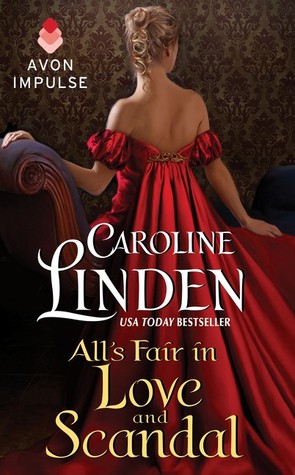
All's Fair in Love and Scandal (Scandalous #2.5) by Caroline Linden
Summary from Goodreads:
Nothing wagered…
Douglas Bennet can’t resist a good wager, especially not one that involves a beautiful woman. When a friend proposes an audacious plan to expose the most notorious woman in England, Douglas agrees at once. After all, it would be quite a coup to discover the true identity of Lady Constance, author of the infamous erotic serial scandalizing the ton, 50 Ways to Sin.
Nothing won…
Madeline Wilde is used to being pursued. For years she’s cultivated a reputation for being unattainable and mysterious, and for good reason: her livelihood depends on discretion. When Douglas turns his legendary charm on her, she dismisses him as just another rake. But he surprises her—instead of merely trying to seduce her, he becomes her friend…her confidant…and her lover. But can it really lead to happily-ever-after…or are they about to become the biggest scandal London has ever seen?
I wasn't sure if I wanted a Happily Ever After for Douglas Bennet. Yet. When he was introduced in Love and Other Scandals he seemed far from ready to settle down and more than a little disappointed to find his best friend Tristan, hero of Love and Other Scandals, in love and at the altar with Douglas's sister Joan. But here we find Douglas, bored and swanning around a ballroom and ready to jump at a five pound wager to get the aloof, widowed Madeline Wilde to dance with him in the mid-series novella All's Fair in Love and Scandal. Madeline, for her part, never dances and dismisses the attractive Douglas with barely a thought (so she thinks). Poor, hurt fowl. Douglas who is then goaded by the loathsome Spence into helping him claim a bounty: deliver proof exposing the author of the naughty pamphlet series 50 Ways to Sin and claim two thousand pounds. Douglas begins to woo Madeline with predictable results...in the direction of the altar.
Now, this is where I wish Linden had made this a full novel in the Scandalous series. I feel like there's a lot of "insta-lust" in a very short amount of time without giving it time to turn into "insta-love" so I feel like I have to take her word that Douglas and Madeline are meant for each other. There are a lot of sweet parts, and the wager-conflict introduced by Madeline is interesting, but it feels very compressed (this possibly may be due to my having read Love and Other Scandals after reading and reviewing Love in the Time of Scandal, Scandalous #3, and I really loved the plotting in that novel). I would have loved to see Douglas and Madeline's relationship develop more slowly and perhaps see samples of Madeline's writing. We didn't even get a snippet of 50 Ways to Sin in this installment, so we have to assume Douglas is reading one introduced in the previous two books.
Dear FTC: I received a digital advance copy of this novel from the publisher...but then I bought a copy as well.
Nothing wagered…
Douglas Bennet can’t resist a good wager, especially not one that involves a beautiful woman. When a friend proposes an audacious plan to expose the most notorious woman in England, Douglas agrees at once. After all, it would be quite a coup to discover the true identity of Lady Constance, author of the infamous erotic serial scandalizing the ton, 50 Ways to Sin.
Nothing won…
Madeline Wilde is used to being pursued. For years she’s cultivated a reputation for being unattainable and mysterious, and for good reason: her livelihood depends on discretion. When Douglas turns his legendary charm on her, she dismisses him as just another rake. But he surprises her—instead of merely trying to seduce her, he becomes her friend…her confidant…and her lover. But can it really lead to happily-ever-after…or are they about to become the biggest scandal London has ever seen?
I wasn't sure if I wanted a Happily Ever After for Douglas Bennet. Yet. When he was introduced in Love and Other Scandals he seemed far from ready to settle down and more than a little disappointed to find his best friend Tristan, hero of Love and Other Scandals, in love and at the altar with Douglas's sister Joan. But here we find Douglas, bored and swanning around a ballroom and ready to jump at a five pound wager to get the aloof, widowed Madeline Wilde to dance with him in the mid-series novella All's Fair in Love and Scandal. Madeline, for her part, never dances and dismisses the attractive Douglas with barely a thought (so she thinks). Poor, hurt fowl. Douglas who is then goaded by the loathsome Spence into helping him claim a bounty: deliver proof exposing the author of the naughty pamphlet series 50 Ways to Sin and claim two thousand pounds. Douglas begins to woo Madeline with predictable results...in the direction of the altar.
Now, this is where I wish Linden had made this a full novel in the Scandalous series. I feel like there's a lot of "insta-lust" in a very short amount of time without giving it time to turn into "insta-love" so I feel like I have to take her word that Douglas and Madeline are meant for each other. There are a lot of sweet parts, and the wager-conflict introduced by Madeline is interesting, but it feels very compressed (this possibly may be due to my having read Love and Other Scandals after reading and reviewing Love in the Time of Scandal, Scandalous #3, and I really loved the plotting in that novel). I would have loved to see Douglas and Madeline's relationship develop more slowly and perhaps see samples of Madeline's writing. We didn't even get a snippet of 50 Ways to Sin in this installment, so we have to assume Douglas is reading one introduced in the previous two books.
Dear FTC: I received a digital advance copy of this novel from the publisher...but then I bought a copy as well.
As If!: The Oral History of Clueless as told by Amy Heckerling and the Cast and Crew by Jen Chaney
Summary from Goodreads:
Acclaimed pop culture journalist Jen Chaney shares an oral history of the cult classic film Clueless in the ultimate written resource about one of the most influential, revered, and enduring movies of the 1990s—in celebration of its twentieth anniversary.
Will we ever get tired of watching Cher navigate Beverly Hills high school and discover true love in the movie Clueless? As if! Written by Amy Heckerling and starring Alicia Silverstone, Clueless is an enduring comedy classic that remains one of the most streamed movies on Netflix, Amazon, and iTunes even twenty years after its release. Inspired by Jane Austen's Emma, Clueless is an everlasting pop culture staple.
In the first book of its kind, Jen Chaney has compiled an oral history of the making of this iconic film using recollections and insights collected from key cast and crew members involved in the making of this endlessly quotable, ahead-of-its-time production. Get a behind-the-scenes look at how Emma influenced Heckerling to write the script, how the stars were cast into each of their roles, what was involved in creating the costumes, sets, and soundtrack, and much more.
This wonderful twentieth anniversary commemoration includes never-before-seen photos, original call sheets, casting notes, and production diary extracts. With supplemental critical insights by the author and other notable movie experts about why Clueless continues to impact pop culture, As If! will leave fans new and old totally buggin' as they understand why this beloved film is timeless.
The motion picture Clueless opened the summer between my junior and senior years of high school. By the time we started school in the fall my classmates and I were fluent in Clueless-speak, "Whatever!" (complete with hand gesture) being the most popular by far. The over-the-knee-socks trend with Mary Janes and plaid miniskirts made an appearance (I had the Mary Janes). We bought the VHS and watched it a lot - my crowd was mostly music and drama kids so quoting along with the dialogue was a frequent activity.
Now that Clueless is officially having its 20th birthday (and totally partied with the Haiti-ans) - ugh, when did I get old - Jen Chaney has pulled together the cast and crew for a delightful, dope oral history of the production and staying power of the movie. She originally started the project for a magazine article but there is so much information here that I can't imagine having to pick and choose what parts to highlight in a magazine article, even a long one. Almost everyone from the producers to the stars to the set decorators agreed to be interviewed and Chaney pulled in quotes from previously published pieces from the last 20 years.
The absolute best parts of this book are the sections dealing with casting, costuming, locations, and the soundtrack. What would Clueless have been like had the producers pushed to use Lauryn Hill as Dionne rather than Stacey Dash who was so great in the role? Or if Seth Green was Travis? The costume designer essentially created an entire fashion trend to put the Clueless girls at the cutting edge of fashion and work against the grunge aesthetic. Turns out the liquor store with the creepy clown is a real place in LA (Chaney even interviewed the actor who played the robber). And what Oasis song almost ended up on the Clueless soundtrack? And what did the Bosstones really think about doing a teen movie that wasn't really in their target audience? (And find out how "outtie" is really spelled....spoiler, that isn't the correct spelling or derivation, to my surprise.)
The only drawback to the book is that everyone is so darned nice about everything. If you're looking for juicy Hollywood gossip, this book just doesn't really have it. With the exception of some side-eye between producers, no one reports anything crazy happening on set or on press tour. Amy Heckerling (the writer and director) was so great. Wallace Shawn is very gracious. Alicia Silverstone worked so hard (which she did, given that Cher was in almost every shot of the movie). Paramount really got what Heckerling was going for. Everyone thought the world of Brittany Murphy and her wide-eyed innocence and mourns her loss. Etc, etc etc. Though we all look for drama in any Hollywood story, it is actually a little bit reassuring (though my cynical side feels like perhaps everyone was on their best interview behavior) to find that Heckerling's pastel-colored, happy, inclusive world of Clueless was supported by a lot of hard-working, gracious, talented people who worked as a team to put out an iconic, groundbreaking piece of art.
As If! is available July 7, wherever books are sold.
Dear FTC: I received a digital advance of this book from the publisher via Edelweiss.
Acclaimed pop culture journalist Jen Chaney shares an oral history of the cult classic film Clueless in the ultimate written resource about one of the most influential, revered, and enduring movies of the 1990s—in celebration of its twentieth anniversary.
Will we ever get tired of watching Cher navigate Beverly Hills high school and discover true love in the movie Clueless? As if! Written by Amy Heckerling and starring Alicia Silverstone, Clueless is an enduring comedy classic that remains one of the most streamed movies on Netflix, Amazon, and iTunes even twenty years after its release. Inspired by Jane Austen's Emma, Clueless is an everlasting pop culture staple.
In the first book of its kind, Jen Chaney has compiled an oral history of the making of this iconic film using recollections and insights collected from key cast and crew members involved in the making of this endlessly quotable, ahead-of-its-time production. Get a behind-the-scenes look at how Emma influenced Heckerling to write the script, how the stars were cast into each of their roles, what was involved in creating the costumes, sets, and soundtrack, and much more.
This wonderful twentieth anniversary commemoration includes never-before-seen photos, original call sheets, casting notes, and production diary extracts. With supplemental critical insights by the author and other notable movie experts about why Clueless continues to impact pop culture, As If! will leave fans new and old totally buggin' as they understand why this beloved film is timeless.
The motion picture Clueless opened the summer between my junior and senior years of high school. By the time we started school in the fall my classmates and I were fluent in Clueless-speak, "Whatever!" (complete with hand gesture) being the most popular by far. The over-the-knee-socks trend with Mary Janes and plaid miniskirts made an appearance (I had the Mary Janes). We bought the VHS and watched it a lot - my crowd was mostly music and drama kids so quoting along with the dialogue was a frequent activity.
Now that Clueless is officially having its 20th birthday (and totally partied with the Haiti-ans) - ugh, when did I get old - Jen Chaney has pulled together the cast and crew for a delightful, dope oral history of the production and staying power of the movie. She originally started the project for a magazine article but there is so much information here that I can't imagine having to pick and choose what parts to highlight in a magazine article, even a long one. Almost everyone from the producers to the stars to the set decorators agreed to be interviewed and Chaney pulled in quotes from previously published pieces from the last 20 years.
The absolute best parts of this book are the sections dealing with casting, costuming, locations, and the soundtrack. What would Clueless have been like had the producers pushed to use Lauryn Hill as Dionne rather than Stacey Dash who was so great in the role? Or if Seth Green was Travis? The costume designer essentially created an entire fashion trend to put the Clueless girls at the cutting edge of fashion and work against the grunge aesthetic. Turns out the liquor store with the creepy clown is a real place in LA (Chaney even interviewed the actor who played the robber). And what Oasis song almost ended up on the Clueless soundtrack? And what did the Bosstones really think about doing a teen movie that wasn't really in their target audience? (And find out how "outtie" is really spelled....spoiler, that isn't the correct spelling or derivation, to my surprise.)
The only drawback to the book is that everyone is so darned nice about everything. If you're looking for juicy Hollywood gossip, this book just doesn't really have it. With the exception of some side-eye between producers, no one reports anything crazy happening on set or on press tour. Amy Heckerling (the writer and director) was so great. Wallace Shawn is very gracious. Alicia Silverstone worked so hard (which she did, given that Cher was in almost every shot of the movie). Paramount really got what Heckerling was going for. Everyone thought the world of Brittany Murphy and her wide-eyed innocence and mourns her loss. Etc, etc etc. Though we all look for drama in any Hollywood story, it is actually a little bit reassuring (though my cynical side feels like perhaps everyone was on their best interview behavior) to find that Heckerling's pastel-colored, happy, inclusive world of Clueless was supported by a lot of hard-working, gracious, talented people who worked as a team to put out an iconic, groundbreaking piece of art.
As If! is available July 7, wherever books are sold.
Dear FTC: I received a digital advance of this book from the publisher via Edelweiss.
01 July 2015
The Fly Trap by Fredrik Sjöberg
Summary from Goodreads:
A Nature Book of the Year ( The Times (UK))
“The hoverflies are only props. No, not only, but to some extent. Here and there, my story is about something else.”
A mesmerizing memoir of extraordinary brilliance by an entomologist, The Fly Trap chronicles Fredrik Sjöberg’s life collecting hoverflies on a remote island in Sweden. Warm and humorous, self-deprecating and contemplative, and a major best seller in its native country, The Fly Trap is a meditation on the unexpected beauty of small things and an exploration of the history of entomology itself.
What drives the obsessive curiosity of collectors to catalog their finds? What is the importance of the hoverfly? As confounded by his unusual vocation as anyone, Sjöberg reflects on a range of ideas—the passage of time, art, lost loves—drawing on sources as disparate as D. H. Lawrence and the fascinating and nearly forgotten naturalist René Edmond Malaise. From the wilderness of Kamchatka to the loneliness of the Swedish isle he calls home, Sjöberg revels in the wonder of the natural world and leaves behind a trail of memorable images and stories.
When I started blogging, if you had told me that one day I would jump at the chance to read and review a memoir by an entomologist (and one who lives in Sweden and studies hoverflies, whatever those are, at that), then I would have had a hearty chuckle. Probably a long one.
But that memoir is the core of The Fly Trap - the reasons why Fredrik Sjöberg lives with his family on an island (Runmarö) off the coast of Sweden, nearer to Stockholm, and studies hoverflies. (If, like me, you don't know what-all constitutes "hoverfly", this is a hoverfly; they are quite good mimics and look a lot like bees or wasps - called Batesian mimicry, which is something I actually remember from Biology I in undergrad - and can be distinguished from bees by having only one pair of wings, not two pairs as bees, etc., do). Sjöberg collects hoverflies not simply because that's his academic discipline, but for the satisfaction of collecting the specimens, classifying them, and displaying a collection. Sjöberg brings in the term "buttonology" - coined by August Strindberg his short story "The Isle of the Blessed" - to describe the lengths to which one goes to perfect one's collection and taxonomy.
The mention of Strindberg brings me to why everyone should read The Fly Trap, whether you care about insects and the environment or if you think that bugs are the grossest thing on Earth and you don't give a rat's backside about hoverflies. The Fly Trap is so much more than a nature memoir. It opens with Sjöberg's recollection of his time working in the theatre - there aren't a lot of ladies in entomology, if you get his drift - cleaning up after Peter Stormare (yes, that Peter Stormare) who wasrequired obliged to urinate live on-stage every performance of Sam Shepard's Curse of the Starving Class. He discusses the pleasures and oddities of living on an island with an excellent biosphere, first by invoking the D.H. Lawrence story "The Man Who Loved Islands" and then by detailing the strange phone calls he takes from people wanting to talk to the resident biologist about their insane "environmental" get-rich plans. John Wyndham's The Day of the Triffids (which I am currently reading on Oyster) comes into play when describing the thrill of finding a plant species alien to the island. He makes a joke about Freudians and dung beetles. He sneaks in a few thoughts on Milan Kundera's novel Slowness because the Czech entomologist character is based on a real person Sjöberg knows. Sjöberg's voice is wry and cheeky as he weaves art and literature around the pursuit of hoverflies. Kudos must be given to the translator, Thomas Teal, for creating a wonderfully readable English translation.
Throughout the book Sjöberg pieces together the life story of René Malaise, a Swedish entomologist and explorer who studied sawflies and amassed such a huge collection that museum curators are still sifting through specimens from his last expedition in the late 1930s. Malaise was an iconoclast, to say the least. He invented the Malaise trap (which Sjöberg uses himself) and developed a fascination with art, leading to a small art collection amassed in the aftermath of the two World Wars. Which may or may not have had a Rembrandt. That went mysteriously missing...and that Sjöberg searches for in the final chapters of The Fly Trap. Malaise, unfortunately, wound up on the wrong side of science history by backing the "constriction theory" of geology (which was the loser to "plate tectonics") and writing a book titled Atlantis to back up his claim. Sjöberg tracked that book down, too.
So you should read The Fly Trap! It was a fun, quick read that was perfect for laying on the couch in a patch of sun with the fan going (I don't like outdoors, there are insects and spiders and things...). This is a great book for fans of H is for Hawk by Helen Macdonald (and if you haven't read H is for Hawk, do that) with similar blends of microhistory/microbiography, memoir, and description of environment. Happy reading! And ignore that pesky fly buzzing around your head....
The Fly Trap is available in the US wherever books are sold.
Dear FTC: I received an advance review copy of this book from the publisher.
A Nature Book of the Year ( The Times (UK))
“The hoverflies are only props. No, not only, but to some extent. Here and there, my story is about something else.”
A mesmerizing memoir of extraordinary brilliance by an entomologist, The Fly Trap chronicles Fredrik Sjöberg’s life collecting hoverflies on a remote island in Sweden. Warm and humorous, self-deprecating and contemplative, and a major best seller in its native country, The Fly Trap is a meditation on the unexpected beauty of small things and an exploration of the history of entomology itself.
What drives the obsessive curiosity of collectors to catalog their finds? What is the importance of the hoverfly? As confounded by his unusual vocation as anyone, Sjöberg reflects on a range of ideas—the passage of time, art, lost loves—drawing on sources as disparate as D. H. Lawrence and the fascinating and nearly forgotten naturalist René Edmond Malaise. From the wilderness of Kamchatka to the loneliness of the Swedish isle he calls home, Sjöberg revels in the wonder of the natural world and leaves behind a trail of memorable images and stories.
When I started blogging, if you had told me that one day I would jump at the chance to read and review a memoir by an entomologist (and one who lives in Sweden and studies hoverflies, whatever those are, at that), then I would have had a hearty chuckle. Probably a long one.
But that memoir is the core of The Fly Trap - the reasons why Fredrik Sjöberg lives with his family on an island (Runmarö) off the coast of Sweden, nearer to Stockholm, and studies hoverflies. (If, like me, you don't know what-all constitutes "hoverfly", this is a hoverfly; they are quite good mimics and look a lot like bees or wasps - called Batesian mimicry, which is something I actually remember from Biology I in undergrad - and can be distinguished from bees by having only one pair of wings, not two pairs as bees, etc., do). Sjöberg collects hoverflies not simply because that's his academic discipline, but for the satisfaction of collecting the specimens, classifying them, and displaying a collection. Sjöberg brings in the term "buttonology" - coined by August Strindberg his short story "The Isle of the Blessed" - to describe the lengths to which one goes to perfect one's collection and taxonomy.
The mention of Strindberg brings me to why everyone should read The Fly Trap, whether you care about insects and the environment or if you think that bugs are the grossest thing on Earth and you don't give a rat's backside about hoverflies. The Fly Trap is so much more than a nature memoir. It opens with Sjöberg's recollection of his time working in the theatre - there aren't a lot of ladies in entomology, if you get his drift - cleaning up after Peter Stormare (yes, that Peter Stormare) who was
Throughout the book Sjöberg pieces together the life story of René Malaise, a Swedish entomologist and explorer who studied sawflies and amassed such a huge collection that museum curators are still sifting through specimens from his last expedition in the late 1930s. Malaise was an iconoclast, to say the least. He invented the Malaise trap (which Sjöberg uses himself) and developed a fascination with art, leading to a small art collection amassed in the aftermath of the two World Wars. Which may or may not have had a Rembrandt. That went mysteriously missing...and that Sjöberg searches for in the final chapters of The Fly Trap. Malaise, unfortunately, wound up on the wrong side of science history by backing the "constriction theory" of geology (which was the loser to "plate tectonics") and writing a book titled Atlantis to back up his claim. Sjöberg tracked that book down, too.
So you should read The Fly Trap! It was a fun, quick read that was perfect for laying on the couch in a patch of sun with the fan going (I don't like outdoors, there are insects and spiders and things...). This is a great book for fans of H is for Hawk by Helen Macdonald (and if you haven't read H is for Hawk, do that) with similar blends of microhistory/microbiography, memoir, and description of environment. Happy reading! And ignore that pesky fly buzzing around your head....
The Fly Trap is available in the US wherever books are sold.
Dear FTC: I received an advance review copy of this book from the publisher.
30 June 2015
Put Up Your Duke (Dukes Behaving Badly #2) by Megan Frampton
Summary from Goodreads:
He was once happily bedding and boxing, but in the newest Duke's Behaving Badly novel, Nicholas Smithfield has inherited a title and a bride . . .
To keep his estate afloat, the new Duke of Gage must honor an agreement to marry Lady Isabella Sawford. Stunningly beautiful, utterly tempting, she's also a bag of wedding night nerves, so Nicholas decides to wait to do his duty—even if it means heading to the boxing saloon every day to punch away his frustration.
Groomed her whole life to become the perfect duchess, Isabella longs for independence, a dream that is gone forever. As her husband, Nicholas can do whatever he likes—but, to Isabella's surprise, the notorious rake instead begins a gentle seduction that is melting every inch of her reserve, night by night . . .
To his utter shock, Nicholas discovers that no previous exploits were half as pleasurable as wooing his own wife. But has the realm's most disreputable duke found the one woman who can bring him to his knees— and leave him there?
Nicholas Smithfield becomes the new Duke of Gage by accident of law: the former Duke of Gage inadvertently caused an investigation of his family tree during the course of a lawsuit and the entire ducal branch was nullified. To the benefit of the cadet branch leading to Nicholas. Also by accident of law, Nicholas inherits the Duke of Gage's betrothed, one Lady Isabella Sawford. Isabella is beautiful, well-trained, docile, and the perfect duchess-to-be, emphasis on perfect. In other words, she is a shell of the woman she could be - and Isabella knows it.
Throughout Put Up Your Duke, Nicholas and Isabella circle warily around each other. Isabella, now married, has the freedom to make her own decisions regarding her household, her wardrobe, her marriage...but isn't quite sure how to proceed or trust that Nicholas won't pull the rug out from under her. Nicholas, though solicitous of Isabella's feelings and he doesn't wish to force himself on her to consummate the marriage, hasn't the foggiest idea how to get her to tell him what's going on in her head rather than tell him what she thinks he wants to hear. (Obviously, coming straight out and saying that he knows she is very nervous, and that he doesn't want to hurt her, and that maybe they could get to know each other first before getting-it-on because that is sexier would clearly cancel half the plot of the novel.)
I was a bit hesitant to start this next installment in Megan Frampton's "Dukes Behaving Badly" series (there's a novella, When Good Earls Go Bad, that I skipped). The first book, The Duke's Guide to Correct Behavior, was underwhelming. While the snippets from the (fictional) behavior guide The Duke's Guide to Correct Behavior were funny, the characters felt flat and/or rehashed from other books, the plot was poky, and there were too many basic historical and conventional slips to ignore. It wasn't a terrible book, just....eh. But Avon Books gave me access to the DRC for Put Up Your Duke - and asked very nicely if I might review it - so after about three chapters, I settled in for a few hours of enjoyable reading.
Put Up Your Duke is a wonderful improvement on the series. The characters of Isabella and Nicholas are well-developed, the main plot is engaging, and the legal mess that lands Nicholas in the ducal coronet is a good hook to the start of the novel. While some of the secondary characters still feel one-dimensional (like Isabella's parents), there is enough hinted at for Lord Collingwood (the former Duke of Gage and a nasty individual) to reappear later in the series without making him boring or giving too much away. I enjoyed this book enough to look forward to the next book in the series (which I believe is called One-Eyed Dukes are Wild, and is set to release at the end of December 2015, but don't quote me on that).
However, I still have to pick a few nits regarding the series title. "Dukes Behaving Badly." Megan Frampton's Dukes are almost saint-like in their mild badness. In The Duke's Guide to Correct Behavior, we are told frequently that Marcus, the Duke of Rutherford, is dissolute and shocking but we never actually see him do anything "shocking". In Put Up Your Duke, the novel opens with Nicholas eating a strawberry out of the cleavage of a courtesan sitting on his lap while two other courtesans fawn over him. When his brother Griff arrives with the news that Nicholas is now the Duke of Gage, Nicholas leaves the brothel and pays the madam even though he's done nothing but eat a strawberry (literally, not figuratively). In the novel, Nicholas frequently mentions that he abstained from sex from that moment; he doesn't have a mistress and he treats Isabella with a great deal of consideration in every way, not just in the bedchamber. So, what makes him so "bad"? Because Nicholas and Marcus are far less "bad" than many of the minor characters. The series is set early in Queen Victoria's reign - the "mad, bad, and dangerous to know" Lord Byron has set the bar pretty high for naughtiness. If we want bad noblemen of romance novels, I'll take a few more "Sebastian Ballister, Marquess of Dain"-s. So more badness in our "Bad" Dukes, please. It makes their rehabilitation far more enjoyable.
Put Up Your Duke by Megan Frampton is available today, June 30, 2015, wherever books are sold.
Dear FTC: I received a digital ARC from the publisher via Edelweiss.
He was once happily bedding and boxing, but in the newest Duke's Behaving Badly novel, Nicholas Smithfield has inherited a title and a bride . . .
To keep his estate afloat, the new Duke of Gage must honor an agreement to marry Lady Isabella Sawford. Stunningly beautiful, utterly tempting, she's also a bag of wedding night nerves, so Nicholas decides to wait to do his duty—even if it means heading to the boxing saloon every day to punch away his frustration.
Groomed her whole life to become the perfect duchess, Isabella longs for independence, a dream that is gone forever. As her husband, Nicholas can do whatever he likes—but, to Isabella's surprise, the notorious rake instead begins a gentle seduction that is melting every inch of her reserve, night by night . . .
To his utter shock, Nicholas discovers that no previous exploits were half as pleasurable as wooing his own wife. But has the realm's most disreputable duke found the one woman who can bring him to his knees— and leave him there?
Nicholas Smithfield becomes the new Duke of Gage by accident of law: the former Duke of Gage inadvertently caused an investigation of his family tree during the course of a lawsuit and the entire ducal branch was nullified. To the benefit of the cadet branch leading to Nicholas. Also by accident of law, Nicholas inherits the Duke of Gage's betrothed, one Lady Isabella Sawford. Isabella is beautiful, well-trained, docile, and the perfect duchess-to-be, emphasis on perfect. In other words, she is a shell of the woman she could be - and Isabella knows it.
Throughout Put Up Your Duke, Nicholas and Isabella circle warily around each other. Isabella, now married, has the freedom to make her own decisions regarding her household, her wardrobe, her marriage...but isn't quite sure how to proceed or trust that Nicholas won't pull the rug out from under her. Nicholas, though solicitous of Isabella's feelings and he doesn't wish to force himself on her to consummate the marriage, hasn't the foggiest idea how to get her to tell him what's going on in her head rather than tell him what she thinks he wants to hear. (Obviously, coming straight out and saying that he knows she is very nervous, and that he doesn't want to hurt her, and that maybe they could get to know each other first before getting-it-on because that is sexier would clearly cancel half the plot of the novel.)
I was a bit hesitant to start this next installment in Megan Frampton's "Dukes Behaving Badly" series (there's a novella, When Good Earls Go Bad, that I skipped). The first book, The Duke's Guide to Correct Behavior, was underwhelming. While the snippets from the (fictional) behavior guide The Duke's Guide to Correct Behavior were funny, the characters felt flat and/or rehashed from other books, the plot was poky, and there were too many basic historical and conventional slips to ignore. It wasn't a terrible book, just....eh. But Avon Books gave me access to the DRC for Put Up Your Duke - and asked very nicely if I might review it - so after about three chapters, I settled in for a few hours of enjoyable reading.
Put Up Your Duke is a wonderful improvement on the series. The characters of Isabella and Nicholas are well-developed, the main plot is engaging, and the legal mess that lands Nicholas in the ducal coronet is a good hook to the start of the novel. While some of the secondary characters still feel one-dimensional (like Isabella's parents), there is enough hinted at for Lord Collingwood (the former Duke of Gage and a nasty individual) to reappear later in the series without making him boring or giving too much away. I enjoyed this book enough to look forward to the next book in the series (which I believe is called One-Eyed Dukes are Wild, and is set to release at the end of December 2015, but don't quote me on that).
However, I still have to pick a few nits regarding the series title. "Dukes Behaving Badly." Megan Frampton's Dukes are almost saint-like in their mild badness. In The Duke's Guide to Correct Behavior, we are told frequently that Marcus, the Duke of Rutherford, is dissolute and shocking but we never actually see him do anything "shocking". In Put Up Your Duke, the novel opens with Nicholas eating a strawberry out of the cleavage of a courtesan sitting on his lap while two other courtesans fawn over him. When his brother Griff arrives with the news that Nicholas is now the Duke of Gage, Nicholas leaves the brothel and pays the madam even though he's done nothing but eat a strawberry (literally, not figuratively). In the novel, Nicholas frequently mentions that he abstained from sex from that moment; he doesn't have a mistress and he treats Isabella with a great deal of consideration in every way, not just in the bedchamber. So, what makes him so "bad"? Because Nicholas and Marcus are far less "bad" than many of the minor characters. The series is set early in Queen Victoria's reign - the "mad, bad, and dangerous to know" Lord Byron has set the bar pretty high for naughtiness. If we want bad noblemen of romance novels, I'll take a few more "Sebastian Ballister, Marquess of Dain"-s. So more badness in our "Bad" Dukes, please. It makes their rehabilitation far more enjoyable.
Put Up Your Duke by Megan Frampton is available today, June 30, 2015, wherever books are sold.
Dear FTC: I received a digital ARC from the publisher via Edelweiss.
28 May 2015
Love in the Time of Scandal by Caroline Linden (Scandalous #3)
Summary from Goodreads:
USA Today bestselling author Caroline Linden's third novel in her Scandalous series brings together a feisty heiress, a notorious rake, and a shocking book that could bring one woman the utmost despair—or the greatest pleasure...
Penelope Weston does not like Benedict Lennox, Lord Atherton. He may be the suave and charming heir to an earl, as well as the most handsome man on earth, but she can't forget how he abandoned a friend in need—nor how he once courted her sister, Abigail. He's the last man she would ever marry. If only she didn't feel so attracted to the arrogant scoundrel...
Once upon a time, Benedict thought he and Penelope got along rather well. Though he needs a wealthy bride to escape his cruel father's control, spirited Penelope just doesn't suit his plans for a model marriage—until a good deed goes awry, and scandalous rumors link his name to Penelope's. She might not be the quiet, sensible wife he thought he wanted, but she is beautiful . . . beguiling . . . and far more passionate than he ever imagined. Can a marriage begun in scandal become a love match, too?
Fair warning: if you haven't read the second book in Caroline Linden's Scandalous series - It Takes a Scandal - you may want to read that before reading Love in the Time of Scandal because the conflict between the hero and heroine is introduced in the earlier book.
Love in the Time of Scandal contains what is possibly my favorite romance trope: the socially-demanded marriage of convenience between two people who think they are completely wrong for each other but turn out to be exactly each what the other needs. Penelope thinks that Benedict Lennox is an ass for not helping his friend and only courted her sister for her money while Benedict thinks Penelope Weston, for all her pounds sterling, is far too loud and unconventional to ever join the aristocratic classes of Society. When Penelope inadvertently causes Benedict's chosen fiancee to reject him, he is righteously angry. However, when he goes to confront her, he finds her at the mercy of a cruel member of the ton, Lord Clary, because she is protecting her friend Olivia Townsend. Benedict rescues Penelope, but the two are seen - at that point they are alone and Penelope is in a, shall we say, less than composed appearance...they must marry.
This is when everything starts to get fun. Penelope's dowry - which her father has not withheld - allows the new couple to form their own household. Penelope also has possession of the scandalous pamphlets 50 Ways to Sin (despite her mother's attempts to ban them) and Benedict gets some marvelous use out of scarlet ribbon. The two of them begin to, very warily, build a life together, one that might even include happiness, warmth, safety, and even love. Then Benedict's sociopathic, abusive father pops up during a dinner party simply to discompose everyone and invite the new Lady Lennox to visit....Linden serves up such a delicious plot turn here.
I loved this installment in the Scandalous series and had there not been an announcement of a fourth book I might have rioted. The plotting is excellent, the details fleshing out both Penelope's and Benedict's characters are so on point, and I love how Caroline Linden uses examples from literature to give her virgin heroines sexual agency (if you don't listen to the DBSA podcast, Caro gives some amazing examples of period erotic literature in a recent episode). I almost cried - almost - at one point. And if I cry out of happiness at a romance novel, you are doing it right!
Love in the Time of Scandal is out now, wherever books are sold.
Dear FTC: I received a digital advance copy of this book from the publisher via Edelweiss...and then I bought a copy.
USA Today bestselling author Caroline Linden's third novel in her Scandalous series brings together a feisty heiress, a notorious rake, and a shocking book that could bring one woman the utmost despair—or the greatest pleasure...
Penelope Weston does not like Benedict Lennox, Lord Atherton. He may be the suave and charming heir to an earl, as well as the most handsome man on earth, but she can't forget how he abandoned a friend in need—nor how he once courted her sister, Abigail. He's the last man she would ever marry. If only she didn't feel so attracted to the arrogant scoundrel...
Once upon a time, Benedict thought he and Penelope got along rather well. Though he needs a wealthy bride to escape his cruel father's control, spirited Penelope just doesn't suit his plans for a model marriage—until a good deed goes awry, and scandalous rumors link his name to Penelope's. She might not be the quiet, sensible wife he thought he wanted, but she is beautiful . . . beguiling . . . and far more passionate than he ever imagined. Can a marriage begun in scandal become a love match, too?
Fair warning: if you haven't read the second book in Caroline Linden's Scandalous series - It Takes a Scandal - you may want to read that before reading Love in the Time of Scandal because the conflict between the hero and heroine is introduced in the earlier book.
Love in the Time of Scandal contains what is possibly my favorite romance trope: the socially-demanded marriage of convenience between two people who think they are completely wrong for each other but turn out to be exactly each what the other needs. Penelope thinks that Benedict Lennox is an ass for not helping his friend and only courted her sister for her money while Benedict thinks Penelope Weston, for all her pounds sterling, is far too loud and unconventional to ever join the aristocratic classes of Society. When Penelope inadvertently causes Benedict's chosen fiancee to reject him, he is righteously angry. However, when he goes to confront her, he finds her at the mercy of a cruel member of the ton, Lord Clary, because she is protecting her friend Olivia Townsend. Benedict rescues Penelope, but the two are seen - at that point they are alone and Penelope is in a, shall we say, less than composed appearance...they must marry.
This is when everything starts to get fun. Penelope's dowry - which her father has not withheld - allows the new couple to form their own household. Penelope also has possession of the scandalous pamphlets 50 Ways to Sin (despite her mother's attempts to ban them) and Benedict gets some marvelous use out of scarlet ribbon. The two of them begin to, very warily, build a life together, one that might even include happiness, warmth, safety, and even love. Then Benedict's sociopathic, abusive father pops up during a dinner party simply to discompose everyone and invite the new Lady Lennox to visit....Linden serves up such a delicious plot turn here.
I loved this installment in the Scandalous series and had there not been an announcement of a fourth book I might have rioted. The plotting is excellent, the details fleshing out both Penelope's and Benedict's characters are so on point, and I love how Caroline Linden uses examples from literature to give her virgin heroines sexual agency (if you don't listen to the DBSA podcast, Caro gives some amazing examples of period erotic literature in a recent episode). I almost cried - almost - at one point. And if I cry out of happiness at a romance novel, you are doing it right!
Love in the Time of Scandal is out now, wherever books are sold.
Dear FTC: I received a digital advance copy of this book from the publisher via Edelweiss...and then I bought a copy.
26 May 2015
Dearest Rogue by Elizabeth Hoyt (Maiden Lane #8)
Summary from Goodreads:
HE CAN GUARD HER
Lady Phoebe Batten is pretty, vivacious, and yearning for a social life befitting the sister of a powerful duke. But because she is almost completely blind, her overprotective brother insists that she have an armed bodyguard by her side at all times-the very irritating Captain Trevillion.
FROM EVERY DANGER
Captain James Trevillion is proud, brooding, and cursed with a leg injury from his service in the King's dragoons. Yet he can still shoot and ride like the devil, so watching over the distracting Lady Phoebe should be no problem at all-until she's targeted by kidnappers.
BUT PASSION ITSELF
Caught in a deadly web of deceit, James must risk life and limb to save his charge from the lowest of cads-one who would force Lady Phoebe into a loveless marriage. But while they're confined to close quarters for her safekeeping, Phoebe begins to see the tender man beneath the soldier's hard exterior . . . and the possibility of a life-and love-she never imagined possible.
I'm not going to lie. I've wanted a novel for Phoebe and Trevillion ever since it was pointed out that they fight like wet cats - which is about halfway through the previous novel in the series, Darling Beast (review). So, lucky for me, I didn't have to wait long for Dearest Rogue.
In Dearest Rogue, Captain James Trevillion - wounded in Duke of Midnight (review) and unable to remain with the dragoons - has been hired by Maximus Batten, Duke of Wakefield (yep, that Duke), as bodyguard to the Duke's visually impaired sister, Phoebe (who has grown and grown on me since her introduction in the second book, Notorious Pleasures). Even if James had the full use of both legs, this would not be an easy job. He has to shoot a would-be kidnapper in the face. On Bond Street. With Phoebe mounted in front of him on their escape horse. When a kidnapping attempt becomes temporarily successful, James whisks Phoebe away to a secret location for her safety. And to drive himself insane with unrequited love, because a duke's daughter could never, ever love a common soldier with a cloudy past.
Or so he thinks. For her part, Phoebe has been chafing against the restrictions imposed by her brother so much she has yet to see Trevillion as a man, not her jailer. As James and Phoebe negotiate how to create new experiences without undue risks, Phoebe realizes how much she doesn't know about James. She had assumed he was old and ugly because she didn't want a bodyguard (he's neither). She had assumed he was uneducated (while not a scholar, he is a middle-class gentleman). She had assumed he was abrupt with her because he didn't like her (she couldn't possibly be more wrong). Just as people make assumptions about her because of her blindness, Phoebe has made assumptions about James.
Dearest Rogue is so stinking adorable I want to weep with joy. The trip out of London taken by James and Phoebe is an absolute delight and the development of their love story is spellbinding. Do you know the best part? There's no dancing around the marriage plot, no back-and-forth, no will-we-won't-we-external-forces-are-a-problem-someone-can't-say-those-three-little-words problems. Once James and Phoebe acknowledge they love each other they just decide everyone else can go to hell. I love it.
When I was reading Dearest Rogue I was also catching up on episodes of the podcast Invisibilia, specifically the show "How to Become Batman" which dealt with blindness. The intersection of book character and podcast interviewee was so timely my head almost exploded. The Invisibilia producers interviewed a blind man who had developed very precise echolocation - he teaches this technique to other visually impaired people so he touches on the topic of raising a blind child and how attempting to protect such a child from any and all risk, with blindness as excuse, actually prevents that child from being able to properly assess and situation and develop independence. This, precisely, is the point Elizabeth Hoyt allows Phoebe to make in Dearest Rogue: that by artificially limiting her experience, even with the best of intentions, Phoebe's world becomes stagnant and she becomes too dependent on others. It is through the development of this part of Phoebe's and James's relationship that makes Dearest Rogue so wonderful and gives it such depth. In that way, it is similar to my favorite Maiden Lane novel, Lord of Darkness (review), where Godric and Megs have to navigate a lot of assumptions and personal history before their happy ending. (What am I saying, I have two favorite Maiden Lane novels now.)
Dearest Rogue is available today, May 26, 2015, wherever books are sold.
Dear FTC: I received a digital advance of this book from the publisher via Edelweiss...and then I bought a copy, too.
HE CAN GUARD HER
Lady Phoebe Batten is pretty, vivacious, and yearning for a social life befitting the sister of a powerful duke. But because she is almost completely blind, her overprotective brother insists that she have an armed bodyguard by her side at all times-the very irritating Captain Trevillion.
FROM EVERY DANGER
Captain James Trevillion is proud, brooding, and cursed with a leg injury from his service in the King's dragoons. Yet he can still shoot and ride like the devil, so watching over the distracting Lady Phoebe should be no problem at all-until she's targeted by kidnappers.
BUT PASSION ITSELF
Caught in a deadly web of deceit, James must risk life and limb to save his charge from the lowest of cads-one who would force Lady Phoebe into a loveless marriage. But while they're confined to close quarters for her safekeeping, Phoebe begins to see the tender man beneath the soldier's hard exterior . . . and the possibility of a life-and love-she never imagined possible.
I'm not going to lie. I've wanted a novel for Phoebe and Trevillion ever since it was pointed out that they fight like wet cats - which is about halfway through the previous novel in the series, Darling Beast (review). So, lucky for me, I didn't have to wait long for Dearest Rogue.
In Dearest Rogue, Captain James Trevillion - wounded in Duke of Midnight (review) and unable to remain with the dragoons - has been hired by Maximus Batten, Duke of Wakefield (yep, that Duke), as bodyguard to the Duke's visually impaired sister, Phoebe (who has grown and grown on me since her introduction in the second book, Notorious Pleasures). Even if James had the full use of both legs, this would not be an easy job. He has to shoot a would-be kidnapper in the face. On Bond Street. With Phoebe mounted in front of him on their escape horse. When a kidnapping attempt becomes temporarily successful, James whisks Phoebe away to a secret location for her safety. And to drive himself insane with unrequited love, because a duke's daughter could never, ever love a common soldier with a cloudy past.
Or so he thinks. For her part, Phoebe has been chafing against the restrictions imposed by her brother so much she has yet to see Trevillion as a man, not her jailer. As James and Phoebe negotiate how to create new experiences without undue risks, Phoebe realizes how much she doesn't know about James. She had assumed he was old and ugly because she didn't want a bodyguard (he's neither). She had assumed he was uneducated (while not a scholar, he is a middle-class gentleman). She had assumed he was abrupt with her because he didn't like her (she couldn't possibly be more wrong). Just as people make assumptions about her because of her blindness, Phoebe has made assumptions about James.
Dearest Rogue is so stinking adorable I want to weep with joy. The trip out of London taken by James and Phoebe is an absolute delight and the development of their love story is spellbinding. Do you know the best part? There's no dancing around the marriage plot, no back-and-forth, no will-we-won't-we-external-forces-are-a-problem-someone-can't-say-those-three-little-words problems. Once James and Phoebe acknowledge they love each other they just decide everyone else can go to hell. I love it.
When I was reading Dearest Rogue I was also catching up on episodes of the podcast Invisibilia, specifically the show "How to Become Batman" which dealt with blindness. The intersection of book character and podcast interviewee was so timely my head almost exploded. The Invisibilia producers interviewed a blind man who had developed very precise echolocation - he teaches this technique to other visually impaired people so he touches on the topic of raising a blind child and how attempting to protect such a child from any and all risk, with blindness as excuse, actually prevents that child from being able to properly assess and situation and develop independence. This, precisely, is the point Elizabeth Hoyt allows Phoebe to make in Dearest Rogue: that by artificially limiting her experience, even with the best of intentions, Phoebe's world becomes stagnant and she becomes too dependent on others. It is through the development of this part of Phoebe's and James's relationship that makes Dearest Rogue so wonderful and gives it such depth. In that way, it is similar to my favorite Maiden Lane novel, Lord of Darkness (review), where Godric and Megs have to navigate a lot of assumptions and personal history before their happy ending. (What am I saying, I have two favorite Maiden Lane novels now.)
Dearest Rogue is available today, May 26, 2015, wherever books are sold.
Dear FTC: I received a digital advance of this book from the publisher via Edelweiss...and then I bought a copy, too.
11 May 2015
The World Between Two Covers by Ann Morgan
Summary from Goodreads:
A beguiling exploration of the joys of reading across boundaries, inspired by the author's year-long journey through a book from every country.
Following an impulse to read more internationally, journalist Ann Morgan undertook first to define "the world" and then to find a story from each of 196 nations. Tireless in her quest and assisted by generous, far-flung strangers, Morgan discovered not only a treasury of world literature but also the keys to unlock it. Whether considering the difficulties faced by writers in developing nations, movingly illustrated by Burundian Marie-Thérese Toyi's Weep Not, Refugee; tracing the use of local myths in the fantastically successful Samoan YA series Telesa; delving into questions of censorship and propaganda while sourcing a title from North Korea; or simply getting hold of The Corsair, the first Qatari novel to be translated into English, Morgan illuminates with wit, warmth, and insight how stories are written the world over and how place-geographical, historical, virtual-shapes the books we read and write.
Some time in late-2012 I stumbled across a blog titled A Year of Reading the World. This very nice lady, Ann Morgan, was apparently wrapping up a year-long blog project wherein she read a book from every country in the world. Plus a territory chosen by poll from her readers. 197 books in all.
197 books, one from each country. Translated into English. (2012, for me, was the year I read 192 books, mostly romance novels because my mother was undergoing treatment for cancer and I couldn't handle much else. So Ann's project caught me attention simply for her level of ambition - I have blog projects, but I am absolutely the worst at reading to list or schedule or timetable.) As 2013 rolled in, I backed up to the beginning of Ann's blog and read it all from the beginning. Not only did she find some really interesting books to read she also had a fair amount of trouble getting books to read from more countries than I would have guessed. Ann's experience led me to check and see how much in-translation work I read....which, like my percentage of POC authors, was pretty terrible. And then Ann announced she'd been offered a book deal based on her blog....
https://www.tumblr.com/search/Kermit-flail#
(Full disclosure: once I found out that Norton's Liveright imprint was going to publish the US edition I begged a galley off them. I have no regrets.)
The US title of Ann's book is The World Between Two Covers and if you thought it was going to be a potted, bound version of the blog you're going to be disappointed. What the book turned out to be is a very well-written examination of why the Anglophone (specifically UK via Ann's experience and US by extension) reading population and publishing arm reads little world literature, particularly in translation. At best estimate approximately only 3% of non-Anglophone world literature is translated and published in English. Only 3%. That's terrible.
Ann touched briefly on many translation or publication issues on her blog but the book allows her to expand her topics in a very accessibly way. There are a number of roadblocks one encounters when trying to find and read literature by authors (and, by extension, purchase legally) from, say, Burkina Faso or Nepal or Kuwait or Monaco or Lichtenstein. New countries may not have a strong press or literature tradition (or even a written tradition as we define it in Western literature, as Ann found with some island nations). Some authors turn increasingly to the ebook self-publishing industry for publication and access to readers, some are fleetingly available through small specialty presses. A huge list of books to read can be derived from Ann's work both in the actual 197 books she read in 2012 and the books she references in mulling over her experience. The World Between Two Covers will make you think and grow your TBR list by leaps and bounds - which is exactly what happened to me. You can also watch me natter on about this in two videos - I talk about the book and then about some recommendations for literature in translation.
And I made a display at the store because, ugh, so much good stuff to read.
Recommendation: buy this sucker and read the heck out of it, pen in hand.
Dear FTC: I requested an ARC from the publisher, nearly read the cover off, and had to buy a nice, clean copy for my shelf.
A beguiling exploration of the joys of reading across boundaries, inspired by the author's year-long journey through a book from every country.
Following an impulse to read more internationally, journalist Ann Morgan undertook first to define "the world" and then to find a story from each of 196 nations. Tireless in her quest and assisted by generous, far-flung strangers, Morgan discovered not only a treasury of world literature but also the keys to unlock it. Whether considering the difficulties faced by writers in developing nations, movingly illustrated by Burundian Marie-Thérese Toyi's Weep Not, Refugee; tracing the use of local myths in the fantastically successful Samoan YA series Telesa; delving into questions of censorship and propaganda while sourcing a title from North Korea; or simply getting hold of The Corsair, the first Qatari novel to be translated into English, Morgan illuminates with wit, warmth, and insight how stories are written the world over and how place-geographical, historical, virtual-shapes the books we read and write.
Some time in late-2012 I stumbled across a blog titled A Year of Reading the World. This very nice lady, Ann Morgan, was apparently wrapping up a year-long blog project wherein she read a book from every country in the world. Plus a territory chosen by poll from her readers. 197 books in all.
197 books, one from each country. Translated into English. (2012, for me, was the year I read 192 books, mostly romance novels because my mother was undergoing treatment for cancer and I couldn't handle much else. So Ann's project caught me attention simply for her level of ambition - I have blog projects, but I am absolutely the worst at reading to list or schedule or timetable.) As 2013 rolled in, I backed up to the beginning of Ann's blog and read it all from the beginning. Not only did she find some really interesting books to read she also had a fair amount of trouble getting books to read from more countries than I would have guessed. Ann's experience led me to check and see how much in-translation work I read....which, like my percentage of POC authors, was pretty terrible. And then Ann announced she'd been offered a book deal based on her blog....
https://www.tumblr.com/search/Kermit-flail#
(Full disclosure: once I found out that Norton's Liveright imprint was going to publish the US edition I begged a galley off them. I have no regrets.)
The US title of Ann's book is The World Between Two Covers and if you thought it was going to be a potted, bound version of the blog you're going to be disappointed. What the book turned out to be is a very well-written examination of why the Anglophone (specifically UK via Ann's experience and US by extension) reading population and publishing arm reads little world literature, particularly in translation. At best estimate approximately only 3% of non-Anglophone world literature is translated and published in English. Only 3%. That's terrible.
Ann touched briefly on many translation or publication issues on her blog but the book allows her to expand her topics in a very accessibly way. There are a number of roadblocks one encounters when trying to find and read literature by authors (and, by extension, purchase legally) from, say, Burkina Faso or Nepal or Kuwait or Monaco or Lichtenstein. New countries may not have a strong press or literature tradition (or even a written tradition as we define it in Western literature, as Ann found with some island nations). Some authors turn increasingly to the ebook self-publishing industry for publication and access to readers, some are fleetingly available through small specialty presses. A huge list of books to read can be derived from Ann's work both in the actual 197 books she read in 2012 and the books she references in mulling over her experience. The World Between Two Covers will make you think and grow your TBR list by leaps and bounds - which is exactly what happened to me. You can also watch me natter on about this in two videos - I talk about the book and then about some recommendations for literature in translation.
And I made a display at the store because, ugh, so much good stuff to read.
A photo posted by Melissa W. (@balletbookworm) on
Recommendation: buy this sucker and read the heck out of it, pen in hand.
Dear FTC: I requested an ARC from the publisher, nearly read the cover off, and had to buy a nice, clean copy for my shelf.
21 April 2015
Dark Sparkler by Amber Tamblyn
Summary from Goodreads:
The lives of more than twenty-five actresses lost before their time—from Marilyn Monroe to Brittany Murphy—explored in haunting, provocative new work by an acclaimed poet and actress
Amber Tamblyn is both an award-winning film and television actress and an acclaimed poet. As such she is deeply fascinated-and intimately familiar—with the toll exacted from young women whose lives are offered in sacrifice as starlets. The stories of these actresses, both famous and obscure-tragic stories of suicide, murder, obscurity, and other forms of death—inspired this empathic and emotionally charged collection of new poetic work.
Featuring subjects from Marilyn Monroe and Frances Farmer to Dana Plato and Brittany Murphy—and paired with original artwork commissioned for the book by luminaries including David Lynch, Adrian Tome, Marilyn Manson, and Marcel Dzama—Dark Sparkler is a surprising and provocative collection from a young artist of wide-ranging talent, culminating in an extended, confessional epilogue of astonishing candor and poetic command.
Actresses featured in Dark Sparkler include:
Marilyn Monroe
Brittany Murphy
Dana Plato
Jayne Mansfield
Jean Harlow
Dominique Dunne
Sharon Tate
Heather O’Rourke
Bridgette Andersen
Shannon Michelle Wilsey
Judith Barsi
Peg Entwistle
Carole Landis
Anissa Jones
Susan Peters
Barbara La Marr
Lucy Gordon
Sirkka Sari
Li Tobler
Thelma Todd
Samantha Smith
Lupe Valez
Taruni Sachdev
Rebecca Shaeffer
My working knowledge of contemporary poetry is not good. So color me surprised to find out that not only does actress Amber Tamblyn have a book of poetry coming out from HarperPerennial it isn't her first collection. Huh. But I was really intrigued by her subject matter for the new collection, Dark Sparkler: the lives and deaths of women in the entertainment history.
I won't lie, there are no happy poems here. This is a sad and intriguing collection of poems distilled from the tragic lives of actresses, some quite obscure (I had trouble finding them with Google - and there is an 8 page list of search terms consisting of actress' names and deaths, many of whom died young and holy dude will that take a bit to go through and reconcile with those poems based on actresses I couldn't find initially). There is no consistent form or style; it is pure feeling.
Included in and around these poems based on real women are anxieties that Tamblyn herself must share with these women - the pressure to perform, to conform, to be on display, to be perfect, and to be the object of obsession. The collection reminds me that actresses are judged far more for their appearance and behavior than their acting ability and that pressure causes so many women to harm themselves or turn to substance abuse. One particular poem is chilling in that it is blank, wordless, as if it is waiting for its subject's final move before filling in (I won't spoil that one by telling you who it is). There are lessons here and a lot of things to think about.
Dear FTC: I received an advance copy of this book from the publisher.
The lives of more than twenty-five actresses lost before their time—from Marilyn Monroe to Brittany Murphy—explored in haunting, provocative new work by an acclaimed poet and actress
Amber Tamblyn is both an award-winning film and television actress and an acclaimed poet. As such she is deeply fascinated-and intimately familiar—with the toll exacted from young women whose lives are offered in sacrifice as starlets. The stories of these actresses, both famous and obscure-tragic stories of suicide, murder, obscurity, and other forms of death—inspired this empathic and emotionally charged collection of new poetic work.
Featuring subjects from Marilyn Monroe and Frances Farmer to Dana Plato and Brittany Murphy—and paired with original artwork commissioned for the book by luminaries including David Lynch, Adrian Tome, Marilyn Manson, and Marcel Dzama—Dark Sparkler is a surprising and provocative collection from a young artist of wide-ranging talent, culminating in an extended, confessional epilogue of astonishing candor and poetic command.
Actresses featured in Dark Sparkler include:
Marilyn Monroe
Brittany Murphy
Dana Plato
Jayne Mansfield
Jean Harlow
Dominique Dunne
Sharon Tate
Heather O’Rourke
Bridgette Andersen
Shannon Michelle Wilsey
Judith Barsi
Peg Entwistle
Carole Landis
Anissa Jones
Susan Peters
Barbara La Marr
Lucy Gordon
Sirkka Sari
Li Tobler
Thelma Todd
Samantha Smith
Lupe Valez
Taruni Sachdev
Rebecca Shaeffer
My working knowledge of contemporary poetry is not good. So color me surprised to find out that not only does actress Amber Tamblyn have a book of poetry coming out from HarperPerennial it isn't her first collection. Huh. But I was really intrigued by her subject matter for the new collection, Dark Sparkler: the lives and deaths of women in the entertainment history.
I won't lie, there are no happy poems here. This is a sad and intriguing collection of poems distilled from the tragic lives of actresses, some quite obscure (I had trouble finding them with Google - and there is an 8 page list of search terms consisting of actress' names and deaths, many of whom died young and holy dude will that take a bit to go through and reconcile with those poems based on actresses I couldn't find initially). There is no consistent form or style; it is pure feeling.
Included in and around these poems based on real women are anxieties that Tamblyn herself must share with these women - the pressure to perform, to conform, to be on display, to be perfect, and to be the object of obsession. The collection reminds me that actresses are judged far more for their appearance and behavior than their acting ability and that pressure causes so many women to harm themselves or turn to substance abuse. One particular poem is chilling in that it is blank, wordless, as if it is waiting for its subject's final move before filling in (I won't spoil that one by telling you who it is). There are lessons here and a lot of things to think about.
Dear FTC: I received an advance copy of this book from the publisher.
17 April 2015
Spinster: Making a Life of One's Own by Kate Bolick
Summary from Goodreads:
“Whom to marry, and when will it happen—these two questions define every woman’s existence.” So begins Spinster, a revelatory and slyly erudite look at the pleasures and possibilities of remaining single. Using her own experiences as a starting point, journalist and cultural critic Kate Bolick invites us into her carefully considered, passionately lived life, weaving together the past and present to examine why she—along with over 100 million American women, whose ranks keep growing—remains unmarried.
This unprecedented demographic shift, Bolick explains, is the logical outcome of hundreds of years of change that has neither been fully understood, nor appreciated. Spinster introduces a cast of pioneering women from the last century whose genius, tenacity, and flair for drama have emboldened Bolick to fashion her life on her own terms: columnist Neith Boyce, essayist Maeve Brennan, social visionary Charlotte Perkins Gilman, poet Edna St. Vincent Millay, and novelist Edith Wharton. By animating their unconventional ideas and choices, Bolick shows us that contemporary debates about settling down, and having it all, are timeless—the crucible upon which all thoughtful women have tried for centuries to forge a good life.
Intellectually substantial and deeply personal, Spinster is both an unreservedly inquisitive memoir and a broader cultural exploration that asks us to acknowledge the opportunities within ourselves to live authentically. Bolick offers us a way back into our own lives—a chance to see those splendid years when we were young and unencumbered, or middle-aged and finally left to our own devices, for what they really are: unbounded and our own to savor.
As a single woman approaching middle-age, there are two things you can do: loathe your single state or work to accept the single life you have. I opt for the second. Loathing one's self because one lacks a socially acceptable relationship construct takes too much time. I have things to do. Yes, it sucks that there's no one to come home to at night (cats do not count) but there's a bit of pride that it's all mine, from the weedy yard to the dripping sink to the bed I do not have to share.
Kate Bolick has been coupled and uncoupled, but never married. As her friends married and had children, she wondered why she wasn't doing the same. She had a great life - she was an editor with Domino magazine at one point - and loved it. She loved her apartment. So....was she normal? Bolick began to notice a pattern in her reading: Charlotte Perkins Gilman, Edna St. Vincent Millay, Edith Wharton and others were women who held good jobs and houses and social lives independent of a marital bond. She explores the lives and intersecting themes of these women and her own life in Spinster: Making a Life of One's Own.
I thought this was a very interesting, thoughtful look at women's lives in the last 100-150 years through the lens of Bolick's five female predecessors. And, yes, several of them married later in life or were married early then divorced/widowed, but the major point is that their most productive periods - and possibly happiest periods - coincided with periods of their lives when they were single. I liked the balance between personal memoir and group biography. A definite recommend.
Dear FTC: I received a digital advance copy from the publisher via Edelweiss.
“Whom to marry, and when will it happen—these two questions define every woman’s existence.” So begins Spinster, a revelatory and slyly erudite look at the pleasures and possibilities of remaining single. Using her own experiences as a starting point, journalist and cultural critic Kate Bolick invites us into her carefully considered, passionately lived life, weaving together the past and present to examine why she—along with over 100 million American women, whose ranks keep growing—remains unmarried.
This unprecedented demographic shift, Bolick explains, is the logical outcome of hundreds of years of change that has neither been fully understood, nor appreciated. Spinster introduces a cast of pioneering women from the last century whose genius, tenacity, and flair for drama have emboldened Bolick to fashion her life on her own terms: columnist Neith Boyce, essayist Maeve Brennan, social visionary Charlotte Perkins Gilman, poet Edna St. Vincent Millay, and novelist Edith Wharton. By animating their unconventional ideas and choices, Bolick shows us that contemporary debates about settling down, and having it all, are timeless—the crucible upon which all thoughtful women have tried for centuries to forge a good life.
Intellectually substantial and deeply personal, Spinster is both an unreservedly inquisitive memoir and a broader cultural exploration that asks us to acknowledge the opportunities within ourselves to live authentically. Bolick offers us a way back into our own lives—a chance to see those splendid years when we were young and unencumbered, or middle-aged and finally left to our own devices, for what they really are: unbounded and our own to savor.
As a single woman approaching middle-age, there are two things you can do: loathe your single state or work to accept the single life you have. I opt for the second. Loathing one's self because one lacks a socially acceptable relationship construct takes too much time. I have things to do. Yes, it sucks that there's no one to come home to at night (cats do not count) but there's a bit of pride that it's all mine, from the weedy yard to the dripping sink to the bed I do not have to share.
Kate Bolick has been coupled and uncoupled, but never married. As her friends married and had children, she wondered why she wasn't doing the same. She had a great life - she was an editor with Domino magazine at one point - and loved it. She loved her apartment. So....was she normal? Bolick began to notice a pattern in her reading: Charlotte Perkins Gilman, Edna St. Vincent Millay, Edith Wharton and others were women who held good jobs and houses and social lives independent of a marital bond. She explores the lives and intersecting themes of these women and her own life in Spinster: Making a Life of One's Own.
I thought this was a very interesting, thoughtful look at women's lives in the last 100-150 years through the lens of Bolick's five female predecessors. And, yes, several of them married later in life or were married early then divorced/widowed, but the major point is that their most productive periods - and possibly happiest periods - coincided with periods of their lives when they were single. I liked the balance between personal memoir and group biography. A definite recommend.
Dear FTC: I received a digital advance copy from the publisher via Edelweiss.
Subscribe to:
Posts (Atom)