28 February 2014

The $11 Billion Year: From Sundance to the Oscars, an Inside Look at the Changing Hollywood System

Summary from Goodreads:
This chronicle of 2012 is a slice of what happened during a watershed year for the Hollywood movie industry. It's not the whole story, but it's a mosaic of what went on, and why, and of where things are heading.

What changed in one Hollywood year to produce a record-breaking box office after two years of decline? How can the Sundance Festival influence a film's fate, as it did for Beasts of the Southern Wild and Searching for Sugar Man, which both went all the way to the Oscars? Why did John Carter misfire and The Hunger Games succeed? How did maneuvers at festivals such as South by Southwest (SXSW), Cannes, Telluride, Toronto, and New York and at conventions such as CinemaCon and Comic-Con benefit Amour, Django Unchained, Moonrise Kingdom, Silver Linings Playbook, Les Misérables, The Life of Pi, The Avengers, Lincoln, and Argo? What jeopardized Zero Dark Thirty's launch? What role does gender bias still play in the industry? What are the ten things that changed the 2012 Oscar race?

When it comes to film, Anne Thompson, a seasoned reporter and critic, addresses these questions and more on her respected daily blog, Thompson on Hollywood. Each year, she observes the Hollywood machine at work: the indies at Sundance, the exhibitors' jockeying at CinemaCon, the international scene at Cannes, the summer tentpoles, the fall's "smart" films and festivals, the family-friendly and big films of the holiday season, and the glamour of the Oscars®. Inspired by William Goldman's classic book The Season, which examined the overall Broadway scene through a production-by-production analysis of one theatrical season, Thompson had long wanted to apply a similar lens to the movie business. When she chose 2012 as "the year" to track, she knew that box-office and DVD sales were declining, production costs were soaring, and the digital revolution was making big waves, but she had no idea that events would converge to bring radical structural movement, record-setting box-office revenues, and what she calls "sublime moviemaking."

Though impossible to mention all 670-plus films released in 2012, Thompson includes many in this book, while focusing on the nine Best Picture nominees and the personalities and powers behind them. Reflecting on the year, Thompson concludes, "The best movies get made because filmmakers, financiers, champions, and a great many gifted creative people stubbornly ignore the obstacles. The question going forward is how adaptive these people are, and how flexible is the industry itself?"

We've all been there - sitting in the full-to-overflowing movie theatre, having forked over our $10-12 (or more, depending on your market), and wondering how the heck the movie we're watching, and had been anticipating for some time, got made?  Or the reverse - a movie we anticipated never seems to appear in a movie theatre anywhere, except maybe in a second-run theatre months later, then very quietly appears on streaming and DVD and is probably the best movie made that year?  The motion picture industry seems a bit like a crapshoot sometimes and is a mechanism that I don't quite understand very well.  When It Books offered me a copy of The $11 Billion Year by Anne Thompson I immediately jumped on it.  Thompson is an excellent film critic and reporter - cf. Thompson on Hollywood - and has been doing her job long enough that she can write with authority (and get the good interviews). 

Thompson chronicles the 2012 year in film starting more-or-less with Sundance in January, skipping over the March 2012 Oscars (a reflection of the 2011 year) to head to Cannes, and then the summer blockbusters and conventions before heading into the serious Oscar contender season and holiday family movies.  She ends the book with the outcome of the March 2013 Oscars and how specific events during 2012 helped shape the eventual outcome of the ceremony.  Along the way, the 2012 domestic box office year was stuffed to overflowing with nearly $11 billion (only a few thousand shy, so just round up) - a fact that Thompson could never have predicted when she started the year.  That fact is actually what makes the book so interesting.  Motion picture financing and distribution is changing as so much of the world goes digital and forgoes the purchase of physical media, as evidenced by declining DVD sales and what had been a declining box office.  Blockbusters (aka summer tent-pole movies) take so much more money to make that a failure could ruin a company (i.e. John Carter - Disney was lucky to have both other revenue flows and also distribute The Avengers, because they had another tent-pole turkey in 2013, The Lone Ranger).  Independent filmmakers may choose to release via on-demand services after a festival premiere if a distribution deal isn't ideal or forthcoming.  Streaming services can either offer original content or do exclusive pre-DVD/blu-ray release rights.  And then there's the angling and scheduling releases to get the best coverage in awards season.

It's enough to make your head spin but Thompson does a great job at presenting all the information in a very balanced and readable way.  You do get her opinion on quality of movie on occasion but you can tell she is a film lover and wants good films to find their audiences.  I learned quite a lot - like the fact that a film must gross twice its production budget just to break even.  Who knew?  A glossary is provided in the back of the book but I found it rather selective (though funny in her examples).  A side effect of reading the book was the reminder of why I have trouble finding movies I want to watch in the theatre: I (25-39, female) am not the target demographic (male, 18-24).  A definite recommend for those who want to know more about the motion picture industry.

Dear FTC: I received a finished copy of this book for review from the publisher.

25 February 2014

When the Duke Was Wicked by Lorraine Heath (Scandalous Gentlemen of St. James #1)

Summary from Goodreads:
They are England’s most eligible bachelors, with the most scandalous reputations. But for the right woman, even an unrepentant rogue may mend his ways…

Lady Grace Mabry’s ample inheritance has made it impossible for her to tell whether a suitor is in love with her—or enamored of her riches. Who better to distinguish beau from blackguard than her notorious childhood friend, the Duke of Lovingdon?

With no interest in marriage, Lovingdon has long lived only for pleasure. He sees little harm in helping Grace find a proper match. After all, he’s familiar with all the ploys a scoundrel uses to gain a woman’s favor. He simply has to teach the lovely innocent how to distinguish honest emotions from false ones. How better than by demonstrating his wicked ways? But as lessons lead to torrid passion and Grace becomes ensnared in another man’s marriage plot, Lovingdon must wage a desperate gamble: Open his heart fully—or risk losing the woman he adores…

Henry, Duke of Lovingdon, seems of have gone off the deep end.  After losing his wife and daughter, he decides that being "good" does not earn God's reward or protection and decides that he's just going to be "bad".  If he's going to be punished, he ought to be doing things for which God might punish him.  Clarification: he still has principles so he's not going to turn into an axe-murderer or anything but he's definitely going to have too many women in his bed, he's going to drink too much, gamble too much, and risk his neck too much.  He certainly isn't going to risk putting his heart back together.  Fuck that.

His childhood best friend, Grace, watches all of this in silence.  Until she goes on the marriage market and discovers that the fortune hunters are thick on the ground.  She turns to Lovingdon to help her spot a fortune-hunter's "tells": it takes a rake to know one.  And Lovingdon helps her.  He hasn't got anything to lose and he would assist Grace's father and brothers in destroying any man who so much as hurt her...until it becomes very possible that he himself could be the very man to break Grace's heart - and his own - in the process.

Rake redemptions are some of my favorite romance plots (although, as "bad" as the rakes are depicted most of them aren't truly terrible; they all have principles - no actual law-breaking, no treating women badly, etc. - save Sebastian St. Vincent from Lisa Kleypas's Devil in Winter who truly has one hell of a hole dig himself out of to turn into a hero).  But is fun to watch as a "hardened rake" protests about never loving again, or liking his "freedom" too much, or his pig-headed determination to end his family line with himself over and over again only to suddenly have a religious conversion-like experience and find himself doing literally anything for the love of one single woman.  Lovingdon is a bit too angsty about his "I can never love again because Juliette" protestations at times but Heath does give him an interesting angle in his conviction that God should have rewarded him for being a good man but instead punished him.

Grace, for her part, is a character I really liked.  Sharp as a tack which in Victorian society means she knows exactly what is in store for her if she doesn't choose a husband wisely.  Grace is also has a very interesting secret, one that I don't think happens often on romance novels, and it's one that puts an interesting twist in Grace and Lovingdon's love story.  It's all very sweet - with the exception of an over-long Epilogue that I loathed and wanted to snip out of my DRC.

Dear FTC: I received a DRC of When the Duke Was Wicked from the publisher via Edelweiss.

16 February 2014

Play It Again: An Amateur Against the Impossible

Summary from Goodreads:
As the editor of The Guardian, Alan Rusbridger’s life is dictated by the demands of the twenty-four-hour news cycle. It is not the kind of job that leaves time for hobbies. But in the summer of 2010, Rusbridger determined to learn, in the course of a year, Chopin’s Ballade No.1 in G minor, one of the most beautiful and challenging pieces of music ever composed. With passages that demand feats of memory, dexterity, and power, even concert pianists are intimidated by its pyrotechnical requirements. Rusbridger’s timing could have been better. The next twelve months witnessed the Arab Spring and the Japanese tsunami and were bookended by The Guardian breaking two major news stories: WikiLeaks and the News of the World phone-hacking scandal. It was a defining year for The Guardian and its editor.

In Play It Again, Rusbridger recounts trying to carve out twenty minutes a day to practice, find the right teacher, the right piano, the right fingering—even if it meant practicing in a Libyan hotel in the midst of a revolution. He sought advice from legendary pianists, from historians and neuroscientists, and even occasionally from secretaries of state. But was he able to conquer the piece? A book about distraction, absorption, discipline, and desire, Play It Again resonates far beyond the realm of music, for anyone with an instinct to “wall off a small part of . . . life for creative expression.”

If you didn't know, I play the piano. Not spectacularly well (something of Elizabeth Bennet's line about not playing as well as she would wish to because she never took the time to practice hits home here), but I can play some advanced pieces. Albeit with a lot of mistakes and only in the privacy of my own home. But that is why I bought an Essex upright during a Steinway sale - I play well enough to care about having a good quality piano.

Alan Rusbridger's book Play It Again caught my eye because we are in similar positions - amateur pianists - but he takes it one step further than me: he actually plays with other amateur and professional musicians, even taking piano intensives in France.  Lucky duck.  While at one of those intensives, a fellow participant suddenly blows everyone away by playing Chopin's Ballade No. 1 in G minor.  So Rusbridger decides that, yes, he, too, can learn to play this amazingly hard (not because it is fast but because holy-crap-there-are-a-lot-of-notes-squashed-into-it) piano solo.  It's one of the holy grails of the piano literature.  Rusbridger overhauls his practice time, finds a teacher, and sets to work...then, of course, everything goes spectacularly haywire.  If it hadn't, there wouldn't be any book to read, in my opinion.

Rusbridger, in his capacity as the editor of the UK's Guardian, is uniquely poised at the outset of what turns out to be the most exhausting and exhilarating news year:  Wikileaks, the Japanese tsunami, the Arab Spring (which, as a side story, necessitates Rusbridger needing to fly to Libya to rescue a reporter), and the News of the World phone hacking scandal.  As much as Rusbridger tries to keep practicing, building his lovely music room, and interviewing major pianists - even the brilliant actor Simon Russell Beale is interviewed because he, too, is a talented pianist - he keeps later and later nights and weekends as the world's news keeps getting bigger and bigger.  A normal person might lose his or her sanity.

In a way, one could argue that music helped Rusbridger keep everything together during such a stressful year and he is successful in his quest to master such a difficult piano piece.  He inspired me to get a little more serious about my own practicing - even to the point of owning up that I never learned "proper" music theory and looked up a few workbooks to help me out (apparently, if you know and practice all your scales and arpeggios in all the keys the runs in piano pieces are much easier - who knew?).  Play It Again is a great book for aspiring pianists and even aspiring journalists - a great look at what goes into a major news publication.

09 February 2014

Hawkeye: My Life as a Weapon

Summary from Goodreads:
The breakout star of this summer's blockbuster Avengers film, Clint Barton - aka the self-made hero Hawkeye - fights for justice! With ex-Young Avenger Kate Bishop by his side, he's out to prove himself as one of Earth's Mightiest Heroes! SHIELD recruits Clint to intercept a packet of incriminating evidence - before he becomes the most wanted man in the world. You won't believe what is on The Tape! What is the Vagabond Code? Matt Fraction pens a Hawkeye thriller that spans the globe...and the darkest parts of Hawkeye's mind. Barton and Bishop mean double the Hawkeye and double the trouble...and stealing from the rich never looked so good.

Hawkeye is kind of the random dude who hangs out with the Avengers.  He isn't a rich genius (Tony Stark/Iron Man), he's not a super-soldier (Captain America), he's not a god (Thor), or a green rage-machine (Hulk).  Nor is he a crazy-hot ex-Russian super-spy (Black Widow).  He's just got really good aim.  So he has to work out and keep up his skills without letting anyone know that ordinary Clint Barton is Hawkeye.

So Matt Fraction wrote a series of stories about Hawkeye, after being severely injured in a fall, trying to save his apartment building from the "tracksuit mafia" aka the Russian slumlords.  And, well, he's kind of a smartass and winds up needing saving by the other Hawkeye (of which I know little, being extremely deficient in Marvel world-lore), Kate Bishop. It was a hilarious story with fabulous art by David Aja.  Then there was a two-part arc involving a tape and a mission from Nick Fury/Maria Hill which had a different artist (Javier Pulido) that I didn't quite like as much.  It was fun, but definitely not has goofy as the first three stories.  The last story was a Young Avengers Presents story from when Kate Bishop is given the name Hawkeye by Cappy - it felt tacked on, especially to me who really doesn't have all the storylines figured out, but helps explain why there are two superheroes named Hawkeye.

Definitely looking forward to the next volume.

08 February 2014

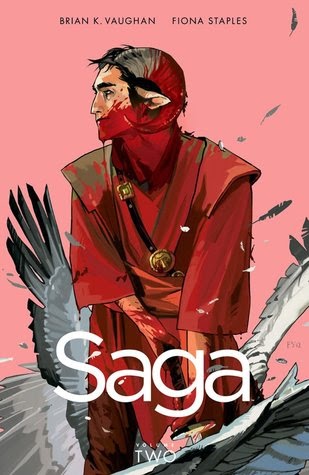
Saga, Volumes 1 and 2

Summary from Goodreads:
When two soldiers from opposite sides of a never-ending galactic war fall in love, they risk everything to bring a fragile new life into a dangerous old universe.

From New York Times bestselling writer Brian K. Vaughan (Y: The Last Man, Ex Machina) and critically acclaimed artist Fiona Staples (Mystery Society, North 40), Saga is the sweeping tale of one young family fighting to find their place in the worlds. Fantasy and science fiction are wed like never before in this sexy, subversive drama for adults.

To paraphrase from one of my Tweets, I wondered what the heck was up with people in Saga who have TVs for heads, to which a friend replied, "Doesn't matter.  Keep reading."

Aye-aye!

In short, Saga, which I didn't get into in single issues and for which I should castigate myself, is pretty much the most amazing space opera combined with Romeo and Juliet.  Volume 1 starts with the birth of the narrator Hazel, backs up a bit to fill in the backstory of her parents and the inter-galactic war that brought them together (spoiler: a book is involved!), and then goes forward to try and get them off the backwater planet.  Which involves a ghost babysitter and a tree that turns into a spaceship.

Head trip. Head trip. Head trip.Head trip. Head trip.

There's also a hit-man who gets side-tracked by a little girl (?) in a brothel.  He also has a sidekick known as a Lying Cat.  Legit, it is a cat that says "Lying" when other characters lie.  Want.

Summary from Goodreads:
From award-winning writer BRIAN K. VAUGHAN (Pride of Baghdad, Ex Machina) and critically acclaimed artist FIONA STAPLES (Mystery Society, Done to Death), SAGA is sweeping tale of one young family fighting to find their place in the universe. Thanks to her star-crossed parents Marko and Alana, newborn baby Hazel has already survived lethal assassins, rampaging armies, and horrific monsters, but in the cold vastness of outer space, the little girl encounters her strangest adventure yet... grandparents.

So Marko, Alana, Hazel, and the ghost babysitter have escaped into space.  Except their spaceship is invaded by Marko's grandparents who tracked them using some special powers.  Marko's old fiancee (oops) is also tracking him because the wedding rings he and Alana are using have some connection to the fiancee's family (double oops).

An asteroid turns out to be a giant egg - wow - and Marko's dad is a tailor.

I love the concept of how a really big spell takes acknowledgement of a secret no one else knows - one of them is really funny and one very sad in how realistic those secrets are.  Which is a great comment about the series: no matter how cracked-out and science-fiction-y the setting the story at the center is one of a family trying to stay together across a cultural/racial divide.  I love it.

Now, when does Volume 3 come out?

02 February 2014

Georgette Heyer's Regency World

Summary from Goodreads:
Immerse yourself in the resplendent glow of Regency England and the world of Georgette Heyer…

From the fascinating slang, the elegant fashions, the precise ways the bon ton ate, drank, danced, and flirted, to the shocking real life scandals of the day, Georgette Heyer’s Regency World takes you behind the scenes of Heyer’s captivating novels.

As much fun to read as Heyer’s own novels, beautifully illustrated, and meticulously researched, Jennifer Kloester’s essential guide brings the world of the Regency to life for Heyer fans and Jane Austen fans alike.

Georgette Heyer's Regency World is a very good overview of cultural norms, home life, habits, clothing, and etc. of the Regency period used in the novels of Georgette Heyer.  It can also explain some things in Austen's novels because she assumes her readers already know her own customs so doesn't over describe. It's very readable. However, many "examples" tend to use characters from Heyer novels (such as the Taverners and Lord Worth from the book Regency Buck) to explain everyday situations. Just be careful that the real people and the novel characters don't mix up in your head (it happened once or twice with me - I was a bit at lost because I've only read a few of Heyer's Regency novels as opposed to her Georgian novels which don't make an appearance here).

27 January 2014

The People in the Trees

Summary from Goodreads:
In 1950, a young doctor called Norton Perina signs on with the anthropologist Paul Tallent for an expedition to the remote Micronesian island of Ivu'ivu in search of a rumored lost tribe. They succeed, finding not only that tribe but also a group of forest dwellers they dub "The Dreamers," who turn out to be fantastically long-lived but progressively more senile. Perina suspects the source of their longevity is a hard-to-find turtle; unable to resist the possibility of eternal life, he kills one and smuggles some meat back to the States. He scientifically proves his thesis, earning worldwide fame and the Nobel Prize, but he soon discovers that its miraculous property comes at a terrible price. As things quickly spiral out of his control, his own demons take hold, with devastating personal consequences.

Tournament of Books 2014!

So, I'm a scientist, I know lots of scientists, therefore, I decided to go with Hanya Yanagihara's The People in the Trees as my next pick for the TOB.

And it was good. Yanagihara is a very good writer and I'd like to see more from her but I just didn't care about the protagonist. He's supposed to be unlikeable, which is fine, but Perina is also boring as hell.  By the end of the first section of his "memoir" I was waiting for his personality to change and it doesn't.  He remains the same arrogant, pedantic, closeted, privileged-white-male asshat he was at the beginning.  I've worked with people like that - those brilliant people who could easily slide into sociopathy - so I just kept rolling my eyes because so much of Perina's narrative felt like something I'd heard before.  Perina is also so closely patterned on the real-life person (Carleton Gajdusek), right down to the Nobel win, that it felt a bit re-hashed because I read up on that guy for a discussion of ethics.  Yanagihara did raise some interesting thoughts on Western interference with newly discovered "lost" tribes and moral relativism when looking at a tribe's cultural practices from a Western perspective but I felt they could have been expanded more had we not been stuck in Perina's voice for so much of the book.  It felt very limited given that we only get Perina's viewpoint and occasionally those of his sycophantic "editor".

And then there was an "Epilogue"....and that pretty much ruined the book.  Epilogues are bad news for some novels.

26 January 2014

The Dept of Speculation

Summary from Goodreads:
Jenny Offill’s heroine, referred to in these pages as simply “the wife,” once exchanged love letters with her husband, postmarked Dept. of Speculation, their code name for all the uncertainty that inheres in life and in the strangely fluid confines of a long relationship. As they confront an array of common catastrophes—a colicky baby, bedbugs, a faltering marriage, stalled ambitions—the wife analyzes her predicament, invoking everything from Keats and Kafka to the thought experiments of the Stoics to the lessons of doomed Russian cosmonauts. She muses on the consuming, capacious experience of maternal love, and the near total destruction of the self that ensues from it, as she confronts the friction between domestic life and the seductions and demands of art.

With cool precision, in language that shimmers with rage and wit and fierce longing, Jenny Offill has crafted an exquisitely suspenseful love story that has the velocity of a train hurtling through the night at top speed. Exceptionally lean and compact, Dept. of Speculation can be read in a single sitting, but there are enough bracing emotional insights in these pages to fill a much longer novel.

The above blurb is kind of a bust.  I was anticipating an epistolary novel filled with these mysterious letters addressed to "Dept of Speculation."  But, no.  The actual letter-writing isn't referred to until probably halfway through the book so if you really, really want an epistolary novel The Dept of Speculation isn't it.

However....

Jenny Offill has written a tiny, gem-like novel (or novella, wherever your length cut-off for novellas happens to be) about a woman's perspective on her life as she moves from student to girlfriend to wife to mother and how it impacts her intention to make some really great art.  It is some of the best 120 pages of writing I've ever read. I would exactly call it stream-of-consciousness in the way that Mrs. Dalloway is a stream-of-consciousness novel but portion are just like being stuck inside someone's head.

My favorite line:
"I think I was afraid to go all in," she says.  "Because all in is terrifying.  With all in, you lose everything."
Agreed.  Going all in on a relationship is the most terrifying thing on Earth.

Dear FTC: I received a DRC of this book from the publisher via Edelweiss.

20 January 2014

Romancing the Duke (Castles Ever After #1) by Tessa Dare

Summary from Goodreads:
In the first in Tessa Dare's captivating Castles Ever After series, a mysterious fortress is the setting for an unlikely love . . .

As the daughter of a famed author, Isolde Ophelia Goodnight grew up on tales of brave knights and fair maidens. She never doubted romance would be in her future, too. The storybooks offered endless possibilities.

And as she grew older, Izzy crossed them off. One by one by one.

Ugly duckling turned swan?
Abducted by handsome highwayman?
Rescued from drudgery by charming prince?

No, no, and… Heh.

Now Izzy’s given up yearning for romance. She’ll settle for a roof over her head. What fairy tales are left over for an impoverished twenty-six year-old woman who’s never even been kissed?

This one.

The Castles Ever After series is centered around one premise: than an eccentric old man bequeathed to each of four young, women, his goddaughters, an entire castle (castle! real castle!).  In the first novel, Romancing the Duke, impoverished, orphaned Izzy Goodnight, daughter of the celebrated author of The Goodnight Tales, a fairy tale series, arrives (or, more properly, is delivered in less-than-ideal circumstances) at her newly inherited castle, Gostley Castle, in Northumberland.  This is her last, best hope to keep a roof over her head.  The castle, surprisingly, is inhabited.  Not by a prince, but by a rough, growling, reclusive male who claims to be Ransom, the Duke of Rothbury.  Incidentally, he claims to be the owner of Izzy's castle.

"Oh, dear.  She did have such a weakness for a pair of well-traveled boots.  They made her desperate to know everywhere they'd been."

Izzy and Ransom begin a very delicate dance to negotiate who actually owns the castle.  And who lives there.  And who will discover whose secrets first.  Izzy has a fabulous one, Ransom's has more to do with his male ego.  As a stop-gap, Izzy begins working as a secretary of-sorts for Ransom.  Since he was blinded through injury, he has holed up in his castle and ignored the world.  Izzy brings the world to him.  Literally.  Fans of her father's Goodnight Tales follow Izzy to Gostley Castle and nothing is the same again.

Romancing the Duke doesn't sparkle quite like the final novel in the Spindle Cove series (quite literally, since Pauline had a run-in with a sugar bin in Any Duchess Will Do) but that doesn't make it any less witty or swoony. It's a little bit Beauty and the Beast and a little bit King Arthur and the Knights of the Round Table and quite funny in places.  Romancing the Duke focuses on the power of belief and fairy tales and dreams - there are Regency cosplayers, y'all. I can't wait to see what stories we get for the other three Castles.

If you read the "impossible/ridiculous sex scenes" post from Smart Bitches a few weeks ago, you will almost die laughing about a certain sex position that is awkward. And someone mentions chickens, chickens, chickens, chickens. And there's an ermine (ok, the ermine isn't an euphemism, it's a real ermine).

Loved it.

Dear FTC: I received a DRC of this novel from the publisher via Edelweiss.

18 January 2014

An Elegant Madness: High Society in Regency England

Summary from Goodreads:
The Regency period was one of the most turbulent ages in British history, one that spanned the French Revolution and the Napoleonic Wars, that witnessed unprecedented industrial progress, artistic accomplishment, and violent social unrest and--paradoxically--the most sparkling social scene English high society has ever enjoyed. Under the influence of the obese, loose-moraled Prince of Wales (to whom Jane Austen dedicated Emma), the Regency was the apex of British decadence, an era of lavish parties and relentless bed-hopping that set a standard for elegance and vulgarity. With wit and lively style, Venetia Murray chronicles the scandals, courtships, and daily life of these aristocrats, and evokes the tempestuous times of the early industrial and French revolutions. Sumptuously illustrated with rare contemporary cartoons, prints, diaries, and caricatures, An Elegant Madness is a book readers of social history and historical romance alike will devour.

Well, since I started writing again, I've had some ongoing story ideas. One of these is set in the Regency and I realized that, since I loathe sloppy historical research, I better do some background reading so I at least start out on the right foot.  You'd think I had already done this given my love of Jane Austen and my concentration in Regency historicals when I read romance novels, but I haven't.  I took a bit of a shotgun approach and rounded up a list of titles, starting with Venetia Murray's An Elegant Madness.

This is a nice book.  It covers major parts of the Regency culture - manners, marriages, views on morality, money, inheritance, food, clothing, etc.  The larger-than-life historical figures of the era - led by the very large Prinny himself - are visited in turn.  The Patronesses of Almack's pop up frequently through their many letters and a number of caricatures and engravings are used to illustrate how the masses viewed High Society.

But the book did feel somewhat jumbled.  Chapters sometimes seemed to veer from the subject - a later chapter about country houses moved from house parties, to how children were raised, to the beginning of the Reform movement which was a bit hard to follow.  The annotation could have been better, in my opinion.  Footnotes and endnotes were used for sources but instances of quotes in French were not translated (Google Translate has trouble with idioms) and an entire menu from one of Prinny's fetes, over 100 dishes, was listed in French.  It was very hard to read, since I don't speak or read French fluently, so the necessity of including the entire menu was lost on me.  I would have appreciated a translation in an appendix.

This is a decent overview for the curious reader, but research-wise I'll need to keep digging.

13 January 2014

A Tale for the Time Being

Summary from Goodreads:
"A time being is someone who lives in time, and that means you, and me, and every one of us who is, or was, or ever will be.”

In Tokyo, sixteen-year-old Nao has decided there’s only one escape from her aching loneliness and her classmates’ bullying. But before she ends it all, Nao first plans to document the life of her great grandmother, a Buddhist nun who’s lived more than a century. A diary is Nao’s only solace—and will touch lives in ways she can scarcely imagine.

Across the Pacific, we meet Ruth, a novelist living on a remote island who discovers a collection of artifacts washed ashore in a Hello Kitty lunchbox—possibly debris from the devastating 2011 tsunami. As the mystery of its contents unfolds, Ruth is pulled into the past, into Nao’s drama and her unknown fate, and forward into her own future.

Full of Ozeki’s signature humor and deeply engaged with the relationship between writer and reader, past and present, fact and fiction, quantum physics, history, and myth, A Tale for the Time Being is a brilliantly inventive, beguiling story of our shared humanity and the search for home.

Since I decided to try to read the Tournament of Books finalists, I knew that the first book I would go for was A Tale for the Time Being by Ruth Ozeki.  It came up on my radar with the announcement of the Booker Prize finalists and I loved the "voice" when I heard an excerpt read by Ozeki on a Guardian Books podcast.  I am kicking myself for not reading it earlier.

A teenage girl in Tokyo, Naoko, begins writing in a diary with the intention of chronicling the life of her great-grandmother.  On an island off the coast of British Columbia a novelist and filmmaker, Ruth, finds a freezer bag filled with something washed up on shore.  Her curious husband Oliver opens the bag to find a diary, packet of letters, and man's watch carefully packed into a Hello Kitty lunchbox.  It is possible that these items were washed out to sea during the 2011 tsunami which had happened only a few weeks prior.  Although Ruth tries to avoid it, she becomes drawn into Nao's story - her life in Tokyo now, her life growing up in California, and her family history.  The two storylines alternate, running almost parallel, until they converge in a very unexpected way.

What makes this book so readable are the two voices of Nao and Ruth and the idea that "Ruth" is telling both stories.  She has annotated Nao's diary regarding Japanese words and cultural norms so that we as readers are almost in the place of Oliver, listening to his wife read from Nao's diary or the letters and journal found with the diary.  It feels intensely personal.  I had some righteous anger and concern, the same as Ruth, regarding the horrors of Nao's experience with school bullies.  It was awful and humiliating and Nao had little visible support at home, and none from the school since it was implied that the teacher was tacitly complicit in the abuse if he wanted to keep his job.  I was firmly on Ruth's side when Oliver pointed out that all the events in the diary were in the past, had already happened, and that Ruth's worry and concern for Nao may turn out to be moot in the end.  Nao was crying for help and the space of time doesn't negate our concern.

Admittedly, I was skeptical when I realized the "Ruth" in the book was the Ruth who wrote the book - it's her basic biography, her husband, her cat, her island, her parents who appear as characters as well as Ruth herself.  It could have felt forced or twee but it works perfectly, I think simply because the storyline of Nao's diary is allowed to inform the storyline of "Ruth" as she reads the diary.  Obviously, Nao is a fictional construct and the specific events in Ruth's storyline were created for the novel, but I found myself wondering how closely the book characters resembled their real-life originals and what those people felt about being a character in a novel, if they cared at all.

I loved the idea of time as conveyed throughout the book.  It does not stop and we all live in time but if we do not actually live in all the millions of moments in each day we won't appreciate those moments.  Ruth Ozeki is a Zen Bhuddist priest and brings so much of that knowledge to bear on the story, particularly through the character of Jiko, Nao's great-grandmother, and how she tries to give Nao a way to navigate her life.  It starts right with the title of the book - yes, this is a tale for the "time being", as a way to pass the time, but also echoing the words of Dogen Zenji in that we are all "time beings", physical beings present in time.  So mind-expanding, for someone (like me) who really hasn't read or thought about Bhuddist philosophy before.

On top of all this, the actual sentence-level construction of the book is just lovely.  I have a tattered little quote journal and I added several favorite lines while reading A Tale for the Time Being:

When her attention was disengaged and fractured, she experienced time at its most granular, wherein moments hung around like particles, diffused and suspended in standing water. (p 91)

I was still thinking about what she said about waves; and it made me sad because I knew that her little wave was not going to last and soon she would join the sea again, and even though i know you can't hold onto water, still I gripped her fingers a little more tightly to keep her from leaking away. (p 195)

...but memories are time beings, too, like cherry blossoms or ginko leaves; for a while they are beautiful, and then they fade and die. (p 390)

And finally, one from p 42, that I had to photograph since I'm not sure how to get Japanese characters into a post:


Beautiful.

A Tale for the Time Being is a definitely recommend, likely one of my favorite books this year and it's only January.

Dear FTC: I purchased a copy of this book.

08 January 2014

New Challenge: The 2014 Tournament of Books

Or, Rooster X, given the artwork and anniversary.

This year marks the tenth offering of The Tournament of Books by The Morning News.  Some might call this March Madness for bookworms.  I've always kind of followed it but never really made and effort to get all the books read so I could actually participate.


Well, in the spirit of reading widely, I decided to give it a shot this year.  TMN announced the finalists yesterday:
    • At Night We Walk in Circles by Daniel Alarcón
    • The Luminaries by Eleanor Catton
    • The Tuner of Silences by Mia Couto
    • The Signature of All Things by Elizabeth Gilbert
    • How to Get Filthy Rich in Rising Asia by Mohsin Hamid
    • The Dinner by Herman Koch
    • The Lowland by Jhumpa Lahiri
    • Long Division by Kiese Laymon
    • The Good Lord Bird by James McBride
    • Hill William by Scott McClanahan
    • The Son by Philipp Meyer
    • A Tale for the Time Being by Ruth Ozeki 
    • Eleanor & Park by Rainbow Rowell 
    • The Goldfinch by Donna Tartt
    • The People in the Trees by Hanya Yanagihara
    • Pre-Tournament Playoff Round
      • Life After Life by Kate Atkinson
      • Woke Up Lonely by Fiona Maazel
So, 17 books in about three months (going to try for the end of March to get them all read - that's a lot of pages there, especially with The Goldfinch and The Luminaries).

I've already read Eleanor & Park, so that's one down.  My next two up are A Tale for the Time Being and The People in the Trees.  Off I go!