Summary from Goodreads:
Having made a fortune, Thorn Dautry, the powerful bastard son of a duke, decides that he needs a wife. But to marry a lady, Thorn must acquire a gleaming, civilized façade, the specialty of Lady Xenobia India.
Exquisite, head-strong, and independent, India vows to make Thorn marriageable in just three weeks.
But neither Thorn nor India anticipate the forbidden passion that explodes between them.
Thorn will stop at nothing to make India his. Failure is not an option.
But there is only one thing that will make India his—the one thing Thorn can't afford to lose...
His fierce and lawless heart.
Eloisa James’s readers will last remember Tobias Dautry (aka Juby, his unfortunate mudlark moniker), illegitimate son of the Duke of Villiers and an opera singer, as a fastidious Oxford scholar holding his baby half-brother on his step-mother’s birthday in the Epilogue for A Duke of Her Own. Eight years have passed since then and now Tobias prefers the name “Thorn.” He is a “chip off the old duke” – ruthless, brilliant, stubborn, dangerous, black of hair streaked with white, and rich beyond imagination but, unfortunately for Thorn’s matrimonial prospects, still not rich enough to completely erase the fact that his parents were never married or erase the childhood experience of mucking in the dangerous waters of the Thames under a cruel master. Thorn has found the perfect lady, Miss Laetitia Rainsford, to keep his house and bear beautiful legitimate children but her too-high-in-the-instep mother needs to agree to the match. To this end he has purchased Starberry Court, the (infamous) residence of a deceased aristocrat, and needs it redecorated in such a manner as to sway Lady Rainsford.
And when a member of the aristocracy requires a household to be lavishly updated and put to rights, they call upon Lady Xenobia India St. Clair to work her magic. Although the short timetable of three weeks might seem impossible, India, the formerly impoverished daughter of an eccentric marquess, finds the house itself - questionable statuary and all - a far easier task than its enticing owner. India and Thorn clash over proprieties, beginning a dizzying round of messages. He teases her about extravagances (painted swallows on the dining room wall! knitted stockings!), she responds by usurping furniture crafted for other patrons at an exorbitant price while ignoring innuendo meant to get a rise out of her (it occasionally works). Before long, Thorn and India are locked in a problem of their own making: how to love and trust when the only person you could truly count on was yourself.
Eloisa James has returned to her acclaimed Desperate Duchesses series with a new installment for the next generation. Thorn and India spar and poke and annoy and argue and have searing make-up sex and confess (they are the Spencer Tracy and Katherine Hepburn of 1799 – if you haven’t seen Pat and Mike or Adam’s Rib, I highly recommend them for the way Tracy and Hepburn just dig at each other with words) and just fall head-over-heels for each other even though the sudden realization of “love” just doesn’t fall in with the plan: get Lady Rainsford to agree to an engagement between Thorn and Laetitia while India will finish her last job at Starberry Court and then get married to someone else. Even some very sage, though veiled, advice from the Duke of Villiers fails to help the lovers sort themselves out. The eventual resolution is very worthy of a batch of soggy Kleenex.
Alongside the hero and heroine, Eloisa stocks her book with fabulous characters. Thorn is the guardian of the orphaned Rose, daughter of one of his band of mudlarks, and a child with such an intelligent, old soul she is an immediate foil for both Thorn and India. Thorn also has a best friend, Vander, who will inherit a dukedom but has a dark childhood of his own. India’s chatty, sweet godmother Lady Adelaide is a dear. Laetitia has a secret and a fantasy that may never come true. She also, unfortunately, has a mother who is the worst combination of Mrs. Bennet, Lady Catherine, and Mrs. Norris (just to mix our Austen references – Eloisa has scattered several throughout the book) and on the receiving end of one of the best lines in the entire book.
That line is uttered by Eleanor, the Duchess of Villiers (the Duke of Villiers gets my second favorite line). I was beyond delighted to find Eleanor and Villiers included in a good chunk of plot. They are my favorite Eloisa couple, both with very smart, distinctive voices. They make me smile. She could write them into all her books and I’d be a happy, happy reader (I may get my wish since I think some of the other Villiers children may feature in future books). Three Weeks with Lady X is out TODAY from your favorite bookseller. Run, do not walk, to the store or your e-reading device/app of choice and BUY THIS BOOK. Happy reading!
25 March 2014
19 March 2014
Sex Criminals, #1-#5
So one day I'm just browsing through my Tumblr feed when lo, Wil Wheaton posts about a new comic - Sex Criminals - that just got the big "middle finger" from the iTunes store. It is apparently full of TOO MUCH GRAPHIC SEX and they won't carry it in the iBooks store anymore. So Wil told everyone to go pick up the first issue free on Comixology (it's still free, bonus) and then, if you liked what you read, subscribe to it because, here's the trick, if you buy it from Comixology directly then it syncs to your iOS app without having to go through the iBooks store.
I'd never tried the Comixology app but I'd heard good things so I decided this was worth giving it a try just for this comic. Every review I'd come across said that not only was Sex Criminals wickedly funny it was also very sex-positive and well-constructed.
You guys. YOU GUYS. Sex Criminals is probably one of the best things I've read this year ("year" meaning 2013 and 2014 since I started the series back in November). It is wickedly funny and honest and naughty and original. If you haven't heard the story, the first issue opens with Suzie and John caught in the middle of a bank heist. Oops. From there Suzie breaks the fourth wall to tell her story, one that opens with a less-than-ideal childhood. When Suzie accidentally learns time freezes when she orgasms - something she calls "The Quiet" - she tries to learn why (probably the best three pages of why we fail children occur while Suzie tries to find honest, non-judgmental answers to her questions about sexuality from adults). Suzie narrates her coming-of-age with a wry wit until she meets John - who has the same miraculous ability that she has.... John takes over the narration in issue two as the past and present storylines gradually merge together until they run head-on in issue five.
Matt Fraction and Chip Zdarsky hit it out of the park with this series. It's a Bonnie-and-Clyde meets pre-code Lubitsch sex comedy with a healthy dose of amazing illustration and equal-opportunity sex jokes. I mean, look at the issue titles: "Suzie Down in the Quiet," "Come, World", "My Sexual Errors and Misfortunes: 2001 - Present," "Sex Police," and "Going Down." Chip and Matt included batches of reader mail at the end of each issue and they are so honest in their answers that it's worth the subscription alone just for the letters. The comic feels like a bonus. The trade volume issue of #1-5 is coming out April 16 and I can't wait to see what little extras and differences are included.
A note about content:
Now, yes, this is a comic intended for adults. It is adult humor and for that reason isn't supposed to be sold to minors (the last page of each issue has a big disclaimer about that). That said, there are a great deal of well-drawn and well-thought out situations that could spark some good discussion. A major point I want to make is that there is NO sexual violence - not toward women, not toward homosexuals, not toward minorities, and not toward men (John does get punched in the face by one of the Sex Police but that's not anything to do with sex). The sex and curiosity about sex depicted in Sex Criminals is presented as healthy and normal. It's not for children (they wouldn't understand much of the dialogue anyway) but for a high school-aged teen they could probably identify with the weirdness that goes along with figuring out what's "normal" when it comes to learning about your sexuality. As to the Apple thing, they're just a bunch of hypocrites. Look at how many Chris Brown and Robin Thicke albums or erotic romance/new adult books or comics that depict overly-busty, scantily-clad women that they sell. They don't really have a leg to stand on - so I am more than happy to buy through Comixology.
I'd never tried the Comixology app but I'd heard good things so I decided this was worth giving it a try just for this comic. Every review I'd come across said that not only was Sex Criminals wickedly funny it was also very sex-positive and well-constructed.
You guys. YOU GUYS. Sex Criminals is probably one of the best things I've read this year ("year" meaning 2013 and 2014 since I started the series back in November). It is wickedly funny and honest and naughty and original. If you haven't heard the story, the first issue opens with Suzie and John caught in the middle of a bank heist. Oops. From there Suzie breaks the fourth wall to tell her story, one that opens with a less-than-ideal childhood. When Suzie accidentally learns time freezes when she orgasms - something she calls "The Quiet" - she tries to learn why (probably the best three pages of why we fail children occur while Suzie tries to find honest, non-judgmental answers to her questions about sexuality from adults). Suzie narrates her coming-of-age with a wry wit until she meets John - who has the same miraculous ability that she has.... John takes over the narration in issue two as the past and present storylines gradually merge together until they run head-on in issue five.
Matt Fraction and Chip Zdarsky hit it out of the park with this series. It's a Bonnie-and-Clyde meets pre-code Lubitsch sex comedy with a healthy dose of amazing illustration and equal-opportunity sex jokes. I mean, look at the issue titles: "Suzie Down in the Quiet," "Come, World", "My Sexual Errors and Misfortunes: 2001 - Present," "Sex Police," and "Going Down." Chip and Matt included batches of reader mail at the end of each issue and they are so honest in their answers that it's worth the subscription alone just for the letters. The comic feels like a bonus. The trade volume issue of #1-5 is coming out April 16 and I can't wait to see what little extras and differences are included.
A note about content:
Now, yes, this is a comic intended for adults. It is adult humor and for that reason isn't supposed to be sold to minors (the last page of each issue has a big disclaimer about that). That said, there are a great deal of well-drawn and well-thought out situations that could spark some good discussion. A major point I want to make is that there is NO sexual violence - not toward women, not toward homosexuals, not toward minorities, and not toward men (John does get punched in the face by one of the Sex Police but that's not anything to do with sex). The sex and curiosity about sex depicted in Sex Criminals is presented as healthy and normal. It's not for children (they wouldn't understand much of the dialogue anyway) but for a high school-aged teen they could probably identify with the weirdness that goes along with figuring out what's "normal" when it comes to learning about your sexuality. As to the Apple thing, they're just a bunch of hypocrites. Look at how many Chris Brown and Robin Thicke albums or erotic romance/new adult books or comics that depict overly-busty, scantily-clad women that they sell. They don't really have a leg to stand on - so I am more than happy to buy through Comixology.
18 March 2014
Science Fiction: The Best 101 Novels 1985 - 2010
Summary from Goodreads:
Inspired by David Pringle's landmark 1985 work Science Fiction: The 100 Best Novels, this volume supplements the earlier selection with the present authors' choices for the best English-language science fiction novels during the past quarter century. Employing a critical slant, the book provides a discussion of the novels and the writers in the context of popular literature. Moreover, each entry features a cover image of the novel, a plot synopsis, and a mini review, making it an ideal go-to guide for anyone wanting to become reacquainted with an old favorite or to discover a previously unknown treasure. With a foreword by David Pringle, this invaluable reference is sure to provoke conversation and debates among sci-fi fans and devotees.
There isn't a whole lot to say about this book. It's a good list of science fiction (not fantasy) books for those who might need an entree into the genre. Like me - I've only read 3.5 of the entries so have found a number of books to check out here. And there are definitely more than just 101 books since some entries cover more than 1 book; I don't think authors are ever duplicated so this is more like 101 authors from 1985-2010. Beware of spoilers, though, since more than one reveal was blown in the summary.
Drawbacks: some of the cover art was from non-us editions, so may not be useful if searching for the book, and the print was too small.
Dear FTC: I purchased my copy of this book.
Inspired by David Pringle's landmark 1985 work Science Fiction: The 100 Best Novels, this volume supplements the earlier selection with the present authors' choices for the best English-language science fiction novels during the past quarter century. Employing a critical slant, the book provides a discussion of the novels and the writers in the context of popular literature. Moreover, each entry features a cover image of the novel, a plot synopsis, and a mini review, making it an ideal go-to guide for anyone wanting to become reacquainted with an old favorite or to discover a previously unknown treasure. With a foreword by David Pringle, this invaluable reference is sure to provoke conversation and debates among sci-fi fans and devotees.
There isn't a whole lot to say about this book. It's a good list of science fiction (not fantasy) books for those who might need an entree into the genre. Like me - I've only read 3.5 of the entries so have found a number of books to check out here. And there are definitely more than just 101 books since some entries cover more than 1 book; I don't think authors are ever duplicated so this is more like 101 authors from 1985-2010. Beware of spoilers, though, since more than one reveal was blown in the summary.
Drawbacks: some of the cover art was from non-us editions, so may not be useful if searching for the book, and the print was too small.
Dear FTC: I purchased my copy of this book.
12 March 2014
Longbourn
Summary from Goodreads:
• Pride and Prejudice was only half the story •
If Elizabeth Bennet had the washing of her own petticoats, Sarah often thought, she’d most likely be a sight more careful with them.
In this irresistibly imagined belowstairs answer to Pride and Prejudice, the servants take center stage. Sarah, the orphaned housemaid, spends her days scrubbing the laundry, polishing the floors, and emptying the chamber pots for the Bennet household. But there is just as much romance, heartbreak, and intrigue downstairs at Longbourn as there is upstairs. When a mysterious new footman arrives, the orderly realm of the servants’ hall threatens to be completely, perhaps irrevocably, upended.
Jo Baker dares to take us beyond the drawing rooms of Jane Austen’s classic—into the often overlooked domain of the stern housekeeper and the starry-eyed kitchen maid, into the gritty daily particulars faced by the lower classes in Regency England during the Napoleonic Wars—and, in doing so, creates a vivid, fascinating, fully realized world that is wholly her own.
The servants are never mentioned in period literature except when absolutely necessary. They were a bit like the wallpaper - always there but meant to be seen not heard. Which is why Jo Baker's Longbourn caught my eye - not only a great way to write Pride and Prejudice fiction in a way that hasn't been done before but it also contained a great deal of research about what life was like for the servants of landed gentry. Our protagonist at the outset is Sarah, one of the maids-of-all-work for the Bennets. She fetches water for washing and laundry, scrubs the dishes and the furniture, helps with the cooking, and plays ladies' maid as needed to the five Bennet daughters. She is up well before dawn and does not go to bed until after the family has retired. Her hands are permanently cracked, dry, and blistered with chilblains. It is not an easy life but one that comes with solid meals and a roof, and security especially if Mrs. Hill and the staff impress Mr. Collins so that he might keep them on after Mr. Bennet passes.
The plot dovetails with Austen's original in many ways, even to the point of providing Sarah with the choice of two beaus: James, the new footman, and Ptolemy Bingley, a biracial servant with the Bingleys who has entrepreneurial aspirations. Backstories provided for Mr. and Mrs. Bennet and Mr. and Mrs. Hill create a more tangled set of relationships than Austen would have ever revealed on her bit of ivory. I think someone not familiar with Pride and Prejudice would enjoy this novel, especially if exploring upstairs-downstairs fiction that has become more popular since Downton Abbey began airing. I'm probably not the best judge because I own eight copies of P&P and have read it so many times I've lost count.
Austenesque-plot aside, the whole thing was going swimmingly until two things kicked it out of kilter. The first was a confrontation between James and Wickham and that fallout (I did enjoy how Baker carries Wickham's behavior to a logical place given his predilections); the second, and more troubling, issue came after the Bingley-Bennet/Darcy-Bennet double wedding. Lizzie takes Sarah with her as her lady's maid and after some kvetching from Sarah about how she's possibly going soft from less work and worry about [spoiler] she resigns her position to go searching for [spoiler]. I'm not sure the point of all the wandering about for years and extended "epilogue"-ness of those last pages (it extends decades into the future beyond P&P and even, i think, beyond the actual concluding action of Longbourn. Although it all seemed very much about agency and freedom and free will, I don't know why it had to take so long and it took away from the end of the book.
Ending aside, Longbourn is an excellent addition to the Austen fanfic-rewrite-reimagining genre. Definitely a great book for fans of Pride and Prejudice as well as those who like good historical research into the everyday nitty-gritty.
• Pride and Prejudice was only half the story •
If Elizabeth Bennet had the washing of her own petticoats, Sarah often thought, she’d most likely be a sight more careful with them.
In this irresistibly imagined belowstairs answer to Pride and Prejudice, the servants take center stage. Sarah, the orphaned housemaid, spends her days scrubbing the laundry, polishing the floors, and emptying the chamber pots for the Bennet household. But there is just as much romance, heartbreak, and intrigue downstairs at Longbourn as there is upstairs. When a mysterious new footman arrives, the orderly realm of the servants’ hall threatens to be completely, perhaps irrevocably, upended.
Jo Baker dares to take us beyond the drawing rooms of Jane Austen’s classic—into the often overlooked domain of the stern housekeeper and the starry-eyed kitchen maid, into the gritty daily particulars faced by the lower classes in Regency England during the Napoleonic Wars—and, in doing so, creates a vivid, fascinating, fully realized world that is wholly her own.
The servants are never mentioned in period literature except when absolutely necessary. They were a bit like the wallpaper - always there but meant to be seen not heard. Which is why Jo Baker's Longbourn caught my eye - not only a great way to write Pride and Prejudice fiction in a way that hasn't been done before but it also contained a great deal of research about what life was like for the servants of landed gentry. Our protagonist at the outset is Sarah, one of the maids-of-all-work for the Bennets. She fetches water for washing and laundry, scrubs the dishes and the furniture, helps with the cooking, and plays ladies' maid as needed to the five Bennet daughters. She is up well before dawn and does not go to bed until after the family has retired. Her hands are permanently cracked, dry, and blistered with chilblains. It is not an easy life but one that comes with solid meals and a roof, and security especially if Mrs. Hill and the staff impress Mr. Collins so that he might keep them on after Mr. Bennet passes.
The plot dovetails with Austen's original in many ways, even to the point of providing Sarah with the choice of two beaus: James, the new footman, and Ptolemy Bingley, a biracial servant with the Bingleys who has entrepreneurial aspirations. Backstories provided for Mr. and Mrs. Bennet and Mr. and Mrs. Hill create a more tangled set of relationships than Austen would have ever revealed on her bit of ivory. I think someone not familiar with Pride and Prejudice would enjoy this novel, especially if exploring upstairs-downstairs fiction that has become more popular since Downton Abbey began airing. I'm probably not the best judge because I own eight copies of P&P and have read it so many times I've lost count.
Austenesque-plot aside, the whole thing was going swimmingly until two things kicked it out of kilter. The first was a confrontation between James and Wickham and that fallout (I did enjoy how Baker carries Wickham's behavior to a logical place given his predilections); the second, and more troubling, issue came after the Bingley-Bennet/Darcy-Bennet double wedding. Lizzie takes Sarah with her as her lady's maid and after some kvetching from Sarah about how she's possibly going soft from less work and worry about [spoiler] she resigns her position to go searching for [spoiler]. I'm not sure the point of all the wandering about for years and extended "epilogue"-ness of those last pages (it extends decades into the future beyond P&P and even, i think, beyond the actual concluding action of Longbourn. Although it all seemed very much about agency and freedom and free will, I don't know why it had to take so long and it took away from the end of the book.
Ending aside, Longbourn is an excellent addition to the Austen fanfic-rewrite-reimagining genre. Definitely a great book for fans of Pride and Prejudice as well as those who like good historical research into the everyday nitty-gritty.
11 March 2014
Lexicon
Summary from Goodreads:
At an exclusive school somewhere outside of Arlington, Virginia, students aren't taught history, geography, or mathematics--at least not in the usual ways. Instead, they are taught to persuade. Here the art of coercion has been raised to a science. Students harness the hidden power of language to manipulate the mind and learn to break down individuals by psychographic markers in order to take control of their thoughts. The very best will graduate as "poets", adept wielders of language who belong to a nameless organization that is as influential as it is secretive. Whip-smart orphan Emily Ruff is making a living running a three-card Monte game on the streets of San Francisco when she attracts the attention of the organization's recruiters. She is flown across the country for the school's strange and rigorous entrance exams, where, once admitted, she will be taught the fundamentals of persuasion by Bronte, Eliot, and Lowell--who have adopted the names of famous poets to conceal their true identities.
Meanwhile, a seemingly innocent man named Wil Jamieson is brutally ambushed by two strange men in an airport bathroom. Although he has no recollection of anything they claim he's done, it turns out Wil is the key to a secret war between rival factions of poets and is quickly caught in their increasingly deadly crossfire. Pursued relentlessly by people with powers he can barely comprehend and protected by the very man who first attacked him, Wil discovers that everything he thought he knew about his past was fiction. In order to survive, must journey to the toxically decimated town of Broken Hill, Australia, to discover who he is and why an entire town was blown off the map.
As the two narratives converge, the shocking work of the poets is fully revealed, the body count rises, and the world crashes toward a Tower of Babel event which would leave all language meaningless. Max Barry's most spellbinding and ambitious novel yet, Lexicon is a brilliant thriller that explores language, power, identity, and our capacity to love--whatever the cost.
So I had a coupon and decided to buy this back in November, actually chuckling to myself in the store, "Wouldn't it be funny if the book in the first Book Riot Quarterly box is Lexicon?" And, lo, it was. So I kept the Book Riot copy - complete with a letter and sticky notes from Max Barry - and gifted the other one to my brother and sister-in-law (I had SIL hooked when I asked if she'd like a novel where people learn mind control through language - she practically grabbed it out of my hands).
The world of Lexicon is very inventive and ruthless. The school is creepy as hell. Everyone is a hustler, you don't know who is trustworthy or if the old guy in the corner will turn out to be a segmented zombie who will try and kill you. You like and loathe all characters in equal parts. Well, except Will and Eliot, poor sod, who both become far more likeable as the book goes along. And Yeats, whom you never want near you, ever (but the real Yeats wasn't a picnic, either, so not a loss). Even Emily is hard to like (and she's a terrible hustler, in my opinion, since we never really get to see her successfully work a crowd).
The denouement of the book is pretty genius. Narrative folds and twists in on itself until the two timelines become impossible to separate. Naming the town "Broken Hill" was a great idea, calling to mind the "Broken Arrow" scenario of an isolated nuclear incident. I did wonder why Charlotte Bronte was chosen as a Poet name instead of Emily Bronte - Emily was the better poet, Charlotte the better novelist.. Perhaps due to name confusion with the protagonist Emily.
Apologies to Max Barry - I couldn't read this slowly, as he asked in his note. But, since Lexicon is the first of his novels that I've read, I'll definitely be on the lookout for more.
At an exclusive school somewhere outside of Arlington, Virginia, students aren't taught history, geography, or mathematics--at least not in the usual ways. Instead, they are taught to persuade. Here the art of coercion has been raised to a science. Students harness the hidden power of language to manipulate the mind and learn to break down individuals by psychographic markers in order to take control of their thoughts. The very best will graduate as "poets", adept wielders of language who belong to a nameless organization that is as influential as it is secretive. Whip-smart orphan Emily Ruff is making a living running a three-card Monte game on the streets of San Francisco when she attracts the attention of the organization's recruiters. She is flown across the country for the school's strange and rigorous entrance exams, where, once admitted, she will be taught the fundamentals of persuasion by Bronte, Eliot, and Lowell--who have adopted the names of famous poets to conceal their true identities.
Meanwhile, a seemingly innocent man named Wil Jamieson is brutally ambushed by two strange men in an airport bathroom. Although he has no recollection of anything they claim he's done, it turns out Wil is the key to a secret war between rival factions of poets and is quickly caught in their increasingly deadly crossfire. Pursued relentlessly by people with powers he can barely comprehend and protected by the very man who first attacked him, Wil discovers that everything he thought he knew about his past was fiction. In order to survive, must journey to the toxically decimated town of Broken Hill, Australia, to discover who he is and why an entire town was blown off the map.
As the two narratives converge, the shocking work of the poets is fully revealed, the body count rises, and the world crashes toward a Tower of Babel event which would leave all language meaningless. Max Barry's most spellbinding and ambitious novel yet, Lexicon is a brilliant thriller that explores language, power, identity, and our capacity to love--whatever the cost.
So I had a coupon and decided to buy this back in November, actually chuckling to myself in the store, "Wouldn't it be funny if the book in the first Book Riot Quarterly box is Lexicon?" And, lo, it was. So I kept the Book Riot copy - complete with a letter and sticky notes from Max Barry - and gifted the other one to my brother and sister-in-law (I had SIL hooked when I asked if she'd like a novel where people learn mind control through language - she practically grabbed it out of my hands).
The world of Lexicon is very inventive and ruthless. The school is creepy as hell. Everyone is a hustler, you don't know who is trustworthy or if the old guy in the corner will turn out to be a segmented zombie who will try and kill you. You like and loathe all characters in equal parts. Well, except Will and Eliot, poor sod, who both become far more likeable as the book goes along. And Yeats, whom you never want near you, ever (but the real Yeats wasn't a picnic, either, so not a loss). Even Emily is hard to like (and she's a terrible hustler, in my opinion, since we never really get to see her successfully work a crowd).
The denouement of the book is pretty genius. Narrative folds and twists in on itself until the two timelines become impossible to separate. Naming the town "Broken Hill" was a great idea, calling to mind the "Broken Arrow" scenario of an isolated nuclear incident. I did wonder why Charlotte Bronte was chosen as a Poet name instead of Emily Bronte - Emily was the better poet, Charlotte the better novelist.. Perhaps due to name confusion with the protagonist Emily.
Apologies to Max Barry - I couldn't read this slowly, as he asked in his note. But, since Lexicon is the first of his novels that I've read, I'll definitely be on the lookout for more.
05 March 2014
All the Great Operas in Ten Minutes (short)
Back when Bravo and A&E actually had arts programming (in the dark ages of the early 1990s before anyone discovered the ickiness of "reality" television competitions), they would occasionally air short films between the longer programs. Wicked cool. I re-found this piece will looking for something else.
It's a Kim Thompson short entitled "All the Great Operas in Ten Minutes". I love this because a) it's animated using paper art and b) it has a body count.
28 February 2014
The $11 Billion Year: From Sundance to the Oscars, an Inside Look at the Changing Hollywood System
Summary from Goodreads:
This chronicle of 2012 is a slice of what happened during a watershed year for the Hollywood movie industry. It's not the whole story, but it's a mosaic of what went on, and why, and of where things are heading.
What changed in one Hollywood year to produce a record-breaking box office after two years of decline? How can the Sundance Festival influence a film's fate, as it did for Beasts of the Southern Wild and Searching for Sugar Man, which both went all the way to the Oscars? Why did John Carter misfire and The Hunger Games succeed? How did maneuvers at festivals such as South by Southwest (SXSW), Cannes, Telluride, Toronto, and New York and at conventions such as CinemaCon and Comic-Con benefit Amour, Django Unchained, Moonrise Kingdom, Silver Linings Playbook, Les Misérables, The Life of Pi, The Avengers, Lincoln, and Argo? What jeopardized Zero Dark Thirty's launch? What role does gender bias still play in the industry? What are the ten things that changed the 2012 Oscar race?
When it comes to film, Anne Thompson, a seasoned reporter and critic, addresses these questions and more on her respected daily blog, Thompson on Hollywood. Each year, she observes the Hollywood machine at work: the indies at Sundance, the exhibitors' jockeying at CinemaCon, the international scene at Cannes, the summer tentpoles, the fall's "smart" films and festivals, the family-friendly and big films of the holiday season, and the glamour of the Oscars®. Inspired by William Goldman's classic book The Season, which examined the overall Broadway scene through a production-by-production analysis of one theatrical season, Thompson had long wanted to apply a similar lens to the movie business. When she chose 2012 as "the year" to track, she knew that box-office and DVD sales were declining, production costs were soaring, and the digital revolution was making big waves, but she had no idea that events would converge to bring radical structural movement, record-setting box-office revenues, and what she calls "sublime moviemaking."
Though impossible to mention all 670-plus films released in 2012, Thompson includes many in this book, while focusing on the nine Best Picture nominees and the personalities and powers behind them. Reflecting on the year, Thompson concludes, "The best movies get made because filmmakers, financiers, champions, and a great many gifted creative people stubbornly ignore the obstacles. The question going forward is how adaptive these people are, and how flexible is the industry itself?"
We've all been there - sitting in the full-to-overflowing movie theatre, having forked over our $10-12 (or more, depending on your market), and wondering how the heck the movie we're watching, and had been anticipating for some time, got made? Or the reverse - a movie we anticipated never seems to appear in a movie theatre anywhere, except maybe in a second-run theatre months later, then very quietly appears on streaming and DVD and is probably the best movie made that year? The motion picture industry seems a bit like a crapshoot sometimes and is a mechanism that I don't quite understand very well. When It Books offered me a copy of The $11 Billion Year by Anne Thompson I immediately jumped on it. Thompson is an excellent film critic and reporter - cf. Thompson on Hollywood - and has been doing her job long enough that she can write with authority (and get the good interviews).
Thompson chronicles the 2012 year in film starting more-or-less with Sundance in January, skipping over the March 2012 Oscars (a reflection of the 2011 year) to head to Cannes, and then the summer blockbusters and conventions before heading into the serious Oscar contender season and holiday family movies. She ends the book with the outcome of the March 2013 Oscars and how specific events during 2012 helped shape the eventual outcome of the ceremony. Along the way, the 2012 domestic box office year was stuffed to overflowing with nearly $11 billion (only a few thousand shy, so just round up) - a fact that Thompson could never have predicted when she started the year. That fact is actually what makes the book so interesting. Motion picture financing and distribution is changing as so much of the world goes digital and forgoes the purchase of physical media, as evidenced by declining DVD sales and what had been a declining box office. Blockbusters (aka summer tent-pole movies) take so much more money to make that a failure could ruin a company (i.e. John Carter - Disney was lucky to have both other revenue flows and also distribute The Avengers, because they had another tent-pole turkey in 2013, The Lone Ranger). Independent filmmakers may choose to release via on-demand services after a festival premiere if a distribution deal isn't ideal or forthcoming. Streaming services can either offer original content or do exclusive pre-DVD/blu-ray release rights. And then there's the angling and scheduling releases to get the best coverage in awards season.
It's enough to make your head spin but Thompson does a great job at presenting all the information in a very balanced and readable way. You do get her opinion on quality of movie on occasion but you can tell she is a film lover and wants good films to find their audiences. I learned quite a lot - like the fact that a film must gross twice its production budget just to break even. Who knew? A glossary is provided in the back of the book but I found it rather selective (though funny in her examples). A side effect of reading the book was the reminder of why I have trouble finding movies I want to watch in the theatre: I (25-39, female) am not the target demographic (male, 18-24). A definite recommend for those who want to know more about the motion picture industry.
Dear FTC: I received a finished copy of this book for review from the publisher.
This chronicle of 2012 is a slice of what happened during a watershed year for the Hollywood movie industry. It's not the whole story, but it's a mosaic of what went on, and why, and of where things are heading.
What changed in one Hollywood year to produce a record-breaking box office after two years of decline? How can the Sundance Festival influence a film's fate, as it did for Beasts of the Southern Wild and Searching for Sugar Man, which both went all the way to the Oscars? Why did John Carter misfire and The Hunger Games succeed? How did maneuvers at festivals such as South by Southwest (SXSW), Cannes, Telluride, Toronto, and New York and at conventions such as CinemaCon and Comic-Con benefit Amour, Django Unchained, Moonrise Kingdom, Silver Linings Playbook, Les Misérables, The Life of Pi, The Avengers, Lincoln, and Argo? What jeopardized Zero Dark Thirty's launch? What role does gender bias still play in the industry? What are the ten things that changed the 2012 Oscar race?
When it comes to film, Anne Thompson, a seasoned reporter and critic, addresses these questions and more on her respected daily blog, Thompson on Hollywood. Each year, she observes the Hollywood machine at work: the indies at Sundance, the exhibitors' jockeying at CinemaCon, the international scene at Cannes, the summer tentpoles, the fall's "smart" films and festivals, the family-friendly and big films of the holiday season, and the glamour of the Oscars®. Inspired by William Goldman's classic book The Season, which examined the overall Broadway scene through a production-by-production analysis of one theatrical season, Thompson had long wanted to apply a similar lens to the movie business. When she chose 2012 as "the year" to track, she knew that box-office and DVD sales were declining, production costs were soaring, and the digital revolution was making big waves, but she had no idea that events would converge to bring radical structural movement, record-setting box-office revenues, and what she calls "sublime moviemaking."
Though impossible to mention all 670-plus films released in 2012, Thompson includes many in this book, while focusing on the nine Best Picture nominees and the personalities and powers behind them. Reflecting on the year, Thompson concludes, "The best movies get made because filmmakers, financiers, champions, and a great many gifted creative people stubbornly ignore the obstacles. The question going forward is how adaptive these people are, and how flexible is the industry itself?"
We've all been there - sitting in the full-to-overflowing movie theatre, having forked over our $10-12 (or more, depending on your market), and wondering how the heck the movie we're watching, and had been anticipating for some time, got made? Or the reverse - a movie we anticipated never seems to appear in a movie theatre anywhere, except maybe in a second-run theatre months later, then very quietly appears on streaming and DVD and is probably the best movie made that year? The motion picture industry seems a bit like a crapshoot sometimes and is a mechanism that I don't quite understand very well. When It Books offered me a copy of The $11 Billion Year by Anne Thompson I immediately jumped on it. Thompson is an excellent film critic and reporter - cf. Thompson on Hollywood - and has been doing her job long enough that she can write with authority (and get the good interviews).
Thompson chronicles the 2012 year in film starting more-or-less with Sundance in January, skipping over the March 2012 Oscars (a reflection of the 2011 year) to head to Cannes, and then the summer blockbusters and conventions before heading into the serious Oscar contender season and holiday family movies. She ends the book with the outcome of the March 2013 Oscars and how specific events during 2012 helped shape the eventual outcome of the ceremony. Along the way, the 2012 domestic box office year was stuffed to overflowing with nearly $11 billion (only a few thousand shy, so just round up) - a fact that Thompson could never have predicted when she started the year. That fact is actually what makes the book so interesting. Motion picture financing and distribution is changing as so much of the world goes digital and forgoes the purchase of physical media, as evidenced by declining DVD sales and what had been a declining box office. Blockbusters (aka summer tent-pole movies) take so much more money to make that a failure could ruin a company (i.e. John Carter - Disney was lucky to have both other revenue flows and also distribute The Avengers, because they had another tent-pole turkey in 2013, The Lone Ranger). Independent filmmakers may choose to release via on-demand services after a festival premiere if a distribution deal isn't ideal or forthcoming. Streaming services can either offer original content or do exclusive pre-DVD/blu-ray release rights. And then there's the angling and scheduling releases to get the best coverage in awards season.
It's enough to make your head spin but Thompson does a great job at presenting all the information in a very balanced and readable way. You do get her opinion on quality of movie on occasion but you can tell she is a film lover and wants good films to find their audiences. I learned quite a lot - like the fact that a film must gross twice its production budget just to break even. Who knew? A glossary is provided in the back of the book but I found it rather selective (though funny in her examples). A side effect of reading the book was the reminder of why I have trouble finding movies I want to watch in the theatre: I (25-39, female) am not the target demographic (male, 18-24). A definite recommend for those who want to know more about the motion picture industry.
Dear FTC: I received a finished copy of this book for review from the publisher.
25 February 2014
When the Duke Was Wicked by Lorraine Heath (Scandalous Gentlemen of St. James #1)
Summary from Goodreads:
They are England’s most eligible bachelors, with the most scandalous reputations. But for the right woman, even an unrepentant rogue may mend his ways…
Lady Grace Mabry’s ample inheritance has made it impossible for her to tell whether a suitor is in love with her—or enamored of her riches. Who better to distinguish beau from blackguard than her notorious childhood friend, the Duke of Lovingdon?
With no interest in marriage, Lovingdon has long lived only for pleasure. He sees little harm in helping Grace find a proper match. After all, he’s familiar with all the ploys a scoundrel uses to gain a woman’s favor. He simply has to teach the lovely innocent how to distinguish honest emotions from false ones. How better than by demonstrating his wicked ways? But as lessons lead to torrid passion and Grace becomes ensnared in another man’s marriage plot, Lovingdon must wage a desperate gamble: Open his heart fully—or risk losing the woman he adores…
Henry, Duke of Lovingdon, seems of have gone off the deep end. After losing his wife and daughter, he decides that being "good" does not earn God's reward or protection and decides that he's just going to be "bad". If he's going to be punished, he ought to be doing things for which God might punish him. Clarification: he still has principles so he's not going to turn into an axe-murderer or anything but he's definitely going to have too many women in his bed, he's going to drink too much, gamble too much, and risk his neck too much. He certainly isn't going to risk putting his heart back together. Fuck that.
His childhood best friend, Grace, watches all of this in silence. Until she goes on the marriage market and discovers that the fortune hunters are thick on the ground. She turns to Lovingdon to help her spot a fortune-hunter's "tells": it takes a rake to know one. And Lovingdon helps her. He hasn't got anything to lose and he would assist Grace's father and brothers in destroying any man who so much as hurt her...until it becomes very possible that he himself could be the very man to break Grace's heart - and his own - in the process.
Rake redemptions are some of my favorite romance plots (although, as "bad" as the rakes are depicted most of them aren't truly terrible; they all have principles - no actual law-breaking, no treating women badly, etc. - save Sebastian St. Vincent from Lisa Kleypas's Devil in Winter who truly has one hell of a hole dig himself out of to turn into a hero). But is fun to watch as a "hardened rake" protests about never loving again, or liking his "freedom" too much, or his pig-headed determination to end his family line with himself over and over again only to suddenly have a religious conversion-like experience and find himself doing literally anything for the love of one single woman. Lovingdon is a bit too angsty about his "I can never love again because Juliette" protestations at times but Heath does give him an interesting angle in his conviction that God should have rewarded him for being a good man but instead punished him.
Grace, for her part, is a character I really liked. Sharp as a tack which in Victorian society means she knows exactly what is in store for her if she doesn't choose a husband wisely. Grace is also has a very interesting secret, one that I don't think happens often on romance novels, and it's one that puts an interesting twist in Grace and Lovingdon's love story. It's all very sweet - with the exception of an over-long Epilogue that I loathed and wanted to snip out of my DRC.
Dear FTC: I received a DRC of When the Duke Was Wicked from the publisher via Edelweiss.
They are England’s most eligible bachelors, with the most scandalous reputations. But for the right woman, even an unrepentant rogue may mend his ways…
Lady Grace Mabry’s ample inheritance has made it impossible for her to tell whether a suitor is in love with her—or enamored of her riches. Who better to distinguish beau from blackguard than her notorious childhood friend, the Duke of Lovingdon?
With no interest in marriage, Lovingdon has long lived only for pleasure. He sees little harm in helping Grace find a proper match. After all, he’s familiar with all the ploys a scoundrel uses to gain a woman’s favor. He simply has to teach the lovely innocent how to distinguish honest emotions from false ones. How better than by demonstrating his wicked ways? But as lessons lead to torrid passion and Grace becomes ensnared in another man’s marriage plot, Lovingdon must wage a desperate gamble: Open his heart fully—or risk losing the woman he adores…
Henry, Duke of Lovingdon, seems of have gone off the deep end. After losing his wife and daughter, he decides that being "good" does not earn God's reward or protection and decides that he's just going to be "bad". If he's going to be punished, he ought to be doing things for which God might punish him. Clarification: he still has principles so he's not going to turn into an axe-murderer or anything but he's definitely going to have too many women in his bed, he's going to drink too much, gamble too much, and risk his neck too much. He certainly isn't going to risk putting his heart back together. Fuck that.
His childhood best friend, Grace, watches all of this in silence. Until she goes on the marriage market and discovers that the fortune hunters are thick on the ground. She turns to Lovingdon to help her spot a fortune-hunter's "tells": it takes a rake to know one. And Lovingdon helps her. He hasn't got anything to lose and he would assist Grace's father and brothers in destroying any man who so much as hurt her...until it becomes very possible that he himself could be the very man to break Grace's heart - and his own - in the process.
Rake redemptions are some of my favorite romance plots (although, as "bad" as the rakes are depicted most of them aren't truly terrible; they all have principles - no actual law-breaking, no treating women badly, etc. - save Sebastian St. Vincent from Lisa Kleypas's Devil in Winter who truly has one hell of a hole dig himself out of to turn into a hero). But is fun to watch as a "hardened rake" protests about never loving again, or liking his "freedom" too much, or his pig-headed determination to end his family line with himself over and over again only to suddenly have a religious conversion-like experience and find himself doing literally anything for the love of one single woman. Lovingdon is a bit too angsty about his "I can never love again because Juliette" protestations at times but Heath does give him an interesting angle in his conviction that God should have rewarded him for being a good man but instead punished him.
Grace, for her part, is a character I really liked. Sharp as a tack which in Victorian society means she knows exactly what is in store for her if she doesn't choose a husband wisely. Grace is also has a very interesting secret, one that I don't think happens often on romance novels, and it's one that puts an interesting twist in Grace and Lovingdon's love story. It's all very sweet - with the exception of an over-long Epilogue that I loathed and wanted to snip out of my DRC.
Dear FTC: I received a DRC of When the Duke Was Wicked from the publisher via Edelweiss.
16 February 2014
Play It Again: An Amateur Against the Impossible
Summary from Goodreads:
As the editor of The Guardian, Alan Rusbridger’s life is dictated by the demands of the twenty-four-hour news cycle. It is not the kind of job that leaves time for hobbies. But in the summer of 2010, Rusbridger determined to learn, in the course of a year, Chopin’s Ballade No.1 in G minor, one of the most beautiful and challenging pieces of music ever composed. With passages that demand feats of memory, dexterity, and power, even concert pianists are intimidated by its pyrotechnical requirements. Rusbridger’s timing could have been better. The next twelve months witnessed the Arab Spring and the Japanese tsunami and were bookended by The Guardian breaking two major news stories: WikiLeaks and the News of the World phone-hacking scandal. It was a defining year for The Guardian and its editor.
In Play It Again, Rusbridger recounts trying to carve out twenty minutes a day to practice, find the right teacher, the right piano, the right fingering—even if it meant practicing in a Libyan hotel in the midst of a revolution. He sought advice from legendary pianists, from historians and neuroscientists, and even occasionally from secretaries of state. But was he able to conquer the piece? A book about distraction, absorption, discipline, and desire, Play It Again resonates far beyond the realm of music, for anyone with an instinct to “wall off a small part of . . . life for creative expression.”
If you didn't know, I play the piano. Not spectacularly well (something of Elizabeth Bennet's line about not playing as well as she would wish to because she never took the time to practice hits home here), but I can play some advanced pieces. Albeit with a lot of mistakes and only in the privacy of my own home. But that is why I bought an Essex upright during a Steinway sale - I play well enough to care about having a good quality piano.
Alan Rusbridger's book Play It Again caught my eye because we are in similar positions - amateur pianists - but he takes it one step further than me: he actually plays with other amateur and professional musicians, even taking piano intensives in France. Lucky duck. While at one of those intensives, a fellow participant suddenly blows everyone away by playing Chopin's Ballade No. 1 in G minor. So Rusbridger decides that, yes, he, too, can learn to play this amazingly hard (not because it is fast but because holy-crap-there-are-a-lot-of-notes-squashed-into-it) piano solo. It's one of the holy grails of the piano literature. Rusbridger overhauls his practice time, finds a teacher, and sets to work...then, of course, everything goes spectacularly haywire. If it hadn't, there wouldn't be any book to read, in my opinion.
Rusbridger, in his capacity as the editor of the UK's Guardian, is uniquely poised at the outset of what turns out to be the most exhausting and exhilarating news year: Wikileaks, the Japanese tsunami, the Arab Spring (which, as a side story, necessitates Rusbridger needing to fly to Libya to rescue a reporter), and the News of the World phone hacking scandal. As much as Rusbridger tries to keep practicing, building his lovely music room, and interviewing major pianists - even the brilliant actor Simon Russell Beale is interviewed because he, too, is a talented pianist - he keeps later and later nights and weekends as the world's news keeps getting bigger and bigger. A normal person might lose his or her sanity.
In a way, one could argue that music helped Rusbridger keep everything together during such a stressful year and he is successful in his quest to master such a difficult piano piece. He inspired me to get a little more serious about my own practicing - even to the point of owning up that I never learned "proper" music theory and looked up a few workbooks to help me out (apparently, if you know and practice all your scales and arpeggios in all the keys the runs in piano pieces are much easier - who knew?). Play It Again is a great book for aspiring pianists and even aspiring journalists - a great look at what goes into a major news publication.
As the editor of The Guardian, Alan Rusbridger’s life is dictated by the demands of the twenty-four-hour news cycle. It is not the kind of job that leaves time for hobbies. But in the summer of 2010, Rusbridger determined to learn, in the course of a year, Chopin’s Ballade No.1 in G minor, one of the most beautiful and challenging pieces of music ever composed. With passages that demand feats of memory, dexterity, and power, even concert pianists are intimidated by its pyrotechnical requirements. Rusbridger’s timing could have been better. The next twelve months witnessed the Arab Spring and the Japanese tsunami and were bookended by The Guardian breaking two major news stories: WikiLeaks and the News of the World phone-hacking scandal. It was a defining year for The Guardian and its editor.
In Play It Again, Rusbridger recounts trying to carve out twenty minutes a day to practice, find the right teacher, the right piano, the right fingering—even if it meant practicing in a Libyan hotel in the midst of a revolution. He sought advice from legendary pianists, from historians and neuroscientists, and even occasionally from secretaries of state. But was he able to conquer the piece? A book about distraction, absorption, discipline, and desire, Play It Again resonates far beyond the realm of music, for anyone with an instinct to “wall off a small part of . . . life for creative expression.”
If you didn't know, I play the piano. Not spectacularly well (something of Elizabeth Bennet's line about not playing as well as she would wish to because she never took the time to practice hits home here), but I can play some advanced pieces. Albeit with a lot of mistakes and only in the privacy of my own home. But that is why I bought an Essex upright during a Steinway sale - I play well enough to care about having a good quality piano.
Alan Rusbridger's book Play It Again caught my eye because we are in similar positions - amateur pianists - but he takes it one step further than me: he actually plays with other amateur and professional musicians, even taking piano intensives in France. Lucky duck. While at one of those intensives, a fellow participant suddenly blows everyone away by playing Chopin's Ballade No. 1 in G minor. So Rusbridger decides that, yes, he, too, can learn to play this amazingly hard (not because it is fast but because holy-crap-there-are-a-lot-of-notes-squashed-into-it) piano solo. It's one of the holy grails of the piano literature. Rusbridger overhauls his practice time, finds a teacher, and sets to work...then, of course, everything goes spectacularly haywire. If it hadn't, there wouldn't be any book to read, in my opinion.
Rusbridger, in his capacity as the editor of the UK's Guardian, is uniquely poised at the outset of what turns out to be the most exhausting and exhilarating news year: Wikileaks, the Japanese tsunami, the Arab Spring (which, as a side story, necessitates Rusbridger needing to fly to Libya to rescue a reporter), and the News of the World phone hacking scandal. As much as Rusbridger tries to keep practicing, building his lovely music room, and interviewing major pianists - even the brilliant actor Simon Russell Beale is interviewed because he, too, is a talented pianist - he keeps later and later nights and weekends as the world's news keeps getting bigger and bigger. A normal person might lose his or her sanity.
In a way, one could argue that music helped Rusbridger keep everything together during such a stressful year and he is successful in his quest to master such a difficult piano piece. He inspired me to get a little more serious about my own practicing - even to the point of owning up that I never learned "proper" music theory and looked up a few workbooks to help me out (apparently, if you know and practice all your scales and arpeggios in all the keys the runs in piano pieces are much easier - who knew?). Play It Again is a great book for aspiring pianists and even aspiring journalists - a great look at what goes into a major news publication.
09 February 2014
Hawkeye: My Life as a Weapon
Summary from Goodreads:
The breakout star of this summer's blockbuster Avengers film, Clint Barton - aka the self-made hero Hawkeye - fights for justice! With ex-Young Avenger Kate Bishop by his side, he's out to prove himself as one of Earth's Mightiest Heroes! SHIELD recruits Clint to intercept a packet of incriminating evidence - before he becomes the most wanted man in the world. You won't believe what is on The Tape! What is the Vagabond Code? Matt Fraction pens a Hawkeye thriller that spans the globe...and the darkest parts of Hawkeye's mind. Barton and Bishop mean double the Hawkeye and double the trouble...and stealing from the rich never looked so good.
Hawkeye is kind of the random dude who hangs out with the Avengers. He isn't a rich genius (Tony Stark/Iron Man), he's not a super-soldier (Captain America), he's not a god (Thor), or a green rage-machine (Hulk). Nor is he a crazy-hot ex-Russian super-spy (Black Widow). He's just got really good aim. So he has to work out and keep up his skills without letting anyone know that ordinary Clint Barton is Hawkeye.
So Matt Fraction wrote a series of stories about Hawkeye, after being severely injured in a fall, trying to save his apartment building from the "tracksuit mafia" aka the Russian slumlords. And, well, he's kind of a smartass and winds up needing saving by the other Hawkeye (of which I know little, being extremely deficient in Marvel world-lore), Kate Bishop. It was a hilarious story with fabulous art by David Aja. Then there was a two-part arc involving a tape and a mission from Nick Fury/Maria Hill which had a different artist (Javier Pulido) that I didn't quite like as much. It was fun, but definitely not has goofy as the first three stories. The last story was a Young Avengers Presents story from when Kate Bishop is given the name Hawkeye by Cappy - it felt tacked on, especially to me who really doesn't have all the storylines figured out, but helps explain why there are two superheroes named Hawkeye.
Definitely looking forward to the next volume.
The breakout star of this summer's blockbuster Avengers film, Clint Barton - aka the self-made hero Hawkeye - fights for justice! With ex-Young Avenger Kate Bishop by his side, he's out to prove himself as one of Earth's Mightiest Heroes! SHIELD recruits Clint to intercept a packet of incriminating evidence - before he becomes the most wanted man in the world. You won't believe what is on The Tape! What is the Vagabond Code? Matt Fraction pens a Hawkeye thriller that spans the globe...and the darkest parts of Hawkeye's mind. Barton and Bishop mean double the Hawkeye and double the trouble...and stealing from the rich never looked so good.
Hawkeye is kind of the random dude who hangs out with the Avengers. He isn't a rich genius (Tony Stark/Iron Man), he's not a super-soldier (Captain America), he's not a god (Thor), or a green rage-machine (Hulk). Nor is he a crazy-hot ex-Russian super-spy (Black Widow). He's just got really good aim. So he has to work out and keep up his skills without letting anyone know that ordinary Clint Barton is Hawkeye.
So Matt Fraction wrote a series of stories about Hawkeye, after being severely injured in a fall, trying to save his apartment building from the "tracksuit mafia" aka the Russian slumlords. And, well, he's kind of a smartass and winds up needing saving by the other Hawkeye (of which I know little, being extremely deficient in Marvel world-lore), Kate Bishop. It was a hilarious story with fabulous art by David Aja. Then there was a two-part arc involving a tape and a mission from Nick Fury/Maria Hill which had a different artist (Javier Pulido) that I didn't quite like as much. It was fun, but definitely not has goofy as the first three stories. The last story was a Young Avengers Presents story from when Kate Bishop is given the name Hawkeye by Cappy - it felt tacked on, especially to me who really doesn't have all the storylines figured out, but helps explain why there are two superheroes named Hawkeye.
Definitely looking forward to the next volume.
08 February 2014
Saga, Volumes 1 and 2
Summary from Goodreads:
When two soldiers from opposite sides of a never-ending galactic war fall in love, they risk everything to bring a fragile new life into a dangerous old universe.
From New York Times bestselling writer Brian K. Vaughan (Y: The Last Man, Ex Machina) and critically acclaimed artist Fiona Staples (Mystery Society, North 40), Saga is the sweeping tale of one young family fighting to find their place in the worlds. Fantasy and science fiction are wed like never before in this sexy, subversive drama for adults.
To paraphrase from one of my Tweets, I wondered what the heck was up with people in Saga who have TVs for heads, to which a friend replied, "Doesn't matter. Keep reading."
Aye-aye!
In short, Saga, which I didn't get into in single issues and for which I should castigate myself, is pretty much the most amazing space opera combined with Romeo and Juliet. Volume 1 starts with the birth of the narrator Hazel, backs up a bit to fill in the backstory of her parents and the inter-galactic war that brought them together (spoiler: a book is involved!), and then goes forward to try and get them off the backwater planet. Which involves a ghost babysitter and a tree that turns into a spaceship.
Head trip. Head trip. Head trip.Head trip. Head trip.
There's also a hit-man who gets side-tracked by a little girl (?) in a brothel. He also has a sidekick known as a Lying Cat. Legit, it is a cat that says "Lying" when other characters lie. Want.
Summary from Goodreads:
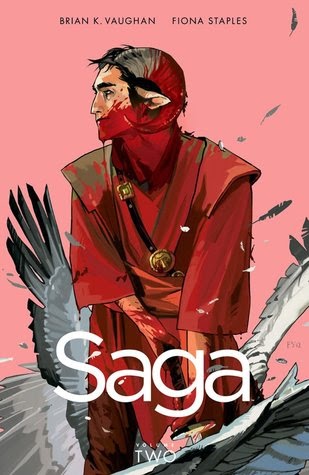
From award-winning writer BRIAN K. VAUGHAN (Pride of Baghdad, Ex Machina) and critically acclaimed artist FIONA STAPLES (Mystery Society, Done to Death), SAGA is sweeping tale of one young family fighting to find their place in the universe. Thanks to her star-crossed parents Marko and Alana, newborn baby Hazel has already survived lethal assassins, rampaging armies, and horrific monsters, but in the cold vastness of outer space, the little girl encounters her strangest adventure yet... grandparents.
So Marko, Alana, Hazel, and the ghost babysitter have escaped into space. Except their spaceship is invaded by Marko's grandparents who tracked them using some special powers. Marko's old fiancee (oops) is also tracking him because the wedding rings he and Alana are using have some connection to the fiancee's family (double oops).
An asteroid turns out to be a giant egg - wow - and Marko's dad is a tailor.
I love the concept of how a really big spell takes acknowledgement of a secret no one else knows - one of them is really funny and one very sad in how realistic those secrets are. Which is a great comment about the series: no matter how cracked-out and science-fiction-y the setting the story at the center is one of a family trying to stay together across a cultural/racial divide. I love it.
Now, when does Volume 3 come out?
When two soldiers from opposite sides of a never-ending galactic war fall in love, they risk everything to bring a fragile new life into a dangerous old universe.
From New York Times bestselling writer Brian K. Vaughan (Y: The Last Man, Ex Machina) and critically acclaimed artist Fiona Staples (Mystery Society, North 40), Saga is the sweeping tale of one young family fighting to find their place in the worlds. Fantasy and science fiction are wed like never before in this sexy, subversive drama for adults.
To paraphrase from one of my Tweets, I wondered what the heck was up with people in Saga who have TVs for heads, to which a friend replied, "Doesn't matter. Keep reading."
Aye-aye!
In short, Saga, which I didn't get into in single issues and for which I should castigate myself, is pretty much the most amazing space opera combined with Romeo and Juliet. Volume 1 starts with the birth of the narrator Hazel, backs up a bit to fill in the backstory of her parents and the inter-galactic war that brought them together (spoiler: a book is involved!), and then goes forward to try and get them off the backwater planet. Which involves a ghost babysitter and a tree that turns into a spaceship.
Head trip. Head trip. Head trip.Head trip. Head trip.
There's also a hit-man who gets side-tracked by a little girl (?) in a brothel. He also has a sidekick known as a Lying Cat. Legit, it is a cat that says "Lying" when other characters lie. Want.
Summary from Goodreads:
From award-winning writer BRIAN K. VAUGHAN (Pride of Baghdad, Ex Machina) and critically acclaimed artist FIONA STAPLES (Mystery Society, Done to Death), SAGA is sweeping tale of one young family fighting to find their place in the universe. Thanks to her star-crossed parents Marko and Alana, newborn baby Hazel has already survived lethal assassins, rampaging armies, and horrific monsters, but in the cold vastness of outer space, the little girl encounters her strangest adventure yet... grandparents.
So Marko, Alana, Hazel, and the ghost babysitter have escaped into space. Except their spaceship is invaded by Marko's grandparents who tracked them using some special powers. Marko's old fiancee (oops) is also tracking him because the wedding rings he and Alana are using have some connection to the fiancee's family (double oops).
An asteroid turns out to be a giant egg - wow - and Marko's dad is a tailor.
I love the concept of how a really big spell takes acknowledgement of a secret no one else knows - one of them is really funny and one very sad in how realistic those secrets are. Which is a great comment about the series: no matter how cracked-out and science-fiction-y the setting the story at the center is one of a family trying to stay together across a cultural/racial divide. I love it.
Now, when does Volume 3 come out?
02 February 2014
Georgette Heyer's Regency World
Summary from Goodreads:
Immerse yourself in the resplendent glow of Regency England and the world of Georgette Heyer…
From the fascinating slang, the elegant fashions, the precise ways the bon ton ate, drank, danced, and flirted, to the shocking real life scandals of the day, Georgette Heyer’s Regency World takes you behind the scenes of Heyer’s captivating novels.
As much fun to read as Heyer’s own novels, beautifully illustrated, and meticulously researched, Jennifer Kloester’s essential guide brings the world of the Regency to life for Heyer fans and Jane Austen fans alike.
Georgette Heyer's Regency World is a very good overview of cultural norms, home life, habits, clothing, and etc. of the Regency period used in the novels of Georgette Heyer. It can also explain some things in Austen's novels because she assumes her readers already know her own customs so doesn't over describe. It's very readable. However, many "examples" tend to use characters from Heyer novels (such as the Taverners and Lord Worth from the book Regency Buck) to explain everyday situations. Just be careful that the real people and the novel characters don't mix up in your head (it happened once or twice with me - I was a bit at lost because I've only read a few of Heyer's Regency novels as opposed to her Georgian novels which don't make an appearance here).
Immerse yourself in the resplendent glow of Regency England and the world of Georgette Heyer…
From the fascinating slang, the elegant fashions, the precise ways the bon ton ate, drank, danced, and flirted, to the shocking real life scandals of the day, Georgette Heyer’s Regency World takes you behind the scenes of Heyer’s captivating novels.
As much fun to read as Heyer’s own novels, beautifully illustrated, and meticulously researched, Jennifer Kloester’s essential guide brings the world of the Regency to life for Heyer fans and Jane Austen fans alike.
Georgette Heyer's Regency World is a very good overview of cultural norms, home life, habits, clothing, and etc. of the Regency period used in the novels of Georgette Heyer. It can also explain some things in Austen's novels because she assumes her readers already know her own customs so doesn't over describe. It's very readable. However, many "examples" tend to use characters from Heyer novels (such as the Taverners and Lord Worth from the book Regency Buck) to explain everyday situations. Just be careful that the real people and the novel characters don't mix up in your head (it happened once or twice with me - I was a bit at lost because I've only read a few of Heyer's Regency novels as opposed to her Georgian novels which don't make an appearance here).
Subscribe to:
Posts (Atom)