27 November 2013

Anything That Moves by Dana Goodyear

Summary from Goodreads:
New Yorker writer Dana Goodyear combines the style of Mary Roach with the on-the-ground food savvy of Anthony Bourdain in a rollicking narrative look at the shocking extremes of the contemporary American food world.

A new American cuisine is forming. Animals never before considered or long since forgotten are emerging as delicacies. Parts that used to be for scrap are centerpieces. Ash and hay are fashionable ingredients, and you pay handsomely to breathe flavored air. Going out to a nice dinner now often precipitates a confrontation with a fundamental question: Is that food?

Dana Goodyear’s anticipated debut, Anything That Moves, is simultaneously a humorous adventure, a behind-the-scenes look at, and an attempt to understand the implications of the way we eat. This is a universe populated by insect-eaters and blood drinkers, avant-garde chefs who make food out of roadside leaves and wood, and others who serve endangered species and Schedule I drugs—a cast of characters, in other words, who flirt with danger, taboo, and disgust in pursuit of the sublime. Behind them is an intricate network of scavengers, dealers, and pitchmen responsible for introducing the rare and exotic into the marketplace. This is the fringe of the modern American meal, but to judge from history, it will not be long before it reaches the family table. Anything That Moves is a highly entertaining, revelatory look into the raucous, strange, fascinatingly complex world of contemporary American food culture, and the places where the extreme is bleeding into the mainstream.


I heard about Anything That Moves from Rebecca (of Book Riot and Bookrageous) and I thought this would be an interesting read as the holiday season heated up.  I like to eat good food and enjoy a good meal, so I consider myself a "foodie", but I won't eat just anything.  I was a very picky eater as a child and I'm still a picky eater as an adult (there's a whole category of foods, led by onions, that hate me therefore I hate them back).  However, there is a different aspect of foodie culture that will put just about anything in their mouths ala Anthony Bourdain and Jonathan Gold.  And I mean anything.  But some of these food(-ish) items, while strange to Western/US tables, are standards of cultures particularly in South Asian and Pacific Rim countries.  (A particular food that keeps coming up is "balut" - if Filipino food is not your thing, do not Google this until you put your cast-iron stomach on first.)

Dana Goodyear grew up hunting with her father and so has a willing, adventurous streak to her diet.  She readily jumped into the foodie lifestyle - her style is reminiscent of Mary Roach without the funny footnotes - and brought a very balanced view to the fringes of food culture.  She followed food critic Jonathan Gold who sort-of pioneered the "eating as sport" idea; Ottolenghi and the food culture of Las Vegas; the Rawsome incident/movement; the molecular gastronomy and haute cuisine movements; and dinners that don't occur at "restaurants" (think word-of-mouth private parties) and that serve not only expected food items but also, in one instance, an entire dinner centered around the idea of marijuana as an ingredient (it is a plant, effects of THC aside).  In what was my favorite chapter, she covered the ethics of eating endangered animals in the US where in other countries those animals are still very much on the menu; she also tangentially touches on the issues of using horse meat in the US where horses are often seen as pets rather than livestock as in other parts of the world (this reminded me of how often in historical novels I see the term "cattle" applied to a team of horses).  Goodyear discovered she was pregnant during her research for the book so she also touched briefly on how her own views on eating had to change and whether she should or should not eat certain items because of the baby.

A very quick read but also very informative.  If you're like me, you might want a bottle of Tums during your reading (I did actually feel like I was developing indigestion during one chapter).  If, on the other hand, you're more in the Bourdain camp you will want make a bucket list from all the places and food items that appear in Goodyear's book.

Dear FTC: I borrowed a copy of this book from my store.

26 November 2013

No Good Duke Goes Unpunished (The Rules of Scoundrels #3)

Summary from Goodreads:

A rogue ruined . . .

He is the Killer Duke, accused of murdering Mara Lowe on the eve of her wedding. With no memory of that fateful night, Temple has reigned over the darkest of London’s corners for twelve years, wealthy and powerful, but beyond redemption. Until one night, Mara resurfaces, offering the one thing he’s dreamed of . . . absolution.

A lady returned . . .

Mara planned never to return to the world from which she’d run, but when her brother falls deep into debt at Temple’s exclusive casino, she has no choice but to offer Temple a trade that ends in her returning to society and proving to the world what only she knows . . . that he is no killer.

A scandal revealed . . .

It’s a fine trade, until Temple realizes that the lady—and her past—are more than they seem. It will take every bit of his strength to resist the pull of this mysterious, maddening woman who seems willing to risk everything for honor . . . and to keep from putting himself on the line for love.

There are few things a male of the peerage can do to be permanently ostracized from Good Society - being accused of murdering your father's teenaged bride is one of them. Even though Mara Lowe's body was never found William Harrow, heir to the Duke of Lamont, is assumed to have killed her. After all, he woke up covered in blood and claimed he had no memory of what happened. Thus began his downfall in the ton's eyes. He joined up with Bourne and then became the third partner in The Fallen Angel gaming hell. Temple is the muscle. Any man who can beat Temple in the boxing ring - and none of that proper gentleman's fighting, this is bare-knuckles - will have his debt wiped from the books of The Fallen Angel. Temple has never lost.

One evening, or morning, given the Angel's working hours, Temple meets a woman outside his home. A woman he knows. From his past.

Mara Lowe.

She tries to explain. To ask Temple to help her. Her idiot brother Christopher Lowe, who knew she was alive, has gambled away not only the remains of the family fortune but the money Mara entrusted to him. Money meant to help the boys in her orphanage. He has lost it all to tables at The Fallen Angel. In exchange for Temple's help Mara will tell him what happened that night twelve years ago.

Temple is, rightfully, pissed. He is dangerously angry and beyond wanting an explanation. He wants retribution. He wants all twelve of those years back. He forces Mara into an impossible bargain: he will help her regain her lost finances only if she agrees to reveal herself to the ton and prove that Temple is no murderer. That Mara masterminded the entire plot and ruined his life. And in doing so, she will permanently ruin her own. Retribution.

No Good Duke Goes Unpunished is a different type of installment in Sarah MacLean's Rules of Scoundrels series. Temple and Bourne, though both characters that have been betrayed, each have a different tone to their anger. Bourne's is cold and calculating, with a hint of guilt at his own folly in assisting his downfall. Temple's anger is black, personal, and lethal. He wants to hurt Mara, to make her feel as alone and rejected as he has for years. As such, this book pulls no punches. The little boys Mara is protecting are not just orphans - they are the ton's unwanted by-blows, an unwelcome reminder that a ton male can do (almost) no wrong. When Temple is seriously injured, Chase has Mara imprisoned in The Fallen Angel while Temple's life hangs in the balance. The ton feels almost like a slavering wolf, licking its chops and savoring the taste of a broken reputation. And Mara's past comes to light. Her reason for taking such a drastic step in faking her own death. It is another reminder that women throughout history have little to no power over the disposition of their own bodies. A woman passed from her father's control to her husband's. In Mara's case, from an abusive father to an aristocratic husband who had notoriously chewed his way through wives, obtaining younger and younger spouses in the manner of Bluebeard. By saving herself, Mara accidentally condemned Temple.

In among this darkness, MacLean lets in a little bit of light. Temple gives the little boys at the orphanage lessons in being well-bred gentlemen (standing when a lady enters the room, etc). We meet Violet (not telling who that is). Pippa and Penny both appear. And there is the wonderful heat MacLean kindles between her damaged hero and heroine. Mara isn't an easy character to like. She isn't supposed to be. But the reader has to admire a character with that much backbone and fortitude, to swallow her pride and reveal herself to the person whom she wronged most in the world. Temple and Mara were attracted to each other twelve years ago and the attraction is still there. It's a bit deeper, though, for having been banged up and marred. And, oh, so hot.

Now, there is a little surprise at the very end of the book. Don't spoil it and look, no matter the temptation, no matter how much you've heard that it is amazing. Because it is. And you'll be mad at yourself if you peek. So don't peek. Paperclip the last 10 pages or so to the back cover and read No Good Duke Goes Unpunished from front to back. Then you can read the surprise.

18 November 2013

The Age of Ice

Summary from Goodreads:
An epic debut novel about a lovelorn eighteenth-century Russian noble, cursed with longevity and an immunity to cold, whose quest for the truth behind his condition spans two thrilling centuries and a stunning array of historical events.

St. Petersburg, Russia, 1740. The Empress Anna Ioanovna has issued her latest eccentric order: construct a palace out of ice blocks. Inside its walls her slaves build a wedding chamber, a canopy bed on a dais, heavy drapes cascading to the floor—all made of ice. Sealed inside are two jesters, one a disgraced nobleman, the other a humpback, a performer by birthright. On the Empress’s command—for her entertainment—these two are to be married, the relationship consummated inside this frozen prison. In the morning guards enter to find them half-dead. Nine months later, two boys are born.

Surrounded by servants and animals, Prince Alexander Velitsyn and his twin brother Andrei have an idyllic childhood on the family’s large country estate. But as they approach manhood stark differences coalesce. Andrei is daring and ambitious; Alexander is tentative and adrift. One frigid winter night on the road between St. Petersburg and Moscow, as he flees his army post, Alexander comes to a horrifying revelation: his body is immune from cold.

J. M. Sidorova's boldly original and genre-bending novel takes readers from the grisly fields of the Napoleonic Wars to the blazing heat of Afghanistan, from the outer reaches of Siberia to the cacophonous streets of nineteenth-century Paris. The adventures of its protagonist, Prince Alexander Velitsyn—on a life-long quest for the truth behind his strange physiology—will span three continents and two centuries, and will bring him into contact with an incredible range of real historical figures, from Mary Shelley, the author of Frankenstein, to the licentious Russian Empress Elizaveta, and to English explorer Joseph Billings.

Romantic, thrilling, and rigorously historical, The Age of Ice is one of the most inventive debut novels of the year.


The premise of this novel is so captivating - two children, born of a frozen, loveless wedding ceremony, are endowed with the ability to adapt to cold temperatures.  One, Alexei, is able to pass as "normal"; the other, the narrator Alexander, becomes freezing cold with the onset of any emotion - anger, desire, sadness - becoming so cold while kissing his betrothed that she develops hypothermia and pneumonia. Alexander thus begins his journey to understand why he is the way he is.

The first 100 pages or so of The Age of Ice move quickly and build Alexander's character through his interactions with others.  However, just as Alexander joins the expedition to explore Siberia - the perfect place for a man who suffers no effects from cold to explore his oddities - the book grinds to a halt.  The plot just stagnates as Alexander and the expedition just seem to wander aimlessly.  Alexander even attempts to kill himself by freezing himself in ice.  At least I think that was what he meant to do...it was confusing.  The rest of the book is a tangle of returning to the society of Russian nobility, marrying his dead brother's wife, the Napoleonic wars, and a period of time in the land wars of Afghanistan/Pakistan/India/Great Britain in Central Asia (which then prompted a period of sniggering via Vizzini).  Had I not specifically requested this book for review, it is unlikely I would have finished it.

The author is a cell biologist and so built up a fantastic premise with, what I felt, very little resolution.  The conceit that Alexander, aside from his extreme cold tolerance and ability to control ice, does not age and cannot die felt forced; he only seemed to attempt to freeze himself to death - why not attempt a more violent means of ending one's life?  The later sections where Alexander seems to jump through time to get him to 2007 just add bulk without bringing him understanding.  I'd like to see what the author does in the future - perhaps a collection of short stories where she can play around with some of these odd concepts without having the burden of creating a book-length narrative.

Dear FTC: I received a DRC of this novel from the publisher via Edelweiss.

11 November 2013

Parnassus on Wheels

Summary from Goodreads:
I imagined him in his beloved Brooklyn, strolling in Prospect Park and preaching to chance comers about his gospel of good books.

"When you sell a man a book," says Roger Mifflin, the sprite-like book peddler at the center of this classic novella, "you don't sell him just twelve ounces of paper and ink and glue—you sell him a whole new life." In this beguiling but little-known prequel to Christopher Morley's beloved Haunted Bookshop, the "whole new life" that the traveling bookman delivers to Helen McGill, the narrator of Parnassus on Wheels, provides the romantic comedy that drives this charming love letter to a life in books.

I recently purchased a subscription to Melville House's Art of the Novella series and one of the first books I received was Christopher Morley's The Haunted Bookshop.  I was going to read it right away but then I read the flap copy and it mentioned Parnassus on Wheels...oops!  Maybe I should read that first.

Well, I didn't have one on hand (obviously) but I had also just started subscribing to Oyster, a subscription-style lending library for ebooks.  It has a beautiful iOS app UI and a huge selection of backlist from HarperCollins, HMH MacMillan, and, you guessed it, Melville House.  A quick search brought up Parnassus on Wheels, with its accompanying information tidbits, so I settled in for a quick read.

Parnassus on Wheels is narrated by Helen McGill.  She keeps house for her brother Andrew on their family's farm and, well, she's beginning to get a tiny bit dissatisfied.  One day Roger Mifflin, having heard that Andrew is an author, shows up to sell him the "Parnassus on Wheels" - a horse-drawn caravan-cum-travelling-bookstore - because he wants to retire.  Helen seizes the opportunity and buys the Parnassus herself, determined to have a little adventure before she ages from middle-age to old-age.  Off she goes, after a bit of coaching by Roger, and certainly does have an adventure!  In the end, Helen and Roger fall in love - which is made all the better because, to mis-paraphrase Jane Austen, neither would have ever expected to play the part of romantic hero or heroine.

Throughout, Roger keeps expounding on his love of books and why books and reading are essential to a happy, well-rounded life.  His enthusiasm is infectious.  Parnassus on Wheels is a lovely little book for booklovers of all stripes.  Highly recommended for an evening with a blanket, some tea, and a cat or dog.

Dear FTC: I read this book on my Oyster app.

29 October 2013

National Cat Day! Happy 10th Birthday to my cats!

October 29 is National Cat Day - and my fur babies turned 10 at the beginning of September so here's a little timeline of my babies from ~8 weeks to present.

I think one of the computer crashes wiped a bunch of pictures so I can only find one (ONE! *sob*) picture of the boys as fuzzy little babies in October 2003.

They were so tiny - barely bigger than my hand.  I took this picture the night I got home from the farm where they were born (it was raining like mad, cold, and my friend's elderly father had to come shoot a possum that had got into the barn).
But they adapted to their cushy indoor cat life well and soon started getting into all sorts of trouble like getting stuck under the dishwasher rack.


 And getting stuck in items meant for the recycling.
And had $1500 worth of abdominal surgery for an intestinal blockage as a result of eating thread (and other things on top of that including the spare wire for the mandoline cheese slicer - which was radiopaque, thank god) and then more charges for his wound infection because he licked the incision (the vet didn't make him wear a cone).  Chaucer-kitteh still (STILL) tries to eat strings and ribbons.  He doesn't learn.


And gained a lot of weight.  At his heaviest, the Dante-kitteh weighed 18 pounds.  We're around 13 pounds now, which is much better, and I get to laugh about his poochy little tummy.  It is the cutest.


It helped that I moved to a split-level so they had to learn about (very scary!) things like stairs.  When one has to go up and down the stairs to eat, use the cat box, and sleep on the nice, warm bed you get lots of exercise.  When we first moved, they refused to go downstairs without me for the first few days - they would sit at either the top or bottom and cry for me to come and walk with them.


They're about the most adorable, annoying things ever.  Chaucer is very good at begging (see left).  Dante knows exactly which drawer in the fridge contains the cheese - which is a favorite kitty treat - and comes running when he hears it open.


They drag their favorite toys all over the house and into bed while I'm sleeping (Chaucer likes to carry his around like a baby and make weird "mrower" noises).  They love to snuggle and can purr like a diesel engine.


They get into just about anything I'm doing - working, knitting, reading, etc etc etc.  They were the subjects of my most popular blog post for a while - "Die Katzen sind nicht amüsiert" - which expressed why they don't like spam comments.


Chaucer has become the more photo-ready of the two - he's a bit better at staying still while keeping his cute facial expression.


But Dante has his moments, too (his little face is getting whiter/graying, which makes me sad).


He is obsessed with the kitteh who lives in the mirror.  All the mirrors.


Also, we are extremely vocal when we want something.  Like when I'm having supper and Chaucer-kitteh would like some, too - he sits at the table and meows incessantly.


I love them so much.  Which is why I spent a good 20 minutes taking pictures/video of them with their new catnip hedgehog and green-frog-with-tail (?) toys because they were so funny.

Happy 10th birthday Chaucer and Dante!!

Happy National Cat Day everyone!


ETA: Plz send treats.  Don't tell mommy.


28 October 2013

The Wicked Wallflower (Bad Boys & Wallflowers #1)

Summary from Goodreads:

Maya Rodale's captivating new series introduces London's Least Likely—three wallflowers who are about to become the toast of the ton…

Lady Emma Avery has accidentally announced her engagement—to the most eligible man in England. As soon as it's discovered that Emma has never actually met the infamously attractive Duke of Ashbrooke, she'll no longer be a wallflower; she'll be a laughingstock. And then Ashbrooke does something Emma never expected. He plays along with her charade.

A temporary betrothal to the irreproachable Lady Avery could be just the thing to repair Ashbrooke's tattered reputation. Seducing her is simply a bonus. And then Emma does what he never expected: she refuses his advances. It's unprecedented. Inconceivable. Quite damnably alluring.

London's Least Likely to Misbehave has aroused the curiosity—among other things—of London's most notorious rogue. Now nothing will suffice but to uncover Emma's wanton side and prove there's nothing so satisfying as two perfect strangers…being perfectly scandalous together.

Rodale's books always put me in a quandary when I go to rate/review them.  On the one hand, I find them inaccurate in the attention to detail and language that I prefer in my Regencies/historicals and possibly over-plotted in the lead up to the resolution, but on the other I quite like her hero/heroine pairings and plot elements.

"Least Likely to Misbehave" is a terrible misnomer when the punishment for stepping outside Society's strictures is ruin and ostracism. The false betrothal announcement was just for fun, it was never meant to be sent to the paper and when it appears in print Emma is particularly lucky that Blake is in need of a very respectable fiancee.

I particularly like Lady Emma in this instance and is very much the stronger character of this pairing. She's allowed to have doubts, as annoying as they are to the reader, right up until the very end. Blake seems more of a stock character at times - the Reformed/Reforming Rake is a very popular type - but he has an interesting relationship with his aunt. (I would have offed the character of Benedict, Emma's waffling long-time suitor, much earlier in the book. What a wanker.) Speaking of Blake's aunt, Agatha, the section of the book that makes up the Fortune Games is a hilarious riff on the popular Hunger Games young adult series and movies. Very imaginative and a way to get her hero and heroine together without parents for a good portion of the book. The Wicked Wallflower is the first in Maya Rodale's new series Bad Boys & Wallflowers that will consist of historicals with contemporary companion novels, the first being The Bad Boy Billionaire's Wicked Arrangement.

27 October 2013

The Best American Nonrequired Reading 2013

Summary from Goodreads:
A selection of the best writing, including fiction, nonfiction, poetry, and comics, published in American periodicals during during 2012 aimed at readers fifteen and up.

This is apparently the last Nonrequired Reading volume that Dave Eggers will edit.  It will be interesting in future seeing the new direction for this section of the Best American series.  As usual, Eggers and the 826 kids came up with a really good selection of web pieces, essays, and short stories. It felt much more heavily weighted toward longer essays/stories than the shorter goofy stuff, which is a bit of a shame because those are often brilliant small pieces.

Karen Russell has a great reporting piece about a torero who now fights with one eye, having been seriously injured by a bull (note: accolades are for writing, not subject).

The Sum of All Kisses (Smythe-Smith #3)

Summary from Goodreads:

He thinks she's an annoying know-it-all...

Hugh Prentice has never had patience for dramatic females, and if Lady Sarah Pleinsworth has ever been acquainted with the words shy or retiring, she's long since tossed them out the window. Besides, a reckless duel has left this brilliant mathematician with a ruined leg, and now he could never court a woman like Sarah, much less dream of marrying her.

She thinks he's just plain mad...

Sarah has never forgiven Hugh for the duel he fought that nearly destroyed her family. But even if she could find a way to forgive him, it wouldn't matter. She doesn't care that his leg is less than perfect, it's his personality she can't abide. But forced to spend a week in close company they discover that first impressions are not always reliable. And when one kiss leads to two, three, and four, the mathematician may lose count, and the lady may, for the first time, find herself speechless ...

New York Times bestselling author Julia Quinn's enchanting third novel in the Smythe-Smith quartet is guaranteed to make you laugh out loud and tug at your heartstrings in equal measures.

Sarah feigned illness to get out of playing in the Smythe-Smith musicale (which, fortunately for her governess Anna and cousin Daniel, led into the love story in A Night Like This). The only way out of the quartet is marriage or death. Sarah, though, currently doesn't have any prospects of marrying before next year's musicale and wedding season is now upon her, first Honoria and Marcus (from Just Like Heaven) and then Anna and Daniel a week or so later. She's thrown together with the person she holds chiefly responsible for her unmarried state: one Lord Hugh Prentice, who was gravely injured in a duel with Daniel during her first Season and whose absolutely deranged father caused Daniel to flee the country in disgrace. It may be an irrational belief, but it's one she clings to.

Hugh, for his part, has put all the pieces of that night back together and concluded that he was as much at fault as Daniel. He made it possible for Daniel to return to England by holding ransom the only thing his father holds dear: Hugh's own life. If Daniel comes to harm, then Hugh will kill himself. The Marquess of Ramsgate cares only that Hugh live to continue the family line and so the tenuous peace holds.

For now. Hugh and Sarah gradually get past their prejudices. He initially thought she was a flighty, overdramatic ton miss; she let him know in no uncertain terms that she did not like him. Daniel, ever the instigator, coops them up in a carriage with Sarah's three younger sisters.  This is possibly the funniest scene Julia Quinn wrote in a very long time because Hugh and Sarah are forced to read a scene from one of Harriet's plays. Also, if you have any number of younger siblings and spent a long car ride with them you will find the dialogue in this scene to be perfect. When Sarah injures her ankle, Hugh keeps her company...and romance takes off.

There are a lot of lovely beats in this book. Hugh is a mathmatical savant, he counts things almost involuntarily. Sarah and Hugh dancing together when they have only two solid legs between them. But a lot of realism runs through The Sum of All Kisses, chiefly that the law is no protection from a member of the peerage with a sadistic bent. Hugh's father overshadows so much of the story that the ending, while satisfying, is tinged with bittersweet. Characters make decisions partially out of self-preservation when they would have freely made those decisions out of love. This is why I love historicals from Julia Quinn, Eloisa James, Tessa Dare, and Sarah MacLean - they are breaking aspects of the genre and it brings up the quality of the storytelling. Speaking of Eloisa James - the cross-pollination that saw JQ's characters in Once Upon a Tower brings Gowan and Edie into The Sum of All Kisses. If you aren't familiar with EJ, I highly recommend her Fairy Tales series (standalones, so you can start with Once Upon a Tower if you wish, but then jump back to the first one, A Kiss at Midnight, which is EJ's take on the Cinderella story).

17 October 2013

The Arrangement (The Survivors' Club #2)

Summary from Goodreads:

Desperate to escape his mother’s matchmaking, Vincent Hunt, Viscount Darleigh, flees to a remote country village. But even there, another marital trap is sprung. So when Miss Sophia Fry’s intervention on his behalf finds her unceremoniously booted from her guardian’s home, Vincent is compelled to act. He may have been blinded in battle, but he can see a solution to both their problems: marriage.

At first, quiet, unassuming Sophia rejects Vincent’s proposal. But when such a gloriously handsome man persuades her that he needs a wife of his own choosing as much as she needs protection from destitution, she agrees. Her alternative is too dreadful to contemplate. But how can an all-consuming fire burn from such a cold arrangement? As friendship and camaraderie lead to sweet seduction and erotic pleasure, dare they believe a bargain born of desperation might lead them both to a love destined to be?

[Note: I did not manage to save my review of The Proposal, the first book in this series, but I do recommend it.]

Vincent, Viscount Darleigh, has had enough - his well-meaning but overbearing mother has equated his blindness with mental deficiency (not to mention that he is now titled and rich) and has decided that he needs a wife in short order. Vincent escapes to a small village with only his valet as company to enjoy a little peace and quiet. It doesn't last. When the neighborhood nest of viperish social climbers decides to trap him into marriage he is soon rescued - by the quiet, unassuming, and very poor Sophia Fry, who is the companion to the intended young lady (I use "lady" loosely). For her basic human decency, Sophia is flung out onto the streets. Vincent seizes the opportunity - he doesn't really want to be married and neither does Sophia yet a marriage of convenience will protect each of them from relatives (and Sophia from destitution). He proposes the arrangement and offers that they will separate after enough time has passed that the marriage cannot be legally questioned or over-turned. Sophia will have the protection of his name and income and Vincent will have some peace.

Love comes in and upsets the apple cart, of course. Sophia determines that before she leaves that Vincent is as self-sufficient as possible; she devises the Regency version of a seeing-eye dog and a track to enable him to ride his horse unassisted. Vincent gives Sophia the confidence to become an independent woman. Most fascinating is that Vincent's blindness is total, his sight will never recover unlike many other blind/partially blind heroes, and so any love that Vincent feels for Sophia develops from their interactions and her personality rather than her looks.

This is a much stronger novel from Mary Balogh than The Proposal. The plot is a bit tighter, the stakes are a bit higher for the hero and heroine, and the resolution is much more satisfying. However, there are a few minor points that could have been better. The actual agree-to-separate-later portion of the proposal scene sounded quite hollow and years of childhood trauma and neglect seemed suddenly forgotten with a good haircut, nice clothes, an attentive husband, and a well-placed punch to the face (though, the punch was very well-deserved, so that's less problematic). On the whole, a good installment to the Survivor's Club series. I'm looking forward to the next one.

15 October 2013

Fangirl

Summary from Goodreads:
In Rainbow Rowell's Fangirl, Cath is a Simon Snow fan. Okay, the whole world is a Simon Snow fan, but for Cath, being a fan is her life—and she’s really good at it. She and her twin sister, Wren, ensconced themselves in the Simon Snow series when they were just kids; it’s what got them through their mother leaving.

Reading. Rereading. Hanging out in Simon Snow forums, writing Simon Snow fan fiction, dressing up like the characters for every movie premiere.  Cath’s sister has mostly grown away from fandom, but Cath can’t let go. She doesn’t want to.

Now that they’re going to college, Wren has told Cath she doesn’t want to be roommates. Cath is on her own, completely outside of her comfort zone. She’s got a surly roommate with a charming, always-around boyfriend, a fiction-writing professor who thinks fan fiction is the end of the civilized world, a handsome classmate who only wants to talk about words . . . And she can’t stop worrying about her dad, who’s loving and fragile and has never really been alone.

For Cath, the question is: Can she do this? Can she make it without Wren holding her hand? Is she ready to start living her own life? And does she even want to move on if it means leaving Simon Snow behind?

If Fangirl had existed when I was a HS senior I would have ate it up with a spoon and asked for more.  It is such a great YA/coming of age story.

I was a bit like Cather when I started undergrad - socially quiet, maybe a little unsure of who I was but definitely sure that I was smart and talented, and I went to a big state university.  My first serious relationships were in undergrad as well as my first major crises of confidence.  Granted, not all within my freshman year as happens to Cath.

I really liked how Rowell contrasted Cath's outgoing immersion in the Simon Snow fanbase with her tentative interactions among the student body in the real world.  Add to that Cath's support - her twin Wren - has decided that she no longer wants to do the "twin thing" and not only changes her social group but also her appearance.  Rowell allows Cath to make mistakes as she goes and to learn from them.  And Cath slowly learns that she is strong enough to take life on her own terms.  This leads me to wonder why the "New Adult" category is so narrowly defined because Cather's story is definitely one in which a new adult learns to be an adult.

Now, mixed in with all this are snippets of Simon Snow novels - a Harry Potter stand-in - and Simon Snow fanfic as written by Cather.  All of it is great fun.

Duke of Midnight (Maiden Lane #6)

Summary from Goodreads:

WHEN A MASKED MAN . . .

Twenty years ago Maximus Batten witnessed the brutal murders of his parents. Now the autocratic Duke of Wakefield, he spends his days ruling Parliament. But by night, disguised as the Ghost of St. Giles, he prowls the grim alleys of St. Giles, ever on the hunt for the murderer. One night he finds a fiery woman who meets him toe-to-toe—and won't back down . . .

MEETS HIS MATCH . . .

Artemis Greaves toils as a lady's companion, but hiding beneath the plain brown serge of her dress is the heart of a huntress. When the Ghost of St. Giles rescues her from footpads, she recognizes a kindred spirit-and is intrigued. She's even more intrigued when she realizes who exactly the notorious Ghost is by day . . .

DESIRE IGNITES A DANGEROUS PASSION

Artemis makes a bold move: she demands that Maximus use his influence to free her imprisoned brother-or she will expose him as the Ghost. But blackmailing a powerful duke isn't without risks. Now that she has the tiger by the tail, can she withstand his ire-or the temptation of his embrace?

[Note: this is another where I had a lengthy review at BR, now lost]

Maximus Batten, Duke of Wakefield.

**dies**

Artemis is no dummy - when the Ghost of St. Giles rescues her and her feather-brained cousin Penelope from footpads in St. Giles (because Penelope had a bet with another idiot aristocrat to drink a cup of gin in St. Giles at midnight) he leaves a distinctive signet ring in her hand.  Only one man would wear such a ring...Artemis uses this knowledge to force Maximus to save her twin brother, Apollo.  The wretched Apollo is locked in the "Incurables" ward at the terrifying Bedlam asylum, accused of a triple-homicide.

Maximus (grudgingly) agrees and, as the Ghost, spirits the maimed Apollo out of the asylum and into the cellars of Wakefield House.  Along the way, he considers marrying Penelope (she's a duke's daughter and wealthy as they come, even if she's an idiot and unkind) and persuades Artemis to move into his house as a temporary companion to his nearly-blind sister, Phoebe.

Now, this is where all the good bits happen and I won't spoil it for you.  Suffice to say, there is a lot of plot left in Duke of Midnight and it has a fantastic final chapter.

(And an Epilogue! This won't be the final Maiden Lane book!)

14 October 2013

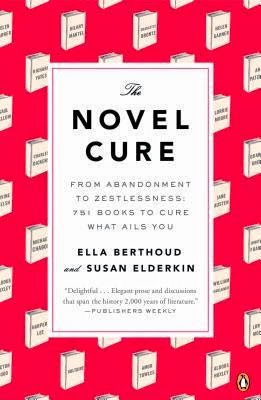
The Novel Cure

Summary from Goodreads:
A novel is a story transmitted from the novelist to the reader. It offers distraction, entertainment, and an opportunity to unwind or focus. But it can also be something more powerful—a way to learn about how to live. Read at the right moment in your life, a novel can—quite literally—change it.

The Novel Cure is a reminder of that power. To create this apothecary, the authors have trawled two thousand years of literature for novels that effectively promote happiness, health, and sanity, written by brilliant minds who knew what it meant to be human and wrote their life lessons into their fiction. Structured like a reference book, readers simply look up their ailment, be it agoraphobia, boredom, or a midlife crisis, and are given a novel to read as the antidote. Bibliotherapy does not discriminate between pains of the body and pains of the head (or heart). Aware that you’ve been cowardly? Pick up To Kill a Mockingbird for an injection of courage. Experiencing a sudden, acute fear of death? Read One Hundred Years of Solitude for some perspective on the larger cycle of life. Nervous about throwing a dinner party? Ali Smith’s There but for The will convince you that yours could never go that wrong. Whatever your condition, the prescription is simple: a novel (or two), to be read at regular intervals and in nice long chunks until you finish. Some treatments will lead to a complete cure. Others will offer solace, showing that you’re not the first to experience these emotions. The Novel Cure is also peppered with useful lists and sidebars recommending the best novels to read when you’re stuck in traffic or can’t fall asleep, the most important novels to read during every decade of life, and many more.

Brilliant in concept and deeply satisfying in execution, The Novel Cure belongs on everyone’s bookshelf and in every medicine cabinet. It will make even the most well-read fiction aficionado pick up a novel he’s never heard of, and see familiar ones with new eyes. Mostly, it will reaffirm literature’s ability to distract and transport, to resonate and reassure, to change the way we see the world and our place in it.

I have a bit of a bone to pick with the blurb - the concept of The Novel Cure is nice, rather than brilliant, and the execution is in no way satisfying.  The authors apparently have a bibliotherapy service (?) which is interesting but I don't think I'd be making use of it based on this book.

The nicest thing I can say about The Novel Cure is that it added lots of books to add to my TBR pile.  There's a really good range and selection of titles but the authors undercut everything with an uneven tone. Are they being flippant, witty, or sarcastic? Earnest? Serious?  I can't tell.  I also think the layout of the book didn't quite work.  I would have much preferred longer chapters by broad subject (relationships, aging, birth, death/dying, etc) rather than an a-to-z run down with really silly alphabetical categories i.e. "Bad Blood", "Beans, Temptation to Spill", etc.  There's even a header for"Broken China"....huh?  Carnivorousness (which ails us)?  There also a moment where "new novels" are dismissed in favor of novels that have stood the test of time yet the authors later recommend Meg Wolitzer's The Interestings for the section on Mr./Mrs. Wrong - it had only been published in April 2013, less than six months prior to the publication of The Novel Cure.

Perhaps this isn't a book for me.  Too late - I read the whole thing.